A blog about architectural tiles, terra cotta and other ceramic surfaces, architectural glass and ornamentation in and around New York.

Showing posts with label Brian Kaiser. Show all posts

Tuesday, December 1, 2015

A BOOK REVIEW and NEW DISCOVERIES and UPDATES-II: JEAN NISON, CERAMIC TILE ARTIST

H A P P Y   H O L I D A Y S


A newly discovered architectural ceramic mosaic by Jean Nison and a book review of Un Siècle de Céramique D'Art En Tunise


St. John the Baptist Catholic Church, Hillsdale, NJ (2015). (Color photos courtesy of Michael Padwee unless otherwise noted)

While taking photos of Robert Pinart’s 50+ stained glass windows in St. John the Baptist Catholic Church in Hillsdale, NJ, I saw a metal sculpture on a mosaic tile base on the far side of the Nave. When I got closer I thought I recognized the mosaic tile pieces as similar to tiles made by Jean Nison, Robert’s ex-wife and close friend. I brought my photos to Robert, and he identified them as Nison’s.


The sculpture is the Tabernacle, where the Eucharist is kept in reserve. The wings are symbols of the cherubim wings on the Ark of the Covenant. The crown is a symbol for the Crown of Thorns, and the fish on the front of the cabinet is a symbol of the food given to those who believe in Jesus Christ. (Conversation with the Parish Secretary)


According to the church dedication booklet, the church architect was Louis J. Mineo, Jr., who lived in Hillsdale and had offices in Emerson, New Jersey, and the Liturgical Designer was Michael F. Segalas. Robert Pinart and Jean Nison both knew Michael Segalas when he worked in the architecture office of Percival Goodman. Pinart said that he obtained some commissions through Michael Segalas. Louis Mineo, Jr. was also the architect of record for other projects in New Jersey where Pinart designed the windows--Pascack Valley Hospital in Westwood (1967) and Temple Beth El in Closter (1968). The sculpture was fabricated by Columbia Art Metal Works, Newark, New Jersey. (Dedication Booklet, Saint John the Baptist Hillsdale, New Jersey, Ecclesiastical Color Publishers, South Hackensack, NJ, 1969)


One of Nison’s trademarks was to drop liquified gold mixed with glaze onto the tiles’ surfaces. The tiles were then fired at low temperatures in a kiln.


Jean Nison's Missing Tiled Table

While digitizing the glass slides of Robert Pinart, I came across a series of photos of a large, abstract dalle de verre window Robert made for his ex-wife, Jean Nison. One of the slides included a section of Nison's living room which showed a tiled table top. Pinart identified the tiling as Jean's, but had no idea what happened to the table after the house was sold.


Jean Nison’s Fireplace Surround for Lever Brothers


Jean Nison, 1950s. (Photo courtesy of the American Crafts Council Library)

In my article about mid-century-modern ceramic tile artist Jean Nison, I mentioned that she was commissioned to create a tile installation in the Lever Brother’s Boardroom in New York City’s landmarked Lever Building.


(Photo taken and edited from: Jean Nison, "Fantasies in Tile", Craft Horizons, Vol. 13, No. 3, May-June 1953, p. 36+)

According to Nison, she visited decorators, left tiles with them and hoped they would call her. This was how, she believed, Raymond Lowey Associates, the industrial design firm, asked her to make a wall decoration for Lever House, at that time the headquarters of Lever Brothers Corporation (now Unilever). I contacted the curator of the Lever House Art Collection, Mr. Richard Marshall, but he had no information about the fate of Nison's tile installation. Unilever Corporation moved out of the building in the 1980s, and may have taken the tiles with them. A request to Unilever for information, however, went unanswered.

Recently, however, the question of the fate of the installation may have been answered.


Two of the tile designs from the Lever Brothers Boardroom fireplace surround illustrating the color scheme of the installation. (Jean Nison, American, born in Egypt of French parents [sic]. Lever House, NYC, (Boardroom Tiles)(framed pair), c. 1952. Ceramic, Size 6 x 6 in. Gift of Eric M. and Joy Hart. G2005.21.13)

After reading my article, the Chief Curator of the Mobile (AL) Museum of Art, Paul Richelson, contacted me. Two tiles from the boardroom fireplace in Lever House had been donated to the Mobile Museum of Art by Eric M. and Joy Hart in 2005. Either these were extra tiles that were not used in the installation, or the installation was removed when Unilever moved from Lever House to Connecticut and tiles were given to some of the executives. If the latter, other tiles from this installation may still exist.


This was probably made for, and sold at Lever House. (Photo from ebay)

To prove my point, a recent ebay auction listed a “replica” boxed tile of the Lever Brothers tile on the left, above. Nison may have made extras to sell in crafts stores and at Lever House, itself.


A Possible New Tile Panel

I was recently contacted by a reader who had purchased a Nison tile depicting a doe on a field of gold bubbles. The tile has writing on the back that says "do again creeping panther", which could mean Nison was considering using the doe tile in a panel setting.


(Photo of 6" tile  painted on a Wheeling Tile Company blank courtesy of Will Cottes)


The Tichenor House Dragon Mural


The full double dragon mural in the master bathroom. (Photo courtesy of the American Craft Council Library)

Built in Long Beach, California in 1904-05 the Tichenor House was one of only three homes constructed in Long Beach by the renowned architectural team of Charles and Henry Greene. In the early 1950s “[the] house was extensively remodeled [...by architect Adrian Wilson and his associate, Alden Becker] with many modern changes to the interior,” (http://articles.latimes.com/1991-05-05/news/hl-2211_1_tichenor-houseincluding the addition of a double dragon tile mural in the master bathroom.

In December of 2011 a fire started in the rear of the house and was extinguished in about twenty minutes. (http://www.presstelegram.com/technology/20111212/fire-strikes-historic-tichenor-house
“The fire in the [bath]room must have been very intense, because the tile was covered with soot that was burned onto the surface of the tile face. The tile also had a crackle glaze, which has many very tiny cracks over the entire surface. This was intentional, and reflects the style of the tile. Unfortunately, the soot permeated the crackle glaze... .” (http://www.justanswer.com/antiques/7ehtb-ra-jpm.html)


Brian Kaiser, a tile conservator and preservationist, was called in and saved the bathroom mural. Kaiser has been restoring the mural ever since, and half of it has been completely restored.


There is a problem, though. Brian lives in a house that was once owned by the ceramicist Rufus Keeler, who, for many years, was the major force behind the Malibu Potteries in Malibu, California. Brian’s house has many interior and exterior tile installations from the 1920s-30s that were designed by Keeler. Nison’s panel from the 1950s does not belong in that setting, and Brian would like to find a new home for Nison’s mural which is approximately 7’ by 7’. If anyone is interested in this mural, they should contact Brian at brian.kaiser'at'ymail.com.


          UN SIÈCLE DE CÉRAMIQUE D'ART EN TUNISE


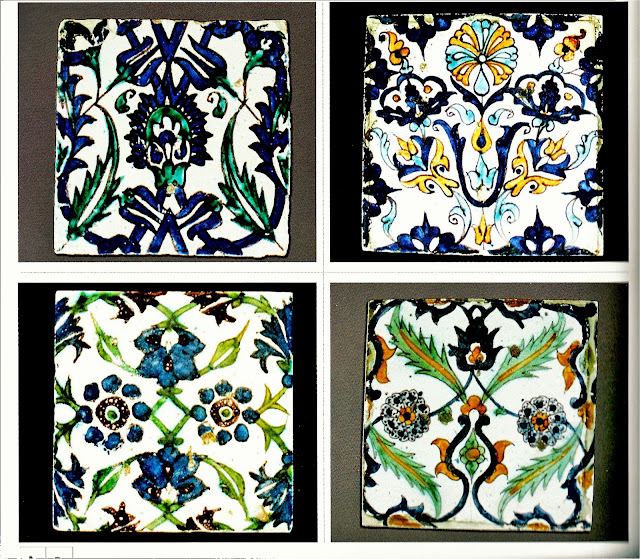
For those of us who have long marveled at the wonderful designs of Jacob Chemla's Tunisian tiles, this book, written by Jacob's grandchildren, Monique Goffard, Jacques Chemla and Lucette Valensi, will be very welcome. In the first third of the twentieth century the "Tunisian Tile Company" and "The African Tile Company" supplied architects like George Washington Smith, Bertram Goodhue and Addison Mizner, among others, with Mediterranean and Middle Eastern-style tiles for resorts, mansions, hotels and other residential and commercial establishments in the United States. Although many of the Tunisian tile installations no longer exist--mainly in New York City and State, many others in California and Florida remain intact.


Detail of a tile panel in the entry hall of the theatre of the President of the Republic in Carthage.


This book details the lives of the Chemla family and their ceramic interests from Haï Chemla through his son, Jacob (1858-1938), and his three sons, Victor, Albert and Mouche and their families. Jacob Chemla is credited with reviving the lost arts of Tunisian ceramics by perfecting a special glaze and blue color that had been thought lost.


Top: vase with a flared neck; bottom: vase with a conical neck. The bottom vase is signed "Awled Chemla Tunis" plus a tulip, an emblem for Ben Ahmed.

There are large sections of photos of architectural tile installations, individual tiles and pottery. Pottery markings and individual signatures of artists are also identified.


Four tile designs.

This is an important book that is not to be missed, especially by tile and pottery enthusiasts, architectural historians and preservationists.

This book is written in French and may be purchased from http://www.amazon.ca/Un-siècle-céramique-dart-Tunisie/dp/2841623777,

https://www.chapters.indigo.ca/en-ca/home/section/34-214-321140-327006-561000-cat.html, or

http://www.priceminister.com/offer/buy/796203172/un-siecle-de-ceramique-d-art-en-tunisie-de-collectif.html.

I have previously written two articles about the tiles produced by the Chemla potteries:  http://tilesinnewyork.blogspot.com/2014/11/lost-tile-installations-tunisian-tiles.html

and

http://tilesinnewyork.blogspot.com/2015/03/the-renaissance-casino-and-ballroom.html.


Friday, August 1, 2014

Bits and Pieces: Two "E"s--Eltinge and Elks, and more about Jean Nison

NISON TILE MURAL NEEDS A NEW HOME

(Photo courtesy of the American Craft Council Library)

Before discussing the Eltinge Theatre and The Lambertville (NJ) Elks Club, I have some news about Jean Nison's "Double Dragon" mural, which I wrote about last month (http://tilesinnewyork.blogspot.com/2014/07/the-ceramic-tiles-and-murals-of-jean.html). I was just told that the Tichenor residence in Long Beach, California has been repaired after a 2011 fire damaged the house and this mural, and the owners can no longer install the mural in the house. The salvaged 7' x 7' mural and about 300 field tiles with gold mixed with the glaze were given to Brian Kaiser to restore, and he has almost completed this. However, Brian lives in an historic house that contains many tile installations by Rufus Keeler, and the mural is too large for the house, and is not of the correct period.


The partially restored double dragon mural. (Photo courtesy of Brian Kaiser)

Thus, Brian needs to find a new home for this mural, and he's willing to discuss this with any interested parties. Brian can be reached at brian.kaiser'at'ymail.com.


Wall mural (left) created by Jean Nison for the Plant-Lover's Bathroom in the “Arts of Daily Living Exhibition” in Pomona, California in 1954. (Scanned from "The Bathroom–Our Refuge from Stress", House Beautiful, Vol. 97, No. 3, March 1955, p. 115. The October 1954 House Beautifulmagazine contains an article about the other rooms in this exhibition.)

Also, after the Nison article was posted, I received a call from one of Jean Nison's relatives who told me that the "Plant Lover's Bathroom" mural from the Pomona, California "Arts of Daily Living" exhibit in 1954 still exists! This tile mural has been stored in boxes in the relative's garage for many years because it was too large to be installed in her house.


The Theater That Moved: the Eltinge Threatre

In 1998 a theater was moved on tracks down 42nd Street toward Eighth Avenue. It was moved because the developer, Bruce Ratner, notorious for his handling of the new Brooklyn arena fiasco, decided it would not cost any more to move the theater as demolish it. At least something historical was preserved!


(The New York Times, March 3, 1998, p. 1)

“On Sunday, March 2, 1998, the Empire, an elegant Beaux Arts Style Broadway theater built in 1912 and weighing 7.4 million lbs., was floated on tracks up 42 St. near Seventh Ave. to a new location close to Eighth Ave. Few among those witnessing this strange migration realized that the theater was originally named The Eltinge Theatre in honor of Julian Eltinge [b. William J. Dalton, 1881, d. 1941], perhaps the greatest female impersonator of the American Stage. The theater has been remodeled as the AMC MoviePlex. On the original lobby ceiling a fresco of the Three Muses, all portraits of Julian Eltinge as a woman can still be seen[, though faded].” (http://www.thejulianeltingeproject.com/project.html)


“Because the Empire contained only 759 seats, which were spread over two balconies and an orchestra, the 42nd Street Redevelopment Project did not recommend that the Empire be saved. Only the facade would be incorporated into the plan. ...the Empire was destined to serve as the lobby of the AMC movie complex with the central elevators rising through the proscenium to the backstage area. In order to save the facade and gutted interior, the theater was put on rollers and moved two hundred feet down 42nd Street. The theater’s proscenium and mural were saved in part. Truely a desecration of art.”  (Ken Bloom, The Routledge Guide To Broadway, Taylor & Francis Group, New York, NY, 2007, p.67)


“On the ceiling of the lobby...is a mural of surprising artistry for a movie house. It depicts three muses in cascading gowns dancing about in a vaguely Greek setting. Hardly cinematic. More theatrical, and so it is. The mural was originally painted to sit above the proscenium of the Eltinge Theatre. ...If the women in the mural looks a bit odd to you, you've got a sharp eye. It's believed that all three are meant to depict the namesake of the Eltinge Theatre—Julian Eltinge, one of the greatest female impersonators of the 20th Century... ." (http://lostnewyorkcity.blogspot.com/2008/02/crossdresser-on-ceiling.htmlColor photos courtesy of Michael Padwee unless otherwise noted)

“Most of the patrons walking into the Empire [...Theater on 42nd Street] have no idea of its history. In the lobby, they are actually standing inside the shell of the Eltinge 42nd Street Theatre, which opened Sept. 11, 1912... . Renowned theater architect Thomas Lamb designed the Beaux Arts-style hall, [some of] whose features are still visible, including its ornate ceiling mural.

The steel and glass Multiplex tower rises from the interior of the original terra cotta building.

“By the Great Depression, though, the Eltinge had fallen on hard times and become a burlesque house. In 1937, Mayor Fiorello LaGuardia used the city's obscenity laws to shut it down, and it became part of the Laffmovie theater. Renamed the Empire in the 1950s, the theater eventually had to rely on showing grindhouse and porn flicks -- staples of a deteriorating Times Square. 


“It closed in the mid-'80s, but later the revitalization of the area and success of the first multiplex in Manhattan gave AMC an idea. The circuit bought the Empire, moved it 200 feet west -- an impressive bit of engineering, given that it meant moving a 7.4 million-pound structure -- then built the multiplex around it, including a soaring glass-curtain wall that rises five levels above the original facade. The revamped multiplex opened for business a decade ago, in April 2001, and became the [‘center of the movie universe’] within a few years.” (http://www.hollywoodreporter.com/news/first-peek-ever-inside-americas-181121) 


“The Eltinge 42nd Street was built by the producer manager Al Woods and named after his very successful client the female impersonator Julian Eltinge. 


The original terra cotta facade of the Eltinge Theatre as designed by Thomas Lamb. (National Terra Cotta Society, Architectural Terra Cotta Brochure Series, Volume Two, The Theatre, 1915, p. 12)

"Thomas Lamb designed a theatre with an individual exterior focused on a large paned window bordered by a carved-stone arch. The facade framing the arch was light colored and trimmed in multi-colored terracotta. The interior seating 880 had both Greek and Egyptian motifs with eight boxes and two balconies.”  (http://www.theaterprint.com/History-of-the-Theatres_ep_41.html#e)


“[Thomas] Lamb [1871-1942] achieved recognition as one of the leading architects of the boom in movie theater construction of the 1910s and 1920s. Particularly associated with the Fox Theatres, Loew's Theatres and Keith-Albee chains of vaudeville and film theaters, Lamb was instrumental in establishing and developing the design and construction of the large, lavishly decorated theaters, known as "movie palaces", as showcases for the films of the emerging Hollywood studios. His first theater design was the City Theatre, built in New York in 1909 for film mogul William Fox. His designs for the 1914 Mark Strand Theatre, the 1916 Rialto Theatre and the 1917 Rivoli Theatre, all in New York's Times Square, set the template for what would become the American movie palace. ...Aside from movie theaters, Lamb is noted for designing (with Joseph Urban) New York's Ziegfeld Theatre, a legitimate theater, as well as the third Madison Square Garden (1925) and the Paramount Hotel in midtown Manhattan…[in addition to the Eltinge Theatre.]” (http://en.wikipedia.org/wiki/Thomas_W._Lamb) “Mr. Lamb...was the architect for several apartment hotels [in the city], for the ‘rooftop auto parking station’ at Fifty-third Street and Seventh Avenue, for the parking lot on the site of the old Hippodrome and for the bus terminal, restaurant and store building which extends from 237-247 West Fiftieth Street to West Fifty-first Street. Mr. Lamb won honorable mention in 1932 in a world-wide competition for designs for the Palace of the Soviets in Moscow.” (http://query.nytimes.com/mem/archive/pdf?res=FA0C14FD3F5D167B93C5AB1789D85F468485F9)


(From Wikipedia. Public domain photo)
“In the 1910s and 1920s, Julian Eltinge was one of the biggest stars of the day, the toast of the Broadway Stage and the Vaudeville Circuit, and an enormously popular and wealthy star of Silent Film. With music composed by Jerome Kern and other leading composers of the day, and lyrics often written by Eltinge himself, his theatrical farces were phenomenal critical and financial successes.” (http://www.thejulianeltingeproject.com/project.html) Eltinge moved to Los Angeles to be closer to the movie studios.

View from the garden. (Elmer Grey, “The Residence of Julian Eltinge, Esq. Los Angeles, California”, The Architectural Record, Vol. XLIX, No. II, February, 1921, p. 98)

Eltinge built a Spanish-style house in Los Angeles with some of the money he earned from his success on the theater stage. The Eltinge residence was designed by the architects Pierpont and Walter S. Davis. Although only ten minutes from downtown Los Angeles, the house is secluded and almost unapproachable by automobile. But, by “a fortunate arrangement of topography…[the view comprises] a beautiful inland lake, rolling hills beyond it with...little villas tucked away amongst them, and beyond those a range of mountains… .” (Elmer Grey, “The Residence of Julian Eltinge, Esq. Los Angeles, California”, The Architectural Record, Vol. XLIX, No. II, February, 1921, p. 100)

(Elmer Grey, p. 103)

Tiled fountain in the garden. (The Architectural Digest Southern California Edition, 1922, p. 30)

“F. Pierpont Davis (1884-1953) and Walter S. Davis (1887-1973)...were the sons of a Baltimore architect, Henry Davis.  F. Pierpont Davis studied with his father and came to Los Angeles to practice architecture in 1905. Walter S. Davis studied architecture at the Massachusetts Institute of Technology and graduated in 1911. He received an MIT traveling fellowship and spent the year 1911-1912 traveling in Spain, France and Italy. At the end of his fellowship he came to Los Angeles to join his brother. They established a joint practice in 1915. Inspired by the Garden City concept, Walter S. Davis, along with his brother Henry, a landscape architect, H. Scott Gerity, and Loyale F. Wilson, wrote California Garden City Houses. The 1915 book articulated architectural concepts that would appear later in the work of the Davis brothers. The book contained plans to bungalow court housing, houses built around patios and called for the development of a new California architectural style based on the architecture of the Mediterranean world...”, [a style seen in Julian Eltinge’s residence]. 
(United States Department of the Interior National Park Service, National Register of Historic Places, Inventory—Nomination Form, El Greco Apartment, pp. 11-12)


By 2007 Eltinge’s secluded “Villa Capistrano” at 2328 Baxter Street was only one of many houses on what used to be his property in the Silver Lake district of Los Angeles, according to Wikimapia.org.


B.P.O.E., The Elks Building in 
Lambertville, New Jersey

A few months ago I stopped in Lambertville, New Jersey on the way home from Fonthill and the Mercer Museum in Doylestown, Pennsylvania. Years ago Suzanne Perrault of the Rago Arts and Auction Center in Lambertville told me that the former Elks building had art tiles on its interior walls. It did!


The Elks Building at 6 Bridge Street in 2013. (Color photos courtesy of Michael Padwee unless otherwise noted)

“The first settlement of the area that is now the City of Lambertville occurred in 1724. The area was no more than a tiny collection of farm houses throughout the 18th century. In the early 19th century, however, Lambertville's site on the Old York Road-the main road between Philadelphia and New York City-gave impetus to further development. In 1812 a bridge was built across the Delaware River and a stone tavern and inn (now greatly enlarged and known as the Lambertville House) was built. The opening of the D[elaware] & R[aritan] Canal in 1834 and of the railroad in 1851 started an industrial boom in Lambertville which included two paper mills, a rubber mill, a wheel and spoke factory, a ceramics factory, machine shops, a brewery, and several saw and flour mills. Also of great importance were the railroad shops where locomotives, freight cars and passenger cars were built.  This prosperity is amply reflected today in the architecture of Lambertville, which boasts one of the country's premier collections of Victorian architecture. Nearly the entire city, comprised of about 1800 structures, is on the State and National Registers of Historic Places.” (New Jersey Department of Environmental Protection, Delaware and Raritan Canal Commission, Delaware and Raritan Canal State Park Master Plan, Second Edition, May, 1989, p. 72)

"The historic [business] district reflects the commercial nature of the downtown in the nineteenth century. A large portion of the building stock is either residential or industrial. ...Water power from the Delaware River and smaller creeks made the area a good location for mills. The majority of mills in Lambertville were sawmills, but there was also a large flour and flax mill… .” (Sarah K. Montgomery, New Hope, Pennsylvania and Lambertville, New Jersey: Two Approaches to Cultural Tourism, A Thesis in Historic Preservation Presented to the Faculties of the University of Pennsylvania in Partial Fulfillment of the Requirements for the Degree of Master of Science in Historic Preservation, 2004, p. 71

“In 1843, one of the most successful mill operations was constructed at the site of the former River’s Edge restaurant, now the Lambert Lane Townhouses. William Hall constructed this flour and flax mill… . It was later expanded and changed hands several times before it burned down in 1939.” (Lambertville City Planning Board, Historic Preservation Master Plan Element, 2001, p. 6)

(Lambertville City Planning Board, Historic Preservation Master Plan Element, 2001, p. 18)

“The building at 6 Bridge Street was constructed in 1830 by Jacob Chamberlin for William Hall who owned the saw and flax mill on Lambert Lane; there is no record of the architect.  In 1892 it was sold and operated as a saloon and hotel and later purchased by the Benevolent and Protective Order of Elks for use as a lodge.  The Elks Lodge [No.] 1070 has since relocated to a building on Wilson Street in Lambertville.” (Email from Fred Eisinger, James Marshall House Museum, Lambertville Historical Society to Michael Padwee dated 7/16/13, titled “ Re: B.P.O.E. building on Bridge Street”)

The entrance to the Elks Building on Bridge Street.


The Providential Tile Works*

This has been identified as possibly the Providential Tile Works in the 1890s. (http://glover320.blogspot.com/2008/01/no-date-no-identification.html; One comment about this photo states, "This photo is in the pottery display at the Trenton City Museum in Ellarslie Mansion on the second floor. The description says 'The Providential Tile Works c. 1880'", and identifies the photo as coming from the Trenton Free Public Library, Trentoniana collection. Mr. Glover sent me a better copy of the photo which is marked "ca. 1898".)
The Providential Tile Works was located on Enterprise Avenue near Cherry Street in East Trenton, New Jersey.  Providential was founded in c.1885 by Joseph Kirkham, James Robinson and Louis Whitehead.  They remained partners until 1891 when Kirkham was bought out by the other two. (Sigafoose, Dick, American Art Pottery, Collector Books, Paducah, KY, 1998, p. 163) Then, about 1900 Whitehead bought out Robinson and took over the business. (“Jas. H. Robinson Dies of Peritonitis”, Trenton Evening Times, September 24, 1909, p. 11)  In 1912 Whitehead died, and his wife, who had been the renowned concert singer, Emma Thurston, decided to run the company.   Providential lasted only about a year more and then passed into receivership in 1913. (Sigafoose, p. 163 At this time everything in the plant was sold, including tiles and molds. (Trenton Evening Times, June 5, 1913, p. 7, column 8) 

According to his obituary, Mr. Robinson was responsible for starting a decorating department at the Providential plant.  In about 1885 Isaac Broome, the master designer at the Trent Tile Company, came to work at the Providential Tile Works. (“Trenton Foremost In Pottery Ranks Says Isaac Broom”, Trenton Times, February 11, 1905, p. 1) It is thought that Broome could have brought some of his tile molds, as well as his artistic skills, with him.  In about 1890 Thomas Scott Callowhill replaced Broome as an artist and modeler at Providential.  Callowhill “was an Englishman who had gained considerable experience working at the Royal Worcester, Doulton, and Lambeth Potteries in England.  Callowhill’s two sons, Hubert and Ronald, were also hired as decorators... .” (Norman Karlson, American Art Tile, 1876-1941, Rizzoli International Publications, Inc., New York, NY, 1997, p. 44) In 1899 Providential hired another well-known ceramicist, Fred Wilde, to manage its plant.  (Trenton Times, October 25, 1899, p. 1)  Wilde had a varied career in art tile works in New York and New Jersey as a talented ceramicist, but he did not stay long at Providential.

The art tiles manufactured by Providential “were glazed tiles, plain and in relief.  Early on, some relief tiles had the raised designs painted different colors, or tints, with some good results.  Underglaze decoration was also produced for a while, but both styles were abandoned as being unsuitable for the American market.  Tiles were made for mantels, hearths, and wall decoration, in relief and intaglio.  From 1900 to 1910, beautiful relief designs, in white glaze decorated in gold, were very popular.” (Sigafoose, p. 163) “The Company never grew to be a very large one, as it confined itself to high-class ware... .  They did not make floor tile, and their greatest output was probably around 500,000 square feet.” (Everett Townshend, “Development of the Tile Industry in the United States” in the American Ceramic Society,  Ceramic Abstracts and The Bulletin, Vol. 22, No. 5, May 15, 1943, p. 133)

*(Adapted from my article, “The Providential Tile Works” in Trenton Potteries, The Newsletter of the Potteries of Trenton Society, Vol. 5, Issue 3, September 2004, pp.1+)

The markings and key patterns on the backs of two 6” Providential tiles. The first is a distinctive Providential raised grid pattern. The 4"x6" detached tiles on the Elks building walls have key patterns with three recessed "bars", similar to the three center "bars" in the second illustration.
The B.P.O.E. Building on Bridge Street has been repurposed into an antiques store for many years. Since the building was sold in 1892 and operated as a saloon and hotel before the Elks bought it, and Providential was operating from 1886 to 1913, the tiles in the entryway were probably installed in that period. Although I have come across a few other buildings with Providential tiles in the entryways, none had installations of pictorial art tiles, nor were they as extensively tiled. Although a tiled entryway to a building might not be a spectacular historic installation, it is the only existing art tile installation made by Providential that I have found.

Three 6” x 18” art tile panels. 18th century musicians.


The entryway is tiled up to the ceiling on both sides of the doors.


The floor is tiled with faux-mosaic patterned tiles. Herman Mueller patented this process in about 1896. The Mosaic Tile Company and the American Encaustic Tiling Company, both of Zanesville, Ohio, made this type of tile.


*****

I would like to thank Suzanne Perrault for suggesting I take a look at the tiles in the B.P.O.E. building in Lambertville.


*****

NEW YORK TIMES ARTICLE ABOUT POTTERY AND GLASS SITES

Eve Kahn, the New York Times "Antiques" columnist, has written an article about glass and pottery sites where shards have been collected, "Fragments of History That Fit in a Pocket". Susan and I took her to some sites in Brooklyn--the International Tile Company (1883-91), the Volkmar Pottery (1895), the Faience Manufacturing Company, and others--but alack and alas, there were no shards to be found. Ms. Kahn's article is well worth reading and was published on August 1. The article mentions both of us and this blog. Just search the New York Times website for "Eve Kahn" or the title of the article, or click on : http://www.nytimes.com/2014/08/01/arts/design/collectors-find-historical-value-in-broken-glass.html?ref=design. Ms. Kahn's "Antiques" columns are also excellent and can be found in the Times' "Art and Design" section on Fridays.