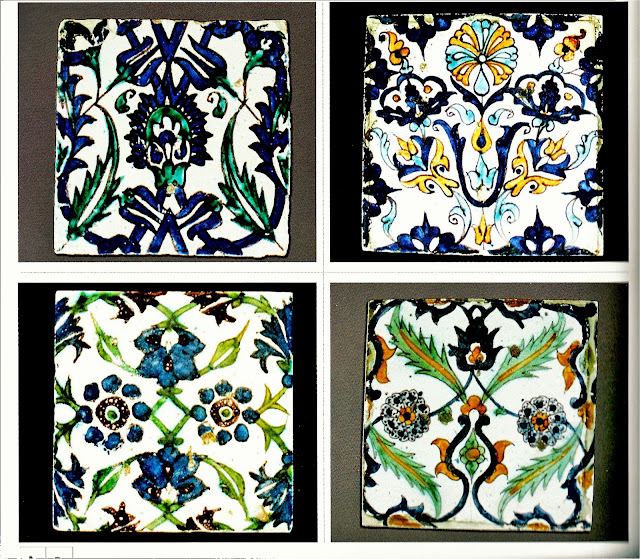
New Resource
Shopfront Elegy blog (https://shopfrontelegy.wordpress.com/)
A pictorial blog with explanations of many British industrial and commercial shopfronts. This blog includes a section of tiled shop fronts: https://shopfrontelegy.wordpress.com/tag/tiled/.
 |
| "Poole Arms, 19 The Quay, Poole, Dorset, 2004 • ...green tiles, this time on the oldest pub on Poole Quay: it dates from 1600s (though not the tiling, which was made by Carter’s of Poole, the forerunners of Poole Pottery)." (Photo courtesy of Vici MacDonald; https://shopfrontelegy.wordpress.com/2014/08/14/poole-arms/) |
The blog's author, Vici MacDonald, has also published a book, Shopfront Elegy Sampler, and writes:
"Shopfront Elegy is an ongoing project by Vici MacDonald, who for many years has been photographing old commercial and industrial facades from around Britain. In 2012 she launched a blog called Shopfront Elegy, which featured one of these images every day. The Shopfront Elegy books further curate this collection of over 30,000 images into a series of themed volumes, ranging from Grimness to Grandeur.
"An overview can be found in this first volume, Shopfront Elegy: Sampler. Photographs from the project can also be found alongside poems by Tamar Yoseloff in the chapbook Formerly (Hercules Editions, London, 2012), which was shortlisted for a Ted Hughes Award and exhibited at the Saison Poetry Library in London’s Southbank Centre.
"Vici MacDonald is an editor, designer and writer based in London, England. She has authored a monograph on Australian sculptor Rosalie Gascoigne, renowned for her poetic assemblages of found text (Regaro, Sydney, 1997). In 2007 she was a founding editor, with publisher Steve Bush, of contemporary art magazine Art World. In 2012 she and poet Tamar Yoseloff co-founded Hercules Editions, a small press combining poetry and imagery. Other publishers and publications she has worked for include Penguin Group, Faber & Faber, Oxford University Press, Smash Hits and The Art Newspaper."
Jean Nison Update
Jean Nison's Furniture
In my original article about the ceramic art of mid-century modern artist Jean Nison, I showed some photos of Nison's tiled table in the Lippincott House in Scarsdale, New York, which was featured in the September 1953 House Beautiful magazine.
 |
| Nison's tiled table is partially shown in the upper right photo in this House Beautiful ad. (House Beautiful, Vol. 95, September 1953) |
 |
| Part of the top of the built-in tile table (full size is 31" x 40"). (Photo credit: Itai Taubenfeld; photo courtesy of Merrill and Dalia Berman) |
This was not the only tiled furniture that Nison created during her career as a ceramic artist, and which I've discussed before. In a photo shoot of a stained glass window made by Nison's ex-husband, Robert Pinart, for her Greenwich Village townhouse, one photo shows part of a tiled coffee table that Nison made for her own use.
 |
| Tiled coffee table in the living room of Jean Nison's townhouse at 35 Spring Street, Manhattan. (Photo credit: probably Robert Sowers; courtesy of Robert Pinart) |
We also know of two instances where Nison designed tiled church "furniture" in collaboration with Robert Pinart, who designed stained/dalle de verre glass windows for the churches. The first project was for the Shepherd of the Hills Lutheran Church in Berkeley, California and consisted of a tiled altar and a tiled baptismal font.
 |
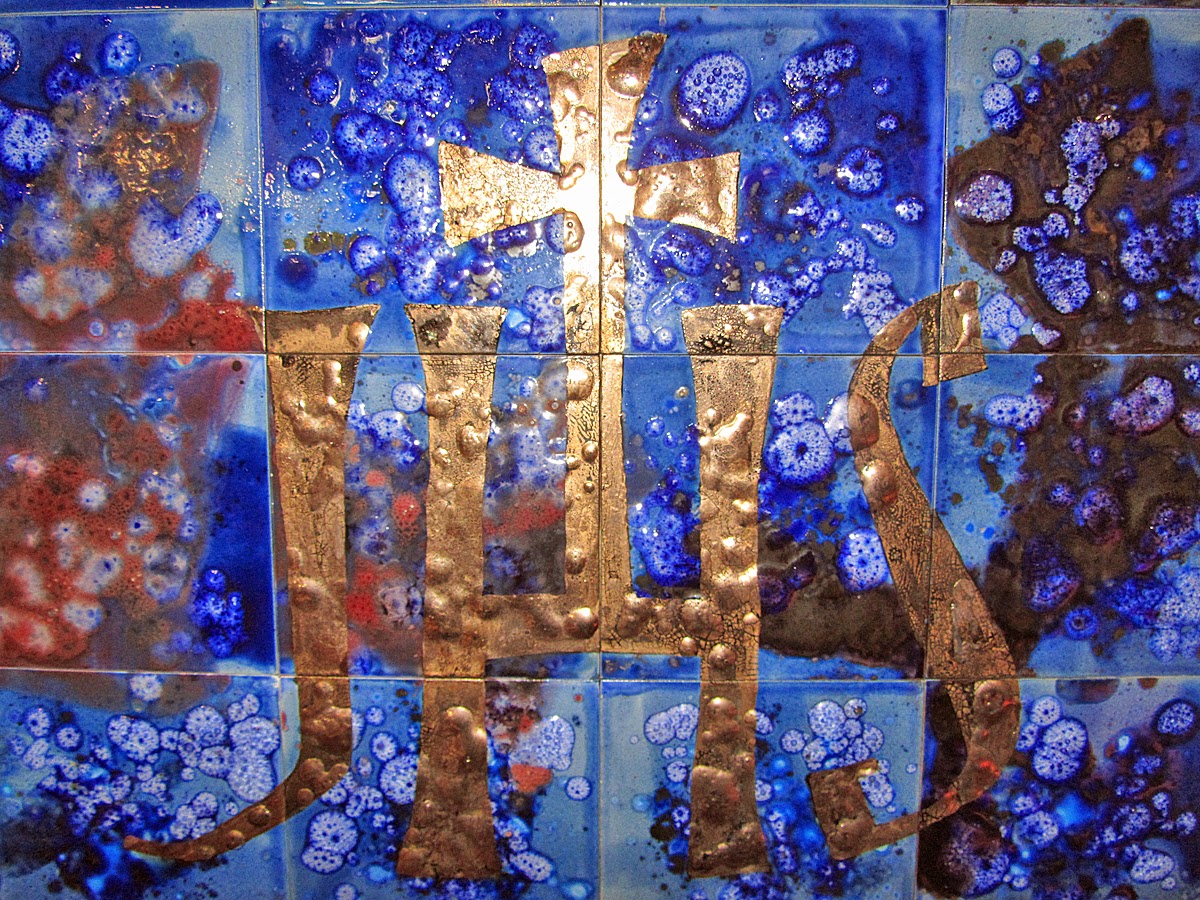
| Jean Nison’s tiled altar in the Shepherd of the Hills Lutheran Church. (http://www.sothb.org/) Printed material from the Church states that "The free standing altar was designed to use the frontal ceramic tiles planned and executed by Jean Nison. The curious bubbly glazes of Miss Nison's tiles is unique and characteristic and is a result of her study and experimentation to create an effect of other-worldliness and a new effect in the diffusion of light." |
 |
| Three photos showing Nison's tiled altar, a detail of the altar tiles, and the tiled baptismal font in the Shepherd of the Hills Lutheran Church, Berkeley, California (1960). According to printed material supplied by the Shepherd of the Hills Church, "The baptismal font matches the altar with artistic use of concrete and Miss Nison's tiles. Thus the font and altar outwardly signify the inner spiritual relationship between the two sacraments." The tiles, themselves, illustrate Nison's use of precious metals (gold and/or silver) mixed with her glazes. |
The second church furniture project was for the St. John the Baptist Catholic Church in Hillsdale, New Jersey (1969). Jean Nison designed a metal sculpture on a mosaic tile base for the Nave. The sculpture, called the Tabernacle, where the Eucharist is kept in reserve, was fabricated by the Columbia Art Metal Works of Newark, New Jersey. (From an unpublished book manuscript, The Glass Art of Robert Pinart: An Annotated Listing, working title, ©2016, 2017, 2018 Susan Ingham Padwee and Michael Padwee.)
 |
| "The Tabernacle" with Jean Nison's tiled-mosaic base. (Photo credit: Michael Padwee) |
 |
| Detail of the tiled-mosaic base. |
 |
| Set of three, tiled nesting tables in Mr. Schwartzbach's home. (Photo credit: Neil Schwartzbach) |
 |
| Three tiles on the largest table picture horses. |
 |
| Three tiles on the middle table picture deer. |
 |
| Two tiles on the smallest table also picture horses. (Photo credits: Neil Schwartzbach) |
I am certain that Jean Nison created other tiled furniture during the 1950s and 1960s. If any of the readers of this blog come across other pieces of Nison's tiled furniture, please let me know. (tileback101 "at" collector "dot" org)
H A P P Y N E W Y E A R
LINKS TO MY PAST BLOG ARTICLES
"Newark, New Jersey Loses Another Architectural Gem: Science High School "
"A Possible Early Sketch for one of Frederick Dana Marsh's Marine Grill Murals" and a new exhibit.
read more...
"The Commercial and Personal Art Tiles of Rafael Guastavino, Jr.: Part II"
read more...
"The Lower East Side and Bialystoker Landsmanshaftn"
"The Identification of United States Art Tiles" and three new resources
"Tile Advertisements in the Paris Métro" and "SAVED!!! The Empire State Dairy Tile Murals in Brooklyn, New York"
"The Sevillian tile style: Catalogo de Azulejos de Estilo Sevillano"
"Bits and Pieces: Updates for the Lever House, the Kesner Building and 2116 Ditmas Avenue, Brooklyn" and an obituary for Robert Pinart
"The Commercial and Personal Art Tiles of Rafael Guastavino, Jr." (Part I)
"Art Deco Commercial Architecture: Montgomery Ward’s Mid-Size Department Stores"
"Tessellations: Islamic Tile Patterns and M.C. Escher"
"Grant's Tomb, the Community and the Gaudi-esque benches of Pedro Silva" AND A request for help
"A Factory As It Might Be" and the 2016 Ortner Preservation Awards
The Atlantic Terra Cotta Company and the Beginnings of Polychrome Terra Cotta Use
Bits and Pieces: The Brooklyn-Battery Tunnel and following up on the James N. Gamble House and the Charles Volkmar Overmantle Mural
Art Deco Buildings and Their Lobbies: the Chrysler Building, the Film Center Building and the Kent Garage/Sofia Brothers Storage Warehouse
ARCHITECTURAL MURALS OF LUMEN MARTIN WINTER and a REPORT ON THE EMPIRE STATE DAIRY BUILDING
The Heart of the Park: Bethesda Terrace and its suspended Minton Tile ceiling
A Landmarks hearing was held on July 19, 2016...
Two Restorations: The City Hall Subway Station and the Tweed Courthouse
Egyptian, Moorish and Middle Eastern Ornamentation Used In Art Deco Terra Cotta in New York City, and Empire State Dairy Update
Wall Murals in Brooklyn: A Mini Survey
Inside Prospect Park: The park's Rustic, Classical and other Internal Architecture
Herman Carl Mueller in Titusville and Trenton, New Jersey; A Charles Volkmar Discovery in Clifton, New Jersey
A Book Review and New Discoveries and Updates-II: Jean Nisan, Ceramic Tile Artist
Polychrome Terra Cotta Buildings in Newark, New Jersey
New Discoveries-I: The Tiled House of Jere T. Smith
Introducing the Stained and Dalle de Verre Glass Art of Robert Pinart
Bits and Pieces: Polychrome Terra Cotta- and Tile-Clad Buildings
Socialist and Labor Architecture and Iconography in New York City
Bits and Pieces: Two Mosaics--Hamden, CT and Manchester, NH
The Renaissance Casino and Ballroom Complex in Harlem: Another Tunisian Tile Installation Headed for Demolition
Clement J. Barnhorn and the Rookwood Pottery
The Woolworth Building
The Mosaic Art of Hildreth Meière
Lost Tile Installations: The Tunisian Tiles of the Chemla Family
The Grueby Children's Murals on East 104th Street
The Experimental Lustre Tiles of Rafael Guastavino, Jr.
Bits and Pieces: Two "E"s--Eltinge and Elks; and more about Jean Nison
The Ceramic Tiles and Murals of Jean Nison
Pleasant Days in Short Hills: A Rookwood Wonderland
Architectural Ceramics in the Queen City
Isaac Broome: Innovation and Design in the Tile Industry after the Centennial Exhibition
"Immigration on the Lower East Side": A Public Arts Mural Created by Richard Haas
Movie Palaces-Part 2: The Loews 175th Street Theatre
Béton-Coignet in New York: The New York and Long Island Coignet Stone Company
Michelin House, London
Movie Palaces, Part 1: Loew's Valencia Theatre
An Architectural and Ceramic Tour of Istanbul - Part II
The Tiles of Fonthill Castle
An Architectural and Ceramic Tour of Istanbul - Part I
Tiled Facades in Madrid
Nineteenth Century Brooklyn Potteries
Ernest Batchelder in Manhattan
Leon Victor Solon: Color, Ceramics and Architecture
Architectural Art Tiles in Reading, Pennsylvania
Charles Lamb and Charles Volkmar
Kansas City Architecture - II
Kansas City Architecture - I
Westchester County--Atwood and Grueby
Modern Houses in New Caanan, Connecticut
PPG Place, Pittsburgh
Aluminum City Terrace, New Kensington, Pennsylvania
Newark's WPA Tile Murals: “Fine Art is an Important Part of Everyday Life”
Public Art Programs in New York City: The CETA Tile Murals at Clark Street
Concrete and Tiles-I: Moyer, Mercer, Murosa
The Café Savarin and the Rookwood Pottery; Chocolate Shoppe Rebounds
Architectural Ceramics of Henry Varnum Poor
Herman Carl Mueller and the Church of St. Thomas the Apostle
Meet Me at the Astor
The Mikvah Under 5 Allen Street; "Historic Hall" Apartments Revisited
London Post-3
Some Moravian Tile Sites in New York
London Post-2
London Post-1
Brooklyn's International Tile Company
Subway Tiles-Part III, the Squire Vickers Era
Subway Tiles-Part II, Heins and LaFarge
Subway Tiles--Part I, Guastavino tiles
Trent in New York-Part III, Historic Hall Apartment House
American Encaustic Tiling Company-Part II, Artists' Tiles
Trent in New York-Part II, a Dey Street Restaurant
American Encaustic Tiling Company-Part I, Tile Showrooms
Trent in New York-Part I, The Bronx Theatre
Fred Dana Marsh's Tiles
*****
About this blog:
This is a non-commercial, educational blog. Content is compiled/written by Michael Padwee and all opinions expressed herein are my own, or quoted, and are offered without intending to harm any person or company.
I fact-check as carefully as possible before posting and try diligently to cite sources of text and photos that are not my own.
I reserve the right to edit content—either add or delete material—as I see fit.
If you find a broken link on this blog, please contact me at mpadwee'at'gmail.com.
I do not accept anything of value to write about products or businesses. If I recommend a product or a company, it is strictly not for profit.
Permission is granted to link back to this site. In fact, link backs are appreciated.
Offensive comments or spam will be deleted. I reserve the right to decide what is considered offensive.
I am not responsible, nor will I be held liable, for blog comments. Writers of comments take full responsibility for their content.
I reserve the right to remove comments asking for appraisals or trying to sell items. (Click on "comments" in the section below to leave a comment.)
FOR SOME REASON I HAVE BEEN LOCKED OUT FROM REPLYING TO COMMENTS MADE ON MY BLOG ARTICLES. IF YOU WANT AN ANSWER TO A COMMENT, PLEASE LEAVE ME A WAY TO CONTACT YOU OTHER THAN THROUGH A REPLY. THANKS.