A blog about architectural tiles, terra cotta and other ceramic surfaces, architectural glass and ornamentation in and around New York.

Showing posts with label Chemla. Show all posts

Tuesday, December 1, 2015

A BOOK REVIEW and NEW DISCOVERIES and UPDATES-II: JEAN NISON, CERAMIC TILE ARTIST

H A P P Y   H O L I D A Y S


A newly discovered architectural ceramic mosaic by Jean Nison and a book review of Un Siècle de Céramique D'Art En Tunise


St. John the Baptist Catholic Church, Hillsdale, NJ (2015). (Color photos courtesy of Michael Padwee unless otherwise noted)

While taking photos of Robert Pinart’s 50+ stained glass windows in St. John the Baptist Catholic Church in Hillsdale, NJ, I saw a metal sculpture on a mosaic tile base on the far side of the Nave. When I got closer I thought I recognized the mosaic tile pieces as similar to tiles made by Jean Nison, Robert’s ex-wife and close friend. I brought my photos to Robert, and he identified them as Nison’s.


The sculpture is the Tabernacle, where the Eucharist is kept in reserve. The wings are symbols of the cherubim wings on the Ark of the Covenant. The crown is a symbol for the Crown of Thorns, and the fish on the front of the cabinet is a symbol of the food given to those who believe in Jesus Christ. (Conversation with the Parish Secretary)


According to the church dedication booklet, the church architect was Louis J. Mineo, Jr., who lived in Hillsdale and had offices in Emerson, New Jersey, and the Liturgical Designer was Michael F. Segalas. Robert Pinart and Jean Nison both knew Michael Segalas when he worked in the architecture office of Percival Goodman. Pinart said that he obtained some commissions through Michael Segalas. Louis Mineo, Jr. was also the architect of record for other projects in New Jersey where Pinart designed the windows--Pascack Valley Hospital in Westwood (1967) and Temple Beth El in Closter (1968). The sculpture was fabricated by Columbia Art Metal Works, Newark, New Jersey. (Dedication Booklet, Saint John the Baptist Hillsdale, New Jersey, Ecclesiastical Color Publishers, South Hackensack, NJ, 1969)


One of Nison’s trademarks was to drop liquified gold mixed with glaze onto the tiles’ surfaces. The tiles were then fired at low temperatures in a kiln.


Jean Nison's Missing Tiled Table

While digitizing the glass slides of Robert Pinart, I came across a series of photos of a large, abstract dalle de verre window Robert made for his ex-wife, Jean Nison. One of the slides included a section of Nison's living room which showed a tiled table top. Pinart identified the tiling as Jean's, but had no idea what happened to the table after the house was sold.


Jean Nison’s Fireplace Surround for Lever Brothers


Jean Nison, 1950s. (Photo courtesy of the American Crafts Council Library)

In my article about mid-century-modern ceramic tile artist Jean Nison, I mentioned that she was commissioned to create a tile installation in the Lever Brother’s Boardroom in New York City’s landmarked Lever Building.


(Photo taken and edited from: Jean Nison, "Fantasies in Tile", Craft Horizons, Vol. 13, No. 3, May-June 1953, p. 36+)

According to Nison, she visited decorators, left tiles with them and hoped they would call her. This was how, she believed, Raymond Lowey Associates, the industrial design firm, asked her to make a wall decoration for Lever House, at that time the headquarters of Lever Brothers Corporation (now Unilever). I contacted the curator of the Lever House Art Collection, Mr. Richard Marshall, but he had no information about the fate of Nison's tile installation. Unilever Corporation moved out of the building in the 1980s, and may have taken the tiles with them. A request to Unilever for information, however, went unanswered.

Recently, however, the question of the fate of the installation may have been answered.


Two of the tile designs from the Lever Brothers Boardroom fireplace surround illustrating the color scheme of the installation. (Jean Nison, American, born in Egypt of French parents [sic]. Lever House, NYC, (Boardroom Tiles)(framed pair), c. 1952. Ceramic, Size 6 x 6 in. Gift of Eric M. and Joy Hart. G2005.21.13)

After reading my article, the Chief Curator of the Mobile (AL) Museum of Art, Paul Richelson, contacted me. Two tiles from the boardroom fireplace in Lever House had been donated to the Mobile Museum of Art by Eric M. and Joy Hart in 2005. Either these were extra tiles that were not used in the installation, or the installation was removed when Unilever moved from Lever House to Connecticut and tiles were given to some of the executives. If the latter, other tiles from this installation may still exist.


This was probably made for, and sold at Lever House. (Photo from ebay)

To prove my point, a recent ebay auction listed a “replica” boxed tile of the Lever Brothers tile on the left, above. Nison may have made extras to sell in crafts stores and at Lever House, itself.


A Possible New Tile Panel

I was recently contacted by a reader who had purchased a Nison tile depicting a doe on a field of gold bubbles. The tile has writing on the back that says "do again creeping panther", which could mean Nison was considering using the doe tile in a panel setting.


(Photo of 6" tile  painted on a Wheeling Tile Company blank courtesy of Will Cottes)


The Tichenor House Dragon Mural


The full double dragon mural in the master bathroom. (Photo courtesy of the American Craft Council Library)

Built in Long Beach, California in 1904-05 the Tichenor House was one of only three homes constructed in Long Beach by the renowned architectural team of Charles and Henry Greene. In the early 1950s “[the] house was extensively remodeled [...by architect Adrian Wilson and his associate, Alden Becker] with many modern changes to the interior,” (http://articles.latimes.com/1991-05-05/news/hl-2211_1_tichenor-houseincluding the addition of a double dragon tile mural in the master bathroom.

In December of 2011 a fire started in the rear of the house and was extinguished in about twenty minutes. (http://www.presstelegram.com/technology/20111212/fire-strikes-historic-tichenor-house
“The fire in the [bath]room must have been very intense, because the tile was covered with soot that was burned onto the surface of the tile face. The tile also had a crackle glaze, which has many very tiny cracks over the entire surface. This was intentional, and reflects the style of the tile. Unfortunately, the soot permeated the crackle glaze... .” (http://www.justanswer.com/antiques/7ehtb-ra-jpm.html)


Brian Kaiser, a tile conservator and preservationist, was called in and saved the bathroom mural. Kaiser has been restoring the mural ever since, and half of it has been completely restored.


There is a problem, though. Brian lives in a house that was once owned by the ceramicist Rufus Keeler, who, for many years, was the major force behind the Malibu Potteries in Malibu, California. Brian’s house has many interior and exterior tile installations from the 1920s-30s that were designed by Keeler. Nison’s panel from the 1950s does not belong in that setting, and Brian would like to find a new home for Nison’s mural which is approximately 7’ by 7’. If anyone is interested in this mural, they should contact Brian at brian.kaiser'at'ymail.com.


          UN SIÈCLE DE CÉRAMIQUE D'ART EN TUNISE


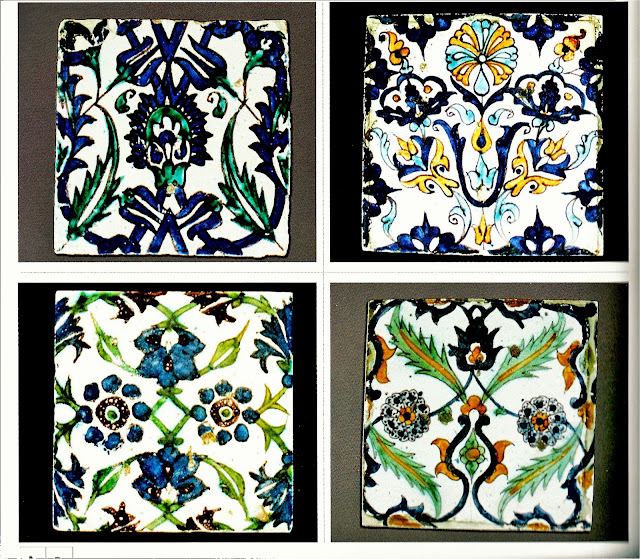
For those of us who have long marveled at the wonderful designs of Jacob Chemla's Tunisian tiles, this book, written by Jacob's grandchildren, Monique Goffard, Jacques Chemla and Lucette Valensi, will be very welcome. In the first third of the twentieth century the "Tunisian Tile Company" and "The African Tile Company" supplied architects like George Washington Smith, Bertram Goodhue and Addison Mizner, among others, with Mediterranean and Middle Eastern-style tiles for resorts, mansions, hotels and other residential and commercial establishments in the United States. Although many of the Tunisian tile installations no longer exist--mainly in New York City and State, many others in California and Florida remain intact.


Detail of a tile panel in the entry hall of the theatre of the President of the Republic in Carthage.


This book details the lives of the Chemla family and their ceramic interests from Haï Chemla through his son, Jacob (1858-1938), and his three sons, Victor, Albert and Mouche and their families. Jacob Chemla is credited with reviving the lost arts of Tunisian ceramics by perfecting a special glaze and blue color that had been thought lost.


Top: vase with a flared neck; bottom: vase with a conical neck. The bottom vase is signed "Awled Chemla Tunis" plus a tulip, an emblem for Ben Ahmed.

There are large sections of photos of architectural tile installations, individual tiles and pottery. Pottery markings and individual signatures of artists are also identified.


Four tile designs.

This is an important book that is not to be missed, especially by tile and pottery enthusiasts, architectural historians and preservationists.

This book is written in French and may be purchased from http://www.amazon.ca/Un-siècle-céramique-dart-Tunisie/dp/2841623777,

https://www.chapters.indigo.ca/en-ca/home/section/34-214-321140-327006-561000-cat.html, or

http://www.priceminister.com/offer/buy/796203172/un-siecle-de-ceramique-d-art-en-tunisie-de-collectif.html.

I have previously written two articles about the tiles produced by the Chemla potteries:  http://tilesinnewyork.blogspot.com/2014/11/lost-tile-installations-tunisian-tiles.html

and

http://tilesinnewyork.blogspot.com/2015/03/the-renaissance-casino-and-ballroom.html.


Sunday, March 1, 2015

The Renaissance Casino and Ballroom Complex in Harlem: Another Tunisian Tile Installation Headed for Demolition

A 1920s photo of the Renaissance Casino. (Photo: Collection of Columbia University)

In 2007 the non-profit Abyssinian Development Corporation, which had ties to Rev. Calvin O. Butts’ Abyssinian Baptist Church, helped defeat the proposed landmark designation for the historic Renaissance Casino complex in Harlem. According to Christopher Gray, “Sheena Wright, the chief executive of the nonprofit development company,...contended that landmark designation would ‘basically kill the project.’” (Christopher Gray, “Streetscapes: A Harlem Landmark in All but Name”, The New York Times, February 18, 2007; http://www.nytimes.com/2007/02/18/realestate/18scap.html?_r=0&pagewanted=print) The Abyssinian Development Corporation had plans to build apartments on the theater property and restore the Renaissance Casino.


"The Renaissance Complex, as the [2007 Abyssinian Development Corporation] project will be dubbed, will be designed by award-winning architect Max Bond. When redevelopment is complete, the 196,000 sq. ft. Renaissance Complex will include: 112 home-ownership units providing the first of its kind for neighborhood residents, 27,000 square feet of cultural and much needed performing arts rehearsal space, 10,000 square feet of commercial space, [and] 10,000 square feet of community space." (https://uptownflavor.wordpress.com/2007/03/22/renaissance-groundbreaking/; Color photos courtesy of Michael Padwee unless otherwise noted)

Also in 2007, Lisa Kersavage of the Municipal Art Society testified at the Landmarks Designation Hearing in favor of landmark designation for the Renaissance Theater and Casino. Ms. Kersavage testified, in part, that “The question before the Commission today is whether these buildings are eligible for designation as landmarks, and clearly they are. As one committee member put it, these buildings comprise one of the 'dearest sites in Harlem,' and are a cultural touchstone for Harlem. [...] Both the Ballroom and Casino played an important role in the Harlem Renaissance. Owned and operated by African-American entrepreneurs, they were Harlem’s first entertainment complex where movies, theater, dancing, and sports could be enjoyed. Major films featuring all African-American casts, banquets, award ceremonies, major musical talent, and the Renaissance Five basketball team, all contributed to the reputation of the complex into the 1960s. In short, the buildings are eligible for designation based on their cultural and historical significance.” (Testimony of the Municipal Art Society Before the Landmarks Preservation Commission By Lisa Kersavage, Municipal Art Society Regarding the Designation of the Renaissance Theater and Casino 2341-2349 Adam Clayton Powell, Jr. Boulevard January 16, 2007) 


Part of the ground floor interior of the Renaissance Ballroom building in January 2015. The question now is if the building is too deteriorated to be restored as part of an overall development plan.

On the other hand, in 2007 “the New York Landmarks Conservancy, one of the city’s major preservation organizations [,...] endorsed the demolition of only the theater portion [...of the complex. It] is rare to have a preservation organization speak against any landmark proposal.” (Christopher Gray, “Streetscapes: A Harlem Landmark in All but Name”, The New York Times, February 18, 2007; http://www.nytimes.com/2007/02/18/realestate/18scap.html?_r=0&pagewanted=print) In fact, the political line-up to speak against landmarking was impressive to say the least. “...an unprecedented delegation of Harlem residents descended on the Landmark Preservation Commission. The reason for this well-connected group which was headed by the prominent attorney Gordon Davis who formerly served as NYC Parks Commissioner and which included the Rev. Calvin O. Butts in his role as founder of the Abyssinian Development Corporation, David Dinkins, former mayor, City Council member Inez Dickens and at least a dozen others as well as letters of support for non-designation from the Borough President Stringer, former Borough President C Virginia Fields, Columbia Planning Dept., and UMEZ, was most unusual. In a neighborhood where some have complained that relatively few buildings have been protected and recognized as city landmarks, especially compared to more prosperous neighborhoods downtown, they demanded that the Renaissance Casino should not be designated as a landmark under any circumstances.” (http://mrmhadams.typepad.com/blog/2014/11/african-american-history-for-salepart-one-the-renaissance-casino.html


A 1920s photo of the Renaissance Ballroom showing the West 138th Street and part of the Seventh Avenue facades.

“Extending along Adam Clayton Powell, Jr. Blvd. from W. 137th Street to the southeast corner of West 138th Street, the Renaissance was built in two stages. The theater of the two-story structure to the south was completed in 1922 while the ballroom built atop a billiard parlor, shops and a Chinese restaurant was completed two years later. Designed by notable theater architect, Harry Creighton Ingalls, the Renaissance Casino and ballroom is a subtly distinguished work most notable for its frieze of polychrome Hispano Moresque style glazed tiles.” (http://mrmhadams.typepad.com/blog/2014/11/african-american-history-for-salepart-one-the-renaissance-casino.html


This was the first theater in New York that was built and owned by African Americans, and it was the first theater in New York where African Americans were allowed to sit in the Orchestra. “The block-long Renaissance complex dates to 1920. That’s when William H. Roach, an immigrant from Montserrat who owned a housecleaning service, bought the northeast corner of 137th Street and Seventh Avenue, now known as Adam Clayton Powell Boulevard. Property records are not explicit, but it appears that Mr. Roach, working chiefly in partnership with his countryman Joseph H. Sweeney and an Antiguan named Cleophus Charity, built the Renaissance Theater there in 1921. Two years later, the partners added the Renaissance Casino, with a second-floor ballroom, at the 138th Street corner of the block. [...A]rticles in The New York Amsterdam News indicate that Mr. Roach and other principals were followers of Marcus Garvey, who promoted black self-sufficiency and business enterprise.” (Christopher Gray, “Streetscapes: A Harlem Landmark in All but Name”, The New York Times, February 18, 2007; http://www.nytimes.com/2007/02/18/realestate/18scap.html?_r=0&pagewanted=print


The Renaissance Ballroom in January 2015 showing the West 138th Street facade and part of the Adam Clayton Powell, Jr. Blvd. facade.


The West 137th Street facade of the Renaissance Theatre in 2003. (Photo courtesy of Ken Roe and Cinema Treasureshttp://cinematreasures.org/theaters/12575/photos/36848)


What’s left of the Renaissance Casino as of January 2015, showing the West 137th Street facade and part of the Adam Clayton Powell, Jr. Blvd. facade.  Rev. Cavin O. Butts’ Abyssinian Baptist Church is in the right background.

“Even in its current condition, the beauty of the Islamic inspired architecture designed by Harry Creighton Ingalls, still shines through.” (http://untappedcities.com/2014/09/02/inside-the-abandoned-renaissance-theater-and-casino-in-harlem/) A frieze of tile panels with "Middle Eastern" designs runs just below the roof line on both buildings. Courses of brick, also under the roof line, were said to evoke Islamic architecture.


Made of fragile earthenware, many of the tiles are now chipped and broken, and some are missing altogether. At the time I became aware of these tiles, in December 2014, the identity of the tile maker was not known. I had recently posted an article about Jacob Chemla, his sons, and their Tunisian pottery which supplied tiles to American architects from the 1910s through the 1930s. I asked a group of people who are members of the Tile Heritage Society, the Friends of Terra Cotta, the American Art Pottery Association and members of the Chemla family to help identify the tile maker. I also went to the Renaissance complex and took photos of the buildings and tiles.


The scars can be seen on many of the tiles, but it can be difficult to see them because of the condition of the tiles.

Close-up photos of the individual tiles show three “scars” on the face of each tile in the shape of an equilateral triangle. The "scars" were left by the small stilts of a tripod used to separate the tiles during firing in the kiln. The tile designs are reminiscent of tiles manufactured from the 1880s through the 1930s by Jacob Chemla and his sons in Tunisia. There were two Chemla family tile companies with showrooms in New York City during the 1910s and 1920s--the Tunisian Tile Company and the African Tile Company, which later became Les fils de J. Chemla, Tunis. Members of the Chemla family, who will soon publish a book about the family’s potteries, have said that if these tiles had the tell-tale scars, they were made by Jacob Chemla and his sons. 

Glazed pottery for wall decoration dates to at least the sixth century B.C.E. in the area of the Middle East occupied by the modern states of Iran and Iraq. By eighth century C.E. the technology and taste for ceramics and tile manufacture had extended along the  northern coast of Africa and across the Strait of Gibraltar to al-Andalus, the Moslem empire in Spain.  The Iraqi tiles decorating the walls of the Mosque of Sidi Ukba in Kairuan in Tunis, built between 817 and 838, is evidence of the spread of interest in tiles. (R.L. Hobson,  A Guide to the Islamic Pottery of the Near East, British Museum, 1932, p. 95 and http://islamic-arts.org/2012/the-uqba-masjid/)

"Despite the diversity implied in its geographic spread and thousand year duration, the history of Islamic pottery has an inherent unity. [. . .] the widespread use of four basic decorative elements also contributed to this phenomenon.  The Islamic potter employed abstract vegetal forms (one of the most popular was the arabesque), calligraphy, figural iconography, and geometric patterns.  (Marilyn Jenkins, Islamic Pottery: A Brief History, The Metropolitan Museum of Art Bulletin, Vol. XL, No. 4, Spring 1983, p. 3)  In addition, much of Islamic decorative arts are characterized by horror vacui, a fear of empty spaces, with surfaces densely ornamented with convoluted motifs.

The Chemla tiles on the the Renaissance Casino and Ballroom are dominated by vegetal motifs, by far the most common decorative device in Islamic art. (see Figures 1, 5-13)  The saz leaf, a curving, feathery plume popularized on 16th century tiles from Isnik, Turkey appears in a small and simplified version on Figures 6 and 13.  From the saz leaf, the palmette evolved. (Figure 7)  Flowers--a simple daisy (Figures 1, 5, and 13) and a more stylized blossom (Figure 1, center), the carnations in Figure 11 and flowers formed by the edges of the tile in Figure 6--were frequent motifs.  Animals are rare in Islamic design compared to vegetal motifs, and the fantastically plumed bird in Figure 1 is unusual.

Geometric motifs are well represented on these tiles.  Sixteen identical tiles depicting floral figures (Figure 2) are arranged to form X shapes and octagons.  The circular corner ornaments on Figure 3 are formed from quarter circles on adjacent tiles.  Figure 4, also composed of sixteen identical tiles, forms a very typical interlaced star-shaped figure which attests to the Islamic fascination with mathematics.

The blue and white palette that dominates much of Islamic ceramics evolved from an interplay of style, technology, and natural resources resulting from trade between the Middle East and China.  Cobalt from Persia, first imported to China in the early years of the fourteenth century, led to the development of Chinese blue and white porcelain whose designs in turn influenced Islamic design.  Early Islamic copper-based glazes established an enduring taste for turquoise evident in these twentieth century tiles.


Figure 1


Figure 2


Figure 3


Figure 4


Figure 5


Figure 6


Figure 7


Figure 8


Figures 9 & 10


Figure 11


Figure 12


Figure 13


This is the fifth building in the New York City area that has utilized Tunisian Tile Company tiles as ornamentation, and it is the only installation that still has the original tiles. Many probably can be restored or saved, but they will first have to be removed professionally to avert further damage. 

But even for this, it may be too late. The current owner of the property, BRP Development Corporation, plans to totally demolish the buildings with some lip service to saving the tiles. "In October, BRP Development Corporation acquired the site for $15 million and shortly after filed permits to raze the building in its entirety. Now, the site's former owners, Abyssinian Development Group, are the main supporters of lobbying for the building's preservation. Abyssinian had planned to restore the building in part, integrating its facade into the base of the structure that would house a ballroom, restaurant, and 500-seat theater, with a new addition of condos on top, but fell short of moving forward due to financial constraints. Now, BRP plans to raze the building that's been abandoned for three decades to create room for "The Renny," a 134-apartment building with 17,500-square-feet of retail space, an education center, and a performance space. The [New YorkTimes elaborates that for many, BRP's insistence on demolishing the structure represents another of the city's failures to preserve Harlem's disappearing culture." (Zoe Rosenberg, "Razing Harlem's Renaissance Ballroom Is 'Cultural Genocide'", New York Curbed, December 22, 2014; http://ny.curbed.com/archives/2014/12/22/razing_harlems_renaissance_ballroom_is_cultural_genocide.php)


Harlem Renaissance Ballroom redevelopment proposal, rendering by Rickenbacker + Leung.

One writer has shown a number of proposed renderings of the site that would have retained parts of the facades that are now slated for total destruction, as well as a rendering of the current BRP proposal: "What Could Have Been: Harlem Renaissance Ballroom, 2351 Adam Clayton Powell Jr. Boulevard" by Stephen Smith, http://newyorkyimby.com/2014/11/what-could-have-been-harlem-renaissance-ballroom-2351-adam-clayton-powell-jr-boulevard.html.


The Renny--the one that will be built, rendering by GF55.

“'It should have been landmarked,' said Peg Breen, president of the New York Landmarks Conservancy… . But in 2007, the conservancy sided with Abyssinian in saying that the building should not gain landmark status. Looking back, Ms. Breen said, 'Maybe it’s a lesson.' But at some point, she said, preservation comes down to economics. 'And is someone willing to invest to put it all together, and to what use?' she said. 'It’s a shame to see it deteriorate like that.'" (Kia Gregory, "In Harlem, Renaissance Theater Is at the Crossroads of Demolition and Preservation", The New York Times, December 19, 2014; http://www.nytimes.com/2014/12/21/nyregion/in-harlem-renaissance-theater-is-at-the-crossroads-of-demolition-and-preservation.html)  


A petition is being circulated to halt the destruction of the Renaissance Casino. Below is the petition and a link to the signature page:

This petition will be delivered to NYC Mayor Bill DeBlasio.


Halt the Destruction of Harlem's Historic Renaissance Casino


The golden era of the Harlem Renaissance was said to have been from 1918 to 1930. The vibrant expression of all art forms reached a crescendo during this period, with bold statements being made by Blacks in music, literature, visual arts, dance and sports. Where Blacks were excluded from participation in the mainstream manifestations of the arts, they created their own relentlessly raucously expressive modalities.

The Harry Creighton Ingalls-designed Renaissance Casino located at the intersection of 138th Street and Seventh Ave (Adam Clayton Powell, Jr. Blvd.) was commissioned in 1920 and completed in  1922 by three eastern Caribbean immigrants. It's birth was co-temporous with the rise of Renaissance Arts movement. Over its 60 year "lifespan" it played host to every mid century manifestation of African American culture,most notably as displayed by the Rens Big Five, a litany of Big bands, performers and  intellectuals of every stripe from Zora to Dubois who all had their voices heard in this revered structure.

It has lain fallow for 35 years, and now stands poised for the wrecking ball. Despite it's incontrovertible historical value, it was denied landmark status in 1991 and again in 2007 due to intense political pressure exerted upon the process by well connected Harlem real estate interests.
""THE RENNY" IS A LANDMARK WITHOUT LANDMARK STATUS, and to destroy it would be an egregious cultural assault against the Harlem community. There are no "do-overs", that was the painful lesson that issued from the destruction of Penn Station.

Mr. Mayor, we ask that you invoke any and all powers at your disposal to halt the ill-considered development plan; and initiate a conversation about how this historical treasure (or elements from it) might be preserved and integrated into any construction taking place on this iconic cultural footprint.

To sign:

https://www.change.org/p/nyc-mayor-bill-deblasio-halt-the-destruction-of-harlem-s-historic-renaissance-casino?utm_campaign=responsive_friend_inviter_chat&utm_medium=facebook&utm_source=share_petition&recruiter=196710751


*****

I would like to thank decorative arts historian Susan Ingham Padwee for her insight and help with the section about Islamic pottery and tile motifs.       


Saturday, November 1, 2014

LOST TILE INSTALLATIONS: The Tunisian Tiles of the Chemla Family

This article discusses the Tunisian tiles of Jacob Chemla and the Chemla Pottery in Tunis. The Chemla Tunisian tiles were produced and used all over the world from the 1870s through 1977. Specifically, this article is about Tunisian Tile Company installations in the New York area--installations which once existed but no longer exist.


Jacob Chemla

According to his grandson, André, Jacob Chemla (1857-1938) was a scholar and artist. He was an advocate with the Rabbinical Court of Tunis; he was a writer and playwright (Love and Malice was one of his plays); he translated The Count of Monte Cristo and works of Cervantes, among others, into Judeo-Arabic.

After 1881, when the French established their protectorate in Tunisia, Jacob became friends with the architects who were designing the buildings of the new French Administration and restoring some of the historic buildings, and who wanted to clad the buildings with “authentic” Arab tiles--Saladin, Roy, Blondel, and especially Raphael Guy Sadoux. These architects wanted to decorate their buildings with tiles like those on the Bardo Palace and the Mosque of Kairouan.

Jacob Chemla organized a pottery in Tunis with the intent of rediscovering the archaic method of making “Arab” tiles. He experimented with glazes and firing, and in time he “...finally found what he had wanted: beautiful iridescent tiles...that were very close to the old enamels, because, as with the old, Jacob had used local products (sand Mégrine for silica, copper, tin and lead were oxidized and crushed on site). With the help of his son, Victor, the chemist of the company, Jacob developed tiles in the old style.


In 1915 an article in Gustave Stickley’s The Craftsman magazine discussed the effort to renew the old craft of Tunisian pottery and tile-making and the interest this had created in the United States: “...of special interest to us here in America is the introduction of this faience work into our own land, the privilege of importation having been obtained from a family of Tunisian potters by whom the secret of the ancient craft has been preserved.  


Tunisian tiles in a wall and bench in the Villa Persane, Tunis. (Photo courtesy of Jeanne Valensi)

“Some idea of the charm which these tiles add to a garden may be gathered from the photographs [supplied by the Robert Rossman Company], which show the foliage-sheltered grounds and low-walled pathways of the Villa Persane, Tunis.” (“Tiles from the Potters of Tunis: Suggestions for the American Landscape”, The Craftsman, Vol. XXVII, No. 5, February 1915, pp. 584-585)

The Craftsman suggests that its readers visit their Garden Department to see the imported tiles and pottery. “The patterns on many of the pieces are semi-geometric, with here and there a leaf or plant form, suggestions of the pomegranate and the seed pods of the lotus, which give a touch of local character to the designs. ...Occasionally there occur some of the conventionalized leaf forms that one finds in Persian designs.” (Ibid., p. 586) 


Tunisian tiles in Dar Marsa Cubes, a bed and breakfast near Tunis. 

Tunisian tiles were “discovered” by the California architect, George Washington Smith, who used them extensively in his Spanish Colonial style of architecture. Other California architects followed Smith’s lead.


Santa Barbara, California City Hall, designed by George Washington Smith.


Santa Barbara, California City Hall


Arlington Theater, Santa Barbara, California. Designed by Edwards and Plunkett. (Photo by DillyLynn, http://en.wikipedia.org/wiki/File:Arlington-fountain.jpg)


Tunisian tiles in the Santa Barbara County Courthouse. (Photo by Archinia; http://commons.wikimedia.org/wiki/File:Santa_Barbara_Courthouse_Interior_Room_Detail.JPG)

Another architect who used Tunisian tiles in California was Bertram Goodhue, and Goodhue also used these tiles in at least one of his New York commissions.


“La Paz”, The Philip W. Henry Residence, Scarborough, NY

One of Goodhue’s commissions was to design a house for Philip Walter Henry (1864-1947) in Scarborough (now a section of Briarcliff Manor), New York. “Philip W. Henry was educated in the public schools of Oxford, New Jersey. After spending 3 years in railway surveying, in 1883 he entered the Rensselaer Polytechnic Institute, Troy, New York and graduated in 1887. After graduation Henry was employed by the Barber Asphalt Paving Company for fifteen years, first as foreman, then became assistant superintendent for the company at St. Joseph, Montana and Omaha, Nebraska.
Then in New York City, he eventually became vice-president of the company. Beginning in 1902 Henry was a consulting civil engineer and actively involved in various companies and corporations. From 1904-1909 Henry was Vice-President of the Pan-American Company of Delaware. From 1906-1909 he was president of the South American Construction Company, which in 1907-08 built 125 miles of railroad in Bolivia. From 1909-1917 he was president of the Central Railroad of Haiti. In 1910 Henry made a reconnaissance of 700 miles of proposed railways in Spain. ...From 1916-1923 Henry was Vice-President of the American International Corporation in charge of engineering investigations all over the world that were brought to the organization for financing. ...In 1898 Henry studied Spanish to assist in his business and enjoyed the language so much he translated several plays of Calderon de la Barca, a noted dramatist of the 17th century. The most notable of de la Barca’s plays translated by Henry is “La Vida es Sueno” (Life is a Dream) translated in 1921 and staged by the RPI players in March, 1939.” (http://archon.server.rpi.edu/archon/?p=creators/creator&id=104


There is a passing reference to the Tunisian tiles installed in La Paz in 1917 in a 1920 House Beautiful article: “Much of Mr. Goodhue’s best known domestic work follows English precedent... .  On the other hand, he has worked much in the Spanish style, which he handles with ease... . Add to this that the owner has extensive business connections in South America, and that he wished his home, despite its Eastern setting, to have something of the Spanish character... . [The] architect has permitted himself, and has been graciously permitted by the owner, to indulge himself in a bit of fantasy... . The [owner’s bath]room is domed with an alabaster lamp hanging from its apex, and wainscoted with Tunisian tile; (this tile is also used in the little pool in the garden). However, though the effect may be roughly classed as somewhat Oriental, there’s no absence of the most extreme practicality” (“Noteworthy Houses by Well-Known Architects--IV: The Home of Philip W. Henry... . Bertram Grosvenor Goodhue, Architect”, House Beautiful, Vol. XLVII, No. II, February 1920, pp. 77, 128)

This house, however, has been extensively “modernized”, and the Tunisian tiles no longer exist. In fact, when he designed the house, Goodhue hired the muralist, Lucile Lloyd, to paint a mural on the Great Hall ceiling, (“Personal and Trade Notes”, Southwest Builder and Contractor, Vol. 57, No. 20, May 13, 1921, p. 14) and this work of art has also been removed.


The small garden pool with Tunisian tiles in the Philip W. Henry residence. (“Noteworthy Houses by Well-Known Architects--IV: The Home of Philip W. Henry... . Bertram Grosvenor Goodhue, Architect”, House Beautiful, Vol. XLVII, No. II, February 1920, p. 78)

Master Bathroom, La Paz, c. 2012. (http://www.frequency.com/video/la-paz-scarboro/27662043)

The McAlpin and Commodore Hotels

At least two major hotels in New York City had Tunisian tile installations. The first was the McAlpin Hotel, built between 33rd and 34th Streets on Sixth Avenue.


A picture post card of the Hotel McAlpin from c.1914.

“The Hotel McAlpin was constructed in 1912 by General Edwin A. McAlpin... . When opened it was the largest hotel in the world. The hotel was designed by the noted architect Frank Mills Andrews (1867–1948). Andrews also was president of the Greeley Square Hotel Company which first operated the hotel. Construction of the Hotel McAlpin neared completion by the end of 1912... . The hotel underwent an expansion half a decade later. The owners had purchased an additional 50 feet of frontage on 34th street two years early and proceeded to dismantle those properties. The new addition was the same height as the original 25-story building”. (http://en.wikipedia.org/wiki/Hotel_McAlpin It was designed by Warren & Wetmore and was known as the Hotel McAlpin Annex. “On the twenty-fourth floor [of the Annex] is located the Turkish Bath and an additional Turkish restroom or dormitory... . This room is decorated with tile inserts furnished by the African Tile Company of Tunis... .” (“Annex to Hotel McAlpin”, Architecture and Building, Vol. L, No. 8, August 1918, p. 53, Plate 141) 


Tunisian tiles in the Turkish Rest Room of the Hotel McAlpin Annex. (Plate 141)


Another view of the Turkish Rest Room. (Photo courtesy of Jeanne Valensi)

A candy store was designed by John J. Petis and incorporated into the ground floor of the hotel’s annex. The candy store also had Tunisian tile work.


Although the Robert Rossman Company was supposedly the sole importer and supplier of Tunisian Tile Company wares to the United States, the Architecture and Building article states that the tiles in the McAlpin Annex were supplied by the African Tile Company of Tunis. It is not known if the African Tile Company was organized as a separate entity from the Tunisian Tile Company. Each had a different address in Manhattan: a 1920 ad in Scribners magazine for the African Tile Company gives their address as 110 East 59th Street, Manhattan. The African Tile Company used the cat* logo of Albert Chemla. *[In an email to the author, Jeanne Valensi, the grand-daughter of Moses (Mouche) Chemla, wrote "I think the cat you are talking about is really a lion. In fact, in the African Tile Company, it’s described as a lion. It’s a traditional pattern in Tunisian poteries. It’s attached with a chain and is always decorated with a flower on its stomach… ."]


An ad for the “African Tile Company”, which may have been a separate entity organized by Jacob’s son, Albert, or it may have just been another name for Tunisian Tile Products.

The Tunisian Tile Company, however, advertised its address--which may have been a Robert Rossman showroom--as 23 West 43rd Street. Both, however, were part of the Chemla family potteries.


Undated ad for Tunisian tile products. (Courtesy of Brian Kaiser)

Robert Rossman also advertised Tunisian tile products in its catalogs.


Page from the 1929 Rossman Tile Corporation Catalog.

The second hotel in New York City that was known to have used Tunisian tiles was the Commodore Hotel on East 42nd Street near Grand Central Terminal. 


Commodore Hotel, a picture post card. (Courtesy of http://www.cardcow.com)

“The Commodore Hotel was constructed by The Bowman-Biltmore Hotels group. The structure itself was developed as part of Terminal City, a complex of palatial hotels and offices connected to Grand Central Terminal and all owned by The New York State Realty and Terminal Company a division of The New York Central Railroad. The Commodore was named after 'Commodore' Cornelius Vanderbilt, the founder of The New York Central Railroad System, [...and] was designed by Warren & Wetmore... . The Commodore opened its doors on January 28, 1919. ...The Commodore was successful for decades and in June 1967 The New York Central Railroad, which by then was running the hotel...upgraded The Commodore with a 3.4 million-dollar refurbishment. ...By the late 1970s, both the railroad line, now called The Penn Central Transportation Company, and the hotel itself, had become...bankrupt... . At that point, the Trump Organization bought The Commodore. Trump decided to completely rebuild the hotel. The first few floors were gutted down to their steel frame (although the same basic layout of public rooms was retained) and the entire building was transformed with a new reflective glass facade. The only portion of the hotel's decor left untouched was the foyer to the grand ballroom, with its neoclassical columns and plasterwork. The hotel re-opened in 1980 as the Grand Hyatt New York.” (http://en.wikipedia.org/wiki/Grand_Hyatt_New_York) 


As one reviewer noted: “With a 20 year tax abatement from the city assuring financial viability and an agreement by the Hyatt chain to manage the new hotel, [Trump] had his architect design a 'slipcover' of reflective glass to install over the original masonry facade... . In what was then a city of tired architecture, his glitterglass remod was a hit and within a couple years was making double the per room rate the old Commodore was making and running at near full occupancy and incidentally kicking off the start of the great NYC real estate boom of the 80s.” (http://citynoise.org/article/8906)


A Tunisian Tile Company installation from the Commodore Hotel. (Photo courtesy of Brian Kaiser)

What Trump did, however, was destroy the Tunisian tile work in the building, among other artistic desecrations.


The Zeigler Mansion


2 East 63rd Street, Manhattan. (Photo from http://www.locationdepartment.net/misc,%20resorts,%20etc/8110-a-da.htm)

This mansion “was built in 1921, commissioned by William Zeigler, heir to the Royal Baking Powder fortune. In a New York Times, 2008 article, Christopher Gray describes some of the innovative techniques used by the architect, Frederick Sterner. These include: creating the appearance of a three-story building by setting back the fourth floor making it almost invisible to the street; a central internal courtyard in the style of a Roman villa; and reducing the rear garden to two small areas either side of the library. Two years later, William Zeigler sold the property to Norman Bailey Woolworth, who used it until 1949 when he donated it to the National Academy of Sciences. It was then purchased in 2005 by Russian businessman Leonard Blavatnik, who has not lived in it but kindly donated the use of the mansion to The Susan G. Komen Race for the Cure ‘Holiday House’.” (http://mhstudioblog.com/2009/12/02/happy-birthday-mh-studio-style/)


The architect of the Zeigler Mansion, Frederick Sterner, was no stranger to the use of tiles as architectural ornamentation. In the first decade of the twentieth century Sterner remodeled his own brownstone near Gramercy Park, at 139 East 19th Street, Manhattan, and made use of Moravian tile work around the entrance to the building. 


Tiled entrance to Sterner House, and photo from 1911.

As Christopher Gray noted, the “town house at 139 East 19th Street was the first building designed in New York by Frederick Sterner, one of the city's most innovative architects. His 1908 complete redesign and renovation of an existing building -- which he did for himself -- was a major achievement for Sterner, then a newcomer to New York, who would go on to bring a touch of color to several of Manhattan's drab brownstone side streets. […In] the summer of 1908 he moved to a block of moldy old brownstones, buying the one at 139 East 19th, between Irving Place and Third Avenue. What to do with mid-19th-century brownstones -- built by the mile, of identical boring design, awkwardly planned and often poorly constructed -- was a subject that puzzled writers at the time… He removed the stoop, covered the dark brownstone with a coat of light cream-colored stucco and replanned the interior. It is now a common approach, but nothing like it had been done in New York before.” (Christopher Gray, “Streetscapes/The Frederick Sterner House, at 139 East 19th Street; An Architect Who Turned Brownstones Into Gems”, The New York Times, June 29, 2003, http://www.nytimes.com/2003/06/29/realestate/streetscapes-frederick-sterner-house-139-east-19th-street-architect-who-turned.html?pagewanted=all&src=pm)

I have found one website with images of most interior rooms and exterior spaces of the Zeigler Mansion, http://www.locationdepartment.net/misc,%20resorts,%20etc/8110-a-da.htm. There are no Tunisian tile installations in this renovated mansion, as far as we can tell.

The twentieth century was a period of renewal of ceramics in Tunisia, especially in Nabeul, where the Chemla family organized a pottery in about 1908. The town of Nabeul became a repository of expertise and was open to the discovery of new techniques by the Jacob Chemla artisans, the Al Kharraz families, Keddidi, Bensedrine and Abderrazak. (A Google translation from: http://fr.wikipedia.org/wiki/Artisanat_tunisien)

Each of Jacob Chemla’s three sons--Victor, Albert and Moses--worked for varying periods of time in the family’s pottery company. Victor, the chemist and technician, was a good decorator and signed his pieces with a flower. Albert was gifted in public relations, and he also participated in the decoration of many important pieces of pottery, tiles and panels. He signed his pieces with a little humorous cat or lion. (The “cat/lion” trademark can be seen on the ad for the African Tile Company, above.) Moses (aka “Mouche”), Jacob’s third son, was an outstanding designer. He excelled in all kinds of decorations for wall panels, large decorated jars, and Arabic calligraphy. Moses also transformed the various Persian, Turkish and Tunisian styles into a recognizable Chemla tile style. Moses signed his work with a small fish.


The Chemla pottery had many setbacks in its early years, but also some architectural triumphs. In the late 19th and early 20th centuries, local architects contacted Jacob and asked him to try to rediscover how to make the colored glazes found on the ancient ceramics of the Hafsides (XIII-XVI centuries), which were lost by the 19th century. According to Jacques Chemla, grandson of Jacob, a major glaze problem was solved in 1910. (From a Google translation of “Ceramics: a family history”, Supplements by Monique Goffard, Lucette Valensi and Jacques Chemla; http://www.chemla.org/ceram2.html)  The Chemla Pottery acquired many architectural commissions such as the tile work on the Gare de Bizerte (the tiled railway station, partially destroyed in World War II), 


La grande synagogue de la Hara, Tunis and some tiling on its interior. (The exterior picture post card view may be found at http://www.terredisrael.com/comm_juive_Tunisie.php; the interior view may be found at http://www.europeana.eu/portal/record/09323/4FD7338636F36F5F91B7D421C41E5A4394654C9E.html)


the decoration of la grande synagogue de la Hara*, Tunis (destroyed in the 1960s),


Interior, El Ghriba Synagogue on the island of Djerba. (Photo taken by Chapultepec, http://en.wikipedia.org/wiki/File:El_Ghriba.jpg)

Djerba’s El Ghriba Synagogue*,


One of two still-existing tiled stairways in the Philippeville Train Station (finished in 1937; now the Gare Ferroviaire de Skikda), “designed by architect Charles Montaland...in a Moorish style, the station is an architectural jewel and combines harmoniously with the other buildings designed by the same architect.” (http://skikda.boussaboua.free.fr/skikda_gare.htm)

the railway station at Philippeville, the Hotel Saint-Georges, Villa Persane in Tunis (the residence of the wealthy consul of the United States), and the Governor’s Palace in Algiers, among others.

*[Jeanne Valensi wrote that she thinks there may not be any Chemla tiles in El Ghriba Synagogue. Lucette Valensi also wrote about Chemla tiling in la grande synagogue de la Hara that was destroyed: "there were Chemla tiles in the old synagogue inside the Hara (the ghetto). It was destroyed in the early 1960s… . [There are no] Chemla tiles in the modern Synagogue built by architect Victor Valensi, and damaged by rioters in June 1967."]

After Jacob Chemla died in 1938, Jacob’s sons, Victor (aka Ai) and Moshe (aka Mouche), took over the helm of the company. After Victor died in 1954 and Mouche died in 1977, Jacob’s grandson, André, continued to design tile panels in Paris.


André also completed a tile mural commission in New York City sometime between 1988 and 1994.


 A tax photo taken in 1988 of the building where Bruno Pittini had his hair salon. This facade was built in 1936 with a cast-iron storefront. In 2008 the owners wanted to build a 14 story building and attach the two-story, landmarked facade to the new building. A compromise was reached, and “the 1936 façade, including the diamond-pattern brickwork and side entrance doors were preserved, the open areas flanking the second floor filled in, and three stories rather than 12 erected above and behind.” (http://daytoninmanhattan.blogspot.com/2014/03/the-ever-changing-no-746-madison-avenue.html) (Photo courtesy of the New York City Department of Records, http://www.nyc.gov/html/records/html/photos/photos.shtml

Bruno Pittini (1945-1995) was the creative force behind the 360 Jacques Dessange beauty salons around the world for 25 years. He became a hairdresser in Paris, achieved a reputation as a stylist and developed a fast and unusual cutting technique, cutting hair as though it were fabric. Mr. Pittini opened Bruno Dessange, the high-end, New York hair salon, in 1984, in partnership with Mr. Dessange. (http://www.nytimes.com/1995/11/22/nyregion/bruno-pittini-50-hair-stylist-to-rich-famous-and-beautiful.html When Mr. Pittini moved into his new salon on Madison Avenue, sometime around 1988, he commissioned André Chemla to design a ceramic tile mural for the salon. 


This photo of a tile mural in one of Pittini's salons was in a Japanese brochure printed for an  exhibition in Japan. This may have been the same mural as the one in Pittini's Madison Avenue salon. (Photo from the Bruno Pittini Facebook page)

Pittini ordered a mural around 20 meters square, representing Japanese characters nearly two meters tall, with very elaborate kimonos colored in enhanced gold and platinum on a straw yellow background with gold sequins and gold chandeliers. (André Chemla, “L'HISTOIRE DE LA CÉRAMIQUE DES CHEMLA”, http://www.chemla.org/ceram.html The building above has since had three floors added to its height, and has had a total interior renovation.


An Iznik-style panel designed by André Chemla. (Photo from http://www.andrechemla.com/)

André “passionately researched the processes, colors and techniques of Iznik ceramics which were the glory of the palaces and mosques of the Ottoman Sultans,” and he created wonderful Iznik-style tiles and pottery which won many awards.

There is much more to the history and development of the ceramics industry in Tunisia, the place of the Chemla family in that development, and the Tunisian Tile Products installations in the United States. My article is only about the few installations in the New York City area, all of which no longer exist. There may be errors in the Chemla family history that I presented from Google translations of the French into English, and if so, my apologies to the Chemla family.


*****

I would like to thank tile preservationist Brian Kaiser for asking me to research the Tunisian tile installations in the New York City area. Brian rescued 3000 Tunisian tiles from the Jackling Mansion in Woodside, California just before Apple CEO, Steve Jobs, had the mansion demolished in 2011. (http://archrecord.construction.com/news/2011/04/110404-Steve-Jobs-House.asp and http://www.cultofmac.com/10656/gallery-beautiful-pictures-of-steve-jobs-abandoned-mansion/10656/)


I would also like to thank blogger Roumi for permission to use his photos of the Gare de Bizerte, if needed.

My thanks also to Lucette and Jeanne Valensi, the daughter and grand-daughter of Moses (Mouche) Chemla, for their help and encouragement.