A blog about architectural tiles, terra cotta and other ceramic surfaces, architectural glass and ornamentation in and around New York.

Showing posts with label Rambusch. Show all posts

Tuesday, September 1, 2015

Introducing the Stained and Dalle de Verre Glass Art of Robert Pinart


Robert Pinart examining one of his abstract expressionist windows, "Tshuvah",  in the New City (New York) Jewish Center in 2014. (Color photos courtesy of Michael Padwee unless otherwise noted)


An Introduction to the Stained and Dalle de Verre Glass Art of Robert Pinart
Susan Ingham Padwee and Michael Padwee

Robert Pinart was an active stained and dalle de verre glass artist and designer for over fifty-five years--from the late 1940s until 2008, and he claims he never retired. He completed about one hundred fifty stained and dalle de verre glass commissions across the country including about twenty windows in the National Episcopal Cathedral, and has had his work included in many exhibitions of architectural stained glass. In 1993 Pinart received the very first Lifetime Achievement Award from the Stained Glass Association of America and had been selected as one of the inaugural ten Senior Advisors for the American Glass Guild(http://www.michiganstainedglass.org/collections/studiosartist.php?id=17-82-47)


"Growth of a Nation" in the Washington Bay and "The Civil War" in the Lincoln Bay of the National Episcopal Cathedral (1976-78).


Pinart was known as one of the best colorists and painters of stained glass in the United States during the last half of the 20th century. He was an abstract expressionist glass artist, and he was one of the first to use dalle de verre in the United States. He characterized the period when he began to work in the United States as very challenging to a stained glass artist. This was an era of “new” types of religious architecture, stained glass designs, and materials used. He believes that glass artists, like himself, were given an unprecedented amount of creative freedom.


Jean Nison and Robert Pinart, 1956. (Photo courtesy of Robert Pinart)


In 1954 Life magazine published an article about French expatriate artists in New York: “a postwar generation of French artists interested in New World opportunity have been quietly heading for New York where they have taken up their Left Bank lives.” ("A Left Bank in New York”, Life, Vol. 37, No. 17, October 25, 1954, pp. 123-124, 126) One of those featured was Robert Pinart (b. 1927, Paris), a stained glass artist, who, at that time, worked for the design firm Rambusch Decorating Company, which made windows for churches throughout the United States.


A maquette of Robert Pinart’s window, probably made for Église Notre-Dame-de-l'Assomption de Bruyères. The window is possibly the “Finding in the Temple-Zeal,” one of the "joyful" rosary mysteries, completed when he worked for Max Ingrand. Ingrand was commissioned to design windows for this church in 1950.  (Photo courtesy of Robert Pinart)

Prior to emigrating to the United States in 1951, Pinart “received his stained glass training in the studios of three well known French stained glass artists: Max Ingrand (1908-1969), Auguste Labouret (1871-1964), and then he free-lanced for Jean Barillet (1912-1997). These studios were involved with the post-World War II movement to restore 13th to 17th century windows damaged by the war or removed from churches prior to the war and stored in caves. Because of the scope of deterioration Robert received a foundation in stained glass work which was unusual for such a young person. As a neophyte stained glass artist in postwar Europe, Pinart worked to restore the stained glass of the Basilica of Saint Quentin, Northeast of Paris, among others.


“Ingrand, Labouret and Barillet were also on the cutting edge of the post-war modernistic art movement in Europe which they, and others, 'translated' into stained glass. These efforts picked up momentum immediately after World War II as replacement stained glass windows were needed in war torn areas of Germany, France and England. It was this aspect of his instructors -- and the modernist art movement -- that greatly influenced the personal artwork and stained glass of Robert Pinart.” (http://www.michiganstainedglass.org/collections/studiosartist.php?id=17-82-47)  

Labouret was an innovator of a new method in making stained glass windows: the stained glass slab partitioned by cement, dalle de verre, in the 1930s. (After World War II various epoxy mixes were used instead of cement, which could create structural problems.) “[Labouret] sought a combination of modern strength and durability with a depth of color found in old glass. The thickness, broken surface and cut edge gives dalle de verre its characteristically rich translucence. The negative matrix area that frames each pane of glass is visually much heavier than the lead in ordinary windows. This characteristic...enriches the color by creating a great contrasting brilliance. This juxtaposition of brilliant color and dark surrounds can be painstakingly achieved in flat leaded glass by elaborately painting or by a combination of etching and painting of flashed glass. Dalle de verre lends itself best to direct and vigorous design. It is a broad medium that, generally, does not encourage copious detail.” (http://stainedglass.org/?page_id=169) 

Labouret designed the 240 stained glass windows for the Basilica of Sainte Anne de Beaupré near Quebec City beginning in 1939 and continuing after World War II until 1950. Robert Pinart designed the “Beatitudes” windows in the Basilica, which were made by the dalle de verre process. (Shawn Waggoner, “Renewing Himself...Always: Designer and Colorist Robert Pinart”, Glass Art, Vol. 27, No. 1, January/February 2011, p. 8; and, http://www.sanctuairesainteanne.org/index.php?lang=en&Itemid=201; and conversation with Robert Pinart)  Pinart said that this commission first brought him to Canada, and then to the United States in 1951, where he settled and became a citizen.

Robert Pinart began his career in the United States by first working briefly for the stained glass studio, Payne-Spiers, in Paterson, New Jersey and then working for the Rambusch Decorating Company on 13th Street in Manhattan. He remained at Rambusch from 1952 until 1956. “It was at Rambusch Studios where Pinart gained a background for his future liturgical work. The studio worked on numerous churches and synagogues, and this honed Pinart’s sense of design as he was allowed to decide personally on the width of the lead, the quality of the glass, and then he could add the painted details.” (http://www.michiganstainedglass.org/collections/studiosartist.php?id=17-82-47 


The Adam and Eve/Creation window from St. Anselm's Catholic Church in Brooklyn, New York. The negative image on the left is courtesy of the Rambusch Decorating Company archives.

Robert has said that he was grateful to Harold Rambusch, the head of the company, because he gave Robert the freedom to design and paint the glass on his own. Harold Rambusch was open to new ideas, and was influential in bringing a new generation of stained glass artists to the public's attention.


One of ten windows Robert designed for St. Edward the Confessor Catholic Church in Syosset, New York, "St. Edward Sent to Normandy at Age of 10 Years." The image on the right is the window after a fire destroyed the church (and Robert's windows) in 2000. When we visited in 2014, a number of artists were being considered to design windows for the new church building. We were told that some of Robert's salvaged glass might be incorporated into the new windows. This is what Robert did when he designed new windows for the Shrine of the Immaculate Conception in Atlanta, Georgia in the 1980s after a fire destroyed some of their windows. (Photos courtesy of St. Edward the Confessor Church)


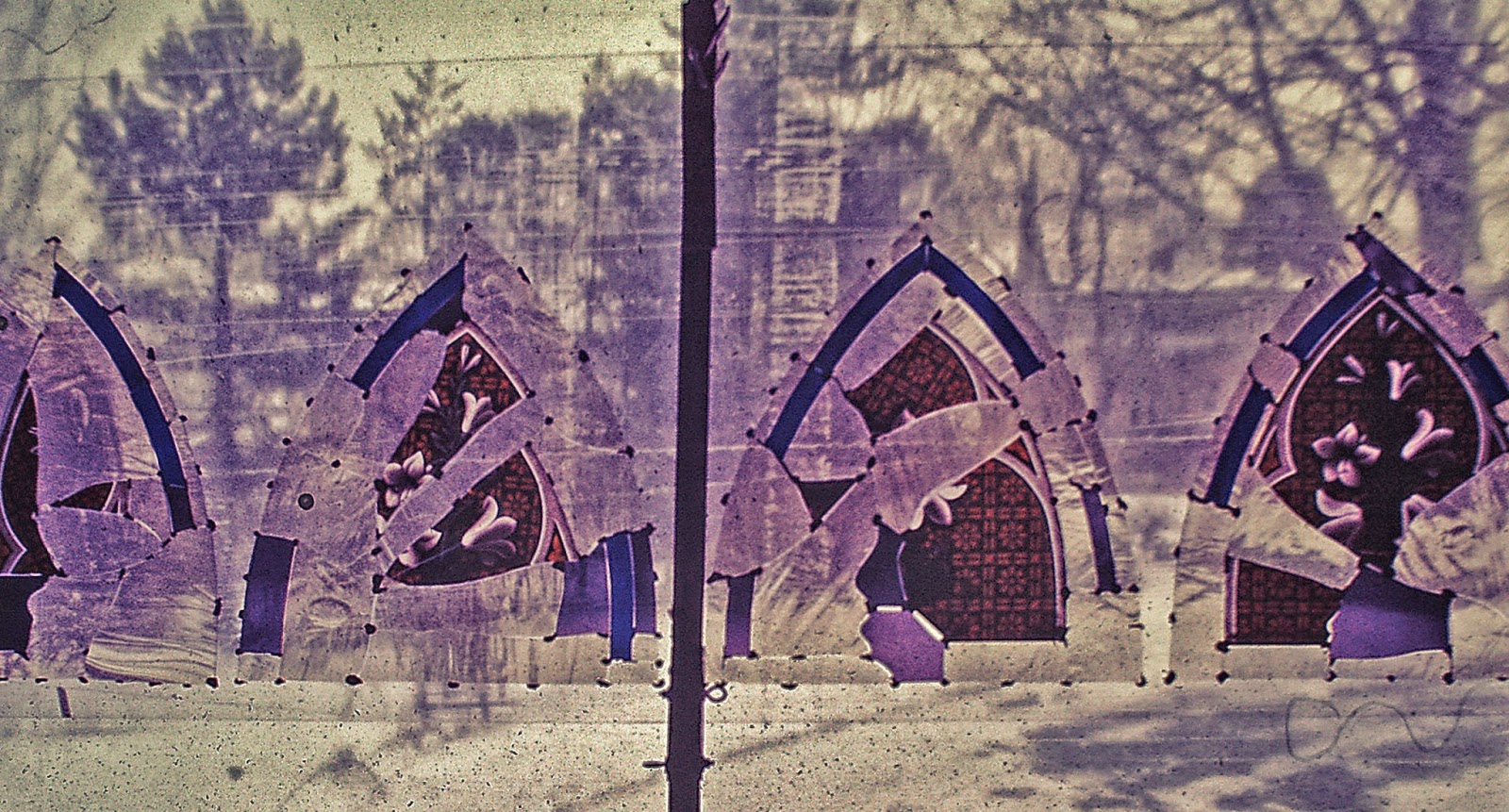
Parts of four lancet-shaped, fire-damaged windows from the Shrine of the Immaculate Conception in Atlanta. The glass is held to a clear glass window with wax. Robert used the old glass with his own glass to produce his new designs for the windows. (Photo courtesy of Robert Pinart)

Pinart designed windows for the Church of St. Anselm in Brooklyn, NY; St Edward the Confessor in Syosset, NY; the Shrine of St. Odilia in Onamia, MN; Queen of Angels Church in Austin, MN; and St. Anthony Shrine in Boston, among others, while at Rambusch.


The windows behind the altar at the St. Anthony Shrine. According to Robert Pinart the small, white petal-like devices in some windows enclose or restrict important scenes or stories for contemplation, while the exploding star-like devices in other windows depict things that cannot be contained in the space of a small window, such as the Alpha and Omega symbols.


A section of the sanctuary windows on a viewing stand in the Rambusch building on 13th Street in Manhattan. At the top right is the story of Cain and Abel. Below it Abraham about to sacrifice Isaac. (Photo courtesy of Robert Pinart)

The stained glass windows behind the second floor altar along with the clerestory windows at the St. Anthony Shrine brought Pinart to national attention when his work was featured on a cover of The Architectural Forum in November 1955. Shortly thereafter Pinart left Rambusch and became an independent stained glass artist/designer. 

Robert obtained his first free-lance commission in 1956--designing windows for St. Luke's Episcopal Parish in Darien, Connecticut as a result of the Architectural Forum cover. Robert continued to design most of the new glass windows in this church over the next twenty years.


The St. Peter, the Annunciation and St. Polycarp windows at St. Luke's Episcopal Parish, Darien, Connecticut.


Pinart’s last window for St. Lukes was a small abstract window for the Sacristy using faceted clear and white glass of varying thicknesses, shapes and textures along with colored glass. “Pinart chose a warm brown glass, as well as clear and white glass to contrast with the smoothness of the brown glass. An abstract pattern, possibly based on a floral motif, includes three large chunks of glass in a pattern, which seems to float. Meditating on the window, one thinks of angels, the Trinity, and the complexity of the natural world." (The Windows of Saint Luke’s Parish, Darien, Connecticut, 1855-2005, book privately published by the church, 2005, p. 40)

His work became known to architects such as Edgar Tafel and Percival Goodman--initially because of the promotional efforts of Jean Nison, and they asked Robert to design the glass for some of their liturgical commissions. 


A picture post card showing Edgar Tafel's Protestant Chapel at JFK Airport.


The main window in the Protestant Chapel at JFK. The chapel was demolished in 1986, and Pinart's windows--he also designed two ceiling windows--may have been stored somewhere. In the 1990s Jean Nison tried to determine if these windows still existed, but she was unsuccessful. No one seems to know where they are. Recently, however, part of this window was pictured on the "Christ for the World" Chapel website: http://www.christfortheworldchapel.org/pages/news.htm.


According to Robert Pinart, this gouache maquette was an early proposed design for the Protestant Chapel window. (Courtesy of Susan and Michael Padwee)

Robert designed the stained glass for the Protestant Chapel at JFK Airport (since demolished) for Tafel, 


A section of an exhibit of Pinart's work held at the Edward Hopper House in Nyack, New York in the 1960s. The small window at the left was made by Robert to show to Edgar Tafel as a color sample of his proposed window for the JFK Protestant chapel. (Photo courtesy of Robert Pinart)

as well as the stained glass in a number of Goodman’s modern Jewish synagogues in the 1950s and 1960s.


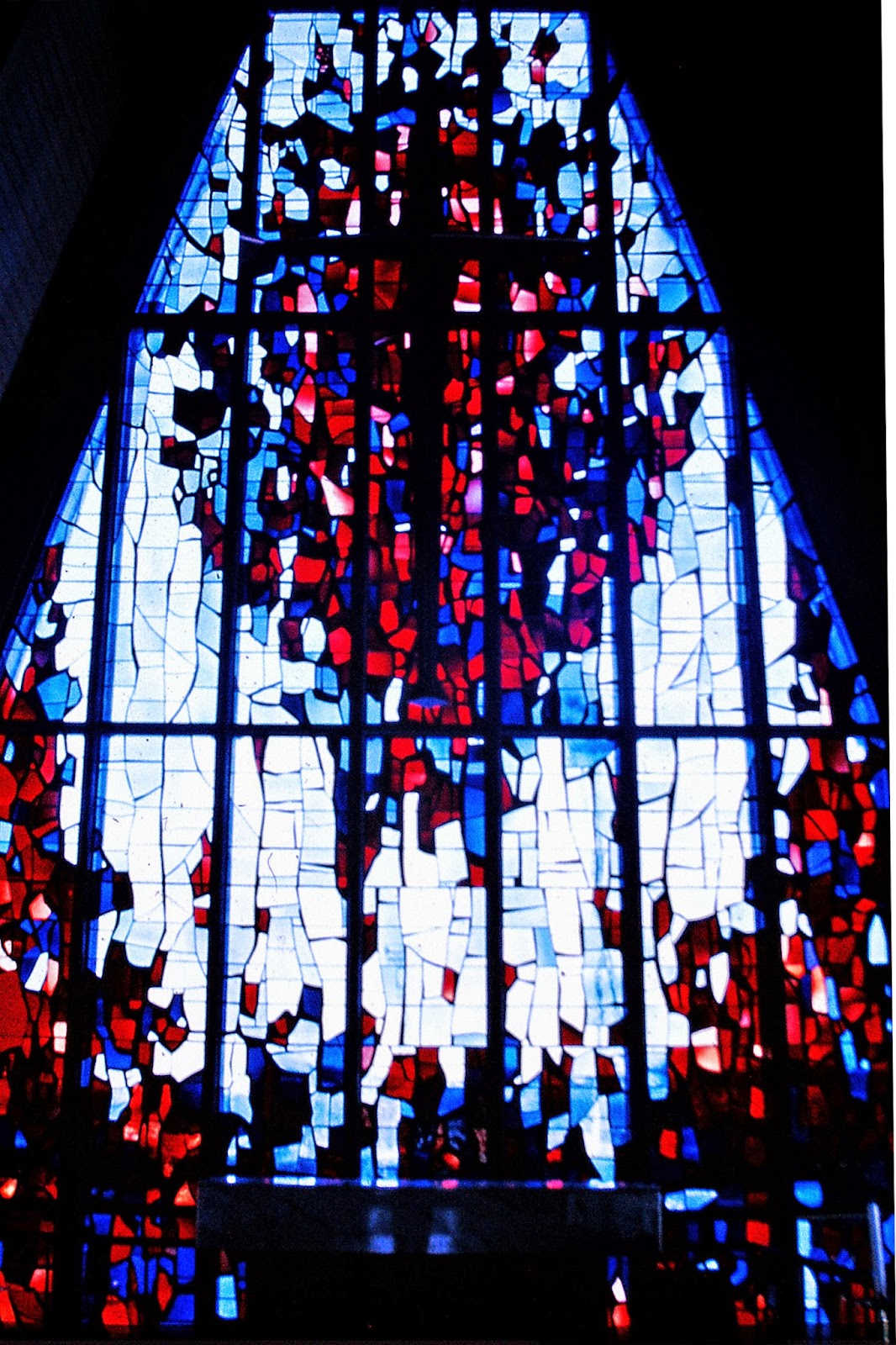
Congregation Shaarey Zedek, Southfield, Michigan (1959-62) was one of Percival Goodman's designs. It rose from flat land and symbolized Mt. Sinai. The 45° dalle de verre windows were designed by Pinart. (Photo from the Shaarey Zedek website; http://www.shaareyzedek.org)


Detail of the dalle de verre windows. (Photo courtesy of Robert Pinart)


Another of Goodman's iconic synagogue designs was Temple Emanuel in Denver, Colorado. Robert designed the dalle de verre sanctuary windows and Ateliers Barillet in Paris fabricated the windows. In addition, Pinart designed a number of weavings, which were woven by Ed Fields, for the Men’s Chapel. According to one synagogue official, the whereabouts of these are unknown.


Behind the Ark. (Photo courtesy of Robert Pinart)


One of four dalle de verre installations surrounding the ark. (Photo courtesy of Robert Pinart)


A wooden maquette of one of the four dalle de verre windows illustrating the exterior, concrete matrix for the window. (Photo courtesy of Robert Pinart)

Robert Pinart also worked with a number of glass studios such as Cummings, J. & R. Lamb, Jean-Jacques Duval and Wilmark (now Nancy Katz/Wilmark) Studios. These studios obtained liturgical commissions, and would ask Pinart to design the windows depending upon the needs of the church or synagogue. Robert also worked on significant repair and replication commissions, such as a damaged Chagall window in Union Church in Pocantico Hills, New York; 


The domes in the Old Executive Office Building. (Photo courtesy of Robert Pinart)

the stained glass domes in the Old Executive Office Building in Washington, DC; and the replication of the stained glass laylight in the Tweed Courthouse rotunda in New York City, which won a 2001 New York City Art Commission design award.


A dalle de verre window installed in the meditation room in the M. L. King, Jr. Student Center at the University of California at Berkeley c. 1962/63. "The window, designed by Robert Pinart..., depicts--in an abstract vocabulary--an angel in a great flash of light." ("California Student Center/Lower Sproul Plaza Historic Structure Report", July 15, 2009, p. 41)  The concrete matrix heightens the play between the darker and lighter portions of the window. The Mayer of Munich stained glass company said their records indicate their company fabricated this window and had it shipped to Berkeley. (Photo courtesy of Robert Pinart)


Pinart's installation of inserts of colored, abstracted, antique musical instruments within translucent panels of  glass (c. 1958). (Photos courtesy of the Department of Music, University of California at Berkeley)


Robert worked in the European crafts tradition that he learned as a young man in the Parisian glass ateliers. 


An early maquette for the Lincoln Bay window commemorating the Civil War in the National Episcopal Cathedral, Washington, DC. (Photo courtesy of Robert Pinart)


Sketch for one of two windows for the Saint Honore Boulangerie Patisserie in Nyack, New York (1986/87). (Courtesy Robert Pinart)

He designed the glass windows after making drawings or maquettes that could be shown to, and discussed with, his clients. 


The center window of three dalle de verre windows for St. Joseph Catholic Church, Wakefield, Massachusetts. The uncut glass sheets at the top are for leaded glass work, not the dalle de verre that Robert was working on. Some of the cut glass pieces for Robert's work--but not all--are laid out on the full-size cartoon. The three chapel windows, fabricated by the Cummings Stained Glass Studios in 1980, are below. (Above photo courtesy of Robert Pinart; photo below courtesy of Merry Nordeen and St. Joseph Church)


He chose the glass he wished to use, and would even travel to Germany for the very best glass if the budget allowed for it. He would cut and shape the glass, after making a full-size cartoon of the window, or he would allow a glazier he trusted to cut the glass according to the cartoon. 


Four of the lancet windows Robert made for the Shrine of the Immaculate Conception, Atlanta, GeorgiaProfessor of Art History Virginia Raguin of Holy Cross University supplied the Cummings Studios with the iconography needed for these, and the other Atlanta windows. (Letter from Virginia Raguin to Robert Pinart, 3 Jan 2000; photo courtesy of Robert Pinart)


Part of a window for Temple Beth El, Charlotte, North Carolina. The glass pieces are held to plate glass with wax and then held up to the light. Robert wanted to see how the glass would look in different types of light before he permanenly bound the glass with epoxy. (Photo courtesy of Mark Liebowitz, Wilmark Stained Glass Studios)

The cut glass would then be attached to clear plate glass with wax, and Robert would paint and stain the glass as needed for the design. 


Robert Pinart painting a window held by wax on an easel at the Cummings Studio in North Adams, Massachusetts in 2000. The window was for Christ Church in Summit, New Jersey. (Photo courtesy of Robert Pinart)


The installed Christ Church window. (Photo courtesy of Rev. Julie Yarborough and Christ Church)

The glass would then be fired in a kiln; either lead cames would be used, or the dalle de verre pieces would be mounted in concrete or an epoxy matrix.


The Morristown (New Jersey) Jewish Center's "Jerusalem" window held to a glass viewing stand with wax at the Wilmark Stained Glass Studios in Pearl River, New York. (Photo courtesy of Robert Pinart)


The Jerusalem window installed (1991).


Although Robert Pinart was known for his liturgical stained glass commissions, he also designed stained glass for private residences. However, while his liturgical work has been fairly well documented, documenting a private commission is much more difficult. A few private commissions were mentioned in different lists of Pinart’s work written by various people over the years. Some of these just said “Langford residence” and gave a city or town name. Also, Robert has spoken to us about some of his private work from time to time, but our knowledge is incomplete.


A dalle de verre window in the Robert Ratcliff residence in Berkeley, California. (Photo c. 1960 at the left courtesy of Jean Nison and Juliana McIntyre; 2015 color photo courtesy of Robert Ratcliff's children, Lucy Pope and Kit Ratcliff)

In the late 1950s Pinart and his wife, Jean Nison, designed dalle de verre windows and a tiled altar and baptismal font for the Shepherd of the Hills Lutheran Church in Berkeley, California. While working on that project, they were invited to dinner at the home of a Berkeley architect, Robert W. Ratcliff. There was a broken glass panel between the dining room and a stairway, and Pinart said he could design a new, abstract stained glass panel for the house. Pinart’s panel is still there and much admired by the current owners, the daughter and son-in-law of Robert Ratcliff. (Telephone conversation with Lucy Pope, 08 Dec. 2014.)


35 Spring Street, Manhattan. (Image from a slide; courtesy of Jean Nison and Robert Pinart)


After Robert’s ex-wife, Jean Nison, bought a townhouse at 35 Spring Street, Manhattan, Robert designed a three-part window to partially block a view of the street traffic. The two side portions of the window opened to the outside, and there was an outer clear glass window protecting the stained glass. Robert said he thought that Jean had the window removed and stored somewhere in the midwest when she sold the townhouse in the early 2000s. (Recorded interview with Robert Pinart, 11 December 2014) We later learned that the windows were slightly damaged, mainly in the lower right quadrant, during a small fire, and they were repaired by Mark Liebowitz (owner of Wilmark Studios) under Robert's direction.


Robert Pinart at 88 with one of a pair of mugs depicting some of his stained glass windows fabricated by Wilmark Studios.

Our hope for the future is to write a monograph about Robert and the artistic influences that helped his creative process. Included will be a catalogue raisonné of his known work at the time and Robert's comments about many of his commissions and the architects and artists with whom he worked.


*****

Susan and I met Robert in the spring of 2014 when I was writing an article about his ex-wife, mid-century-modern ceramic artist Jean Nison. We went to Robert's home to interview him, and after talking with him, we began to visit schools, churches and synagogues where he designed windows; we researched his art work and recorded interviews with him in order to write a monograph about him. Many of the churches and synagogues throughout the country where Robert was commissioned to design windows, sent us photos of Robert's windows, as well as written material about the commissions. Thus far, we've taken two extended trips to photograph his work in New England and in the Southeast and mid-Atlantic states. Robert has also been very generous allowing us to digitize his slides and glass records and sketches for archiving and publication, and we were given a small archive of material to duplicate that was assembled by Jean Nison. We were also given access to the Rambusch archives by Catha and Viggo Rambusch, and to the Wilmark Stained Glass Studios archives by Mark Liebowitz and Nancy Katz. Other stained glass artists, such as Jean-Jacques Duval, C. Z. Lawrence, and Robert Rambusch, were of great help. More recently, we spent a week at the Rakow Research Library in the Corning Museum of Glass going through the Cummings Stained Glass Studio archives--about 604 boxes of uncataloged material. Cummings fabricated about forty of Robert's commissions.


Some of the places you can see Robert Pinart's windows in the New York-New Jersey-Connecticut area are:

St. Anselm's Roman Catholic Church, 356 82nd Street, Brooklyn,
        NY (the side aisle windows in the Sanctuary)
Fifth Avenue Synagogue, 5 East 62nd Street, Manhattan (the oval
        windows on the facade; a painted mural of the flora and fauna
        of Israel has been painted over)
New City Jewish Center, 47 Old Schoolhouse Road, New City, NY
Young Israel of Scarsdale, 1313 Weaver Street, Scarsdale, NY
Morristown Jewish Center, 177 Speedwell Avenue, Morristown, 
        NJ (Chapel)
Christ Church, 561 Springfield Avenue, Summit, NJ
Hackensack UMV at Pascack Valley (chapel), 250 Old Hook
        Road, Westwood, NJ
Temple Sholom (Blumberg Chapel), 594 North Bridge Street,
        Bridgewater, NJ
Temple Beth El of Northern Valley, 221 Schraalenburgh Road,
        Closter, NJ (Chapel and Sanctuary)
St. John the Baptist Church, 69 Valley Street, Hillsdale, NJ 
        (Sanctuary; there is also a metal sculpture on a tiled base in
        the Sanctuary. The tiled base was made by Jean Nison
        according to Robert)
Princeton Junior School, 90 Fackler Road, Lawrenceville, NJ
Congregation B'nai Israel, 2710 Park Avenue, Bridgeport, CT (the   
        old Ark tapestry now in the lobby)
St. Luke's Episcopal Parish, 1864 Post Rd, Darien, CT
Temple Sholom, 300 E. Putnam Avenue, Greenwich, CT (Chapel
       and ten windows in the Sanctuary and adjacent area; Robert
       Sowers designed the main sanctuary windows)
Congregation Mishkan-Israel, 785 Ridge Road, Hamden, CT
       (Sanctuary; Robert's windows were fabricated by his friend,
       Jean-Jacques Duval, who also designed the stained glass
       windows in the Chapel)
St. Luke's Episcopal Church, 111 Whalley Avenue, New Haven,
       CT (two side windows in the Apse, the window over the
       entrance to the Nave, and a pair of windows in the left aisle)


*****

With this article I am broadening the scope of my "Tiles in New York" blog from just architectural tiles, ceramics and terra cotta to also include architectural glass and other architectural ornamentation. This blog, however, will retain its original name and url.


*****

Monday, December 1, 2014

THE MOSAIC ART OF HILDRETH MEIÈRE

A recent traveling exhibit of Hildreth Meière’s work came to New York City from Washington, DC. In Washington the exhibit focused on Meière’s work in that city, and in New York a tour of four buildings with her mosaic work was organized. I was lucky to take the New York tour, along with Susan and Paul Tunick of Friends of Terra Cotta, and photograph three of the sites: Temple Emanu-El, St. Bartholomew’s Episcopal Church and 32 Sixth Avenue.

But, who was Hildreth Meière?


(Photo from: http://www.mosaicartnow.com/2010/12/a-few-of-our-favorite-things-hildreth-meiere/

“Hildreth Meière [1892-1961]...was an integral part of the art deco movement creating drawings, paintings mosaics, leather works, gold leafed objects, and metal sculptures. ...Not only did she put art on the inside of buildings, but on the outside as well.” (http://www.brightestyoungthings.com/articles/hildreth-meiere-epic-mosaics-all-over-the-place.htmMeière was “a distinguished Art Deco muralist, mosaicist, painter and decorative artist, [who is ranked with a] very small number of women artists -- such as Violet Oakley, Berenice Abbott, Isabel Bishop and Georgia O'Keeffe -- whose achievements gained the recognition of the established art world during the first half of [the Twentieth] Century. ...Her major commissions include the Nebraska State Capitol at Lincoln, and the National Academy of Sciences, the Municipal Center and the Resurrection Chapel of the National Cathedral in Washington, DC.  In New York, her most famous designs are the Art Deco plaques on the exterior wall of Radio City Music Hall.  Her work may be found in St. Patrick's Cathedral, St. Bartholomew's Episcopal Church, Temple Emanu-El, and the banking room of The Bank of New York Mellon (formerly the Irving Trust Company) at One Wall Street.  Her murals also appeared in Chicago's 1933 Century of Progress Fair, and the 1939-40 New York World's Fair.  An accomplished ecclesiastical artist, she created numerous altarpieces and stained glass windows.” (http://www.hildrethmeiere.com/Biography.html)

“[What] makes her career most notable was the groundbreaking influence she had as a woman in a time where men dominated every profession. She was the first woman ever appointed to the New York City Art Commission, and she came to found the Liturgical Arts Society in her 57th Street studio in New York, serving as the organization's first president. She served four terms as President of the National Society of Mural Painters; six terms as First Vice President of the Architectural League of New York; Director of the Municipal Arts Society; Director of the Department of Mural Painting at the Beaux Arts Institute of Design; member of the Architectural Guild of America; and a board member of the Art Students League, the Municipal Arts Society, the School Art League, and the Advisory Committee of the Cooper Union Art School, all in New York.” (http://en.wikipedia.org/wiki/Hildreth_Meiere“As the county’s leading practitioner of the art of mosaic, her mural art stands among the most distinguished of her era.” (Don Chandler, “Marie Hildreth Meière 91892-1961) Art Deco Mural Painter and Mosaicist”; http://www.hildrethmeiere.com/Profile.html)


(Color photos courtesy of Michael Padwee unless otherwise noted)


The Nebraska State Capital Building, Lincoln, Nebraska

Meière’s first major commission was the Nebraska State Capital Building (built 1922-1932).


A drawing by Meière from the R. Guastavino Company Archives for a tiled section of the Rotunda Dome. (From:  "Palaces for the People: Guastavino and the Art of Structural Tile",  an exhibit at The Museum of the City of New York, March 26- September 7, 2014; borrowed from the Guastavino/Collins archive, Drawings and Archives, Avery Architectural and Fine Arts Library, Columbia University;  http://findingaids.cul.columbia.edu/ead/nnc-a/ldpd_3463538/summary)

“The architect of the Nebraska State Capital Building, Bertram Goodhue, hired Hildreth Meière to design the mosaic floors, ceilings and walls. The De Paoli Company and the R. Guastavino Company, both of New York, executed Meière's designs: De Paoli in marble and Guastavino in ceramic and "Acustalith" tiles.” (http://www.hildrethmeiere.com/CommissionsNebraskaNE.html)


Hildreth Meière’s design for the R. Guastavino Company-tiled Rotunda Dome.

"Her extensive assignment included designs for the ceilings of the foyer, rotunda, senate, and house chambers, 


The De Paoli Company's marble mosaics on the Rotunda floor.

"the mosaic floor in the foyer and rotunda (patterned after the floors in the Cathedral of Siena);


"the Indian Tapestry in the senate; the leather doors of the house chamber (modeled after the Tree of Life in Assyrian reliefs, with an Egyptian sun-burst); the gold-leaf friezes in the house; and the domes of both the rotunda and the vestibule. 


Some of the Guastavino-tiled wall murals and window arches in the foyer hallway.

"Begun in 1924, Meiere's work on these commissions continued until at least 1932.


"The tile mosaics of Meiere also depend to some extent on antique models. Before deciding on technique, color, and style, she studied floor and wall mosaics in Venice, Ravenna, Siena, and Rome. The influence of such fourth-century art as that in the Basilica of Junius Bassus may be seen in Meiere's use of the technique of opus sectile* and in the bright coloration of the decorations for the dome and foyer. That Meiere was not only a capable designer but also an excellent draughtsman can be seen in the treatment of the figure and its relationship to its surrounding space.


“In comparison to the [painted] murals [on the main floor], the tile mosaics are remarkable for their color. Depending on the space to be decorated - and in many cases the areas seem more decorated than painted - the colors vary from the vestibule to the rotunda. In some areas the color of the limestone on the walls and ceilings forms an integral part of the work itself and serves as the background color for groups of figures." (http://www.nebraskahistory.org/publish/publicat/history/full-text/1974-3-Capitol_Design.pdf; pp. 394, 402-403)


*[“Opus sectile is an art technique popularized in the ancient and medieval Roman world where materials were cut and inlaid into walls and floors to make a picture or pattern. Common materials were marble, mother of pearl, and glass. The materials were cut in thin pieces, polished, then trimmed further according to a chosen pattern. Unlike tessellated mosaic techniques, where the placement of very small uniformly sized pieces forms a picture, opus sectile pieces are much larger and can be shaped to define large parts of the design.”] (http://en.wikipedia.org/wiki/Opus_sectile)


"Surviving documents illustrate the working relationship [between Meière and the Guastavino Company] during the Nebraska project. Meière sent images of her mural designs to the Guastavino Company, which then fired the correct size and color of the various tiles. The elaborate tile finish work required much more extensive scaffolding than usual for the vault builders. ...Befitting Goodhue's scrupulous vision of craftsmanship, the custom tile pieces were cut by hand to size, taking account of the shrinkage which occurred during firing. Due to the meticulous attention to color, many tiles 'required two and three glaze firings at different temperatures.' Despite this great care, 'Hildreth Meière was a perfectionist and rejected many tiles so the manufacture of many extra batches of tiles became a necessity." (John Ochsendorf, Guastavino Vaulting: The Art of Structural Tile, Princeton Architectural Press, New York, 2010, pp. 173-174. [A further discussion of the making of extra tiles for an installation can be found in Richard D. Mohr's article, "Art Tiles in the Prairie School: Part II--Griffin + Mahoney + Teco" in the Journal of the American Art Pottery Association, Winter 2012, Vol. 28, No. 1])


According to the Hildreth Meière website, Meière completed over one hundred commissions throughout the country, a number of which can be seen in the New York City metropolitan area. (http://hildrethmeiere.com/ComissionsByState.html)


32 Sixth Avenue, The Walker-Lispenard Telephone Company Building/The AT&T Long Distance Building (1932)


Facade of 32 Sixth Avenue/Avenue of the Americas.

The lobby of the AT&T Long Distance Building was conceived by the architect of the building's third expansion, Ralph Thomas Walker (1989-1973). Walker designed Art Deco skyscrapers such as the Barclay Vesey Telephone Building at 17th and West Streets and the Western Union Building at 60 Hudson Street, among others, and he believed that a building's lobby should be a "jazzy" and "lively" introduction to the business conducted in the building. To this end he hired Hildreth Meière to design the lobby of 32 Sixth Avenue for AT&T. (From the PBS documentary Treasures of New York: Ralph Walker)

Meière designed the lobby ceiling as you enter the building from the Avenue of the Americas. The lobby ceiling mosaic is titled “The Continents Linked by the Telephone and Wireless” and showed mosaic “lines of communication” connecting four mosaic representations of the continents. 


Meière used “allegorical figures to convey the function of the Long Distance Building as a hub of international communication... . Meière’s mural embodies the exoticism that typifies many Art Deco designs. Two classically inspired female messengers command the center of the ceiling.” (Catherine Coleman Brawer and Kathleen Murphy Skolnik, The Art Deco Murals of Hildreth Meière, Andrea Monfried Editions, New York, 2014, p. 146)


“Over one hovers an eagle; over the other, a condor. Diagonal gold lines representing telephone and telegraph wires connect to regal personifications of four continents reclining at the periphery of the ceiling... .” (Catherine Coleman Brawer and Kathleen Murphy Skolnik, The Art Deco Murals of Hildreth Meière, Andrea Monfried Editions, New York, 2014, p. 146)


Australia


“Australia holds a sheaf of wheat and rests her arm on the back of a sheep while a kangaroo looks on.


Africa

“Africa, holding a fan and accompanied by lions, gestures toward the Great Pyramids.


Asia


”Asia, set against a backdrop of pagodas, is garbed in a kimono and flanked by a tiger and elephant.


Europe


“Finally, a crowned Europe holds a scepter and orb while reclining on an Ionic capital before a Roman aqueduct. The dome of St. Peter’s Basilica in Rome and the towers of Notre Dame in Paris rise in the distance.” (Catherine Coleman Brawer and Kathleen Murphy Skolnik, The Art Deco Murals of Hildreth Meière, Andrea Monfried Editions, New York, 2014, pp. 146-147)


A side hallway ceiling above a bank of elevators. Although it looks as if the ceiling is not flat, that effect is due to the optical illusion in Meière’s mosaic design.


These murals were composed of silhouette glass mosaic with colored cement and were executed by the Ravenna Mosaic Company* in 1932. The silhouette mosaic technique “used glass tesserae [to] form the outline and details of a design that is filled in with colored cement. More economical than solid mosaics, silhouette mosaics were frequently used in the 1930s to reduce the cost of mosaic decoration.” (Catherine Coleman Brawer and Kathleen Murphy Skolnik, The Art Deco Murals of Hildreth Meière, Andrea Monfried Editions, New York, 2014, p. 147)


*[“In the United States, Paul [Heuduck (1882-1972)] helped establish the Ravenna Mosaic Company, a joint endeavor between the St. Louis art glass studio owned by Emil Frei and Puhl-Wagner. The Ravenna Company was founded primarily to work on the Byzantine glass mosaics which were to fill the new St. Louis Cathedral. Under the direction of Gerdt Wagner, Ravenna maintained offices in both New York and St. Louis during its early years. Many of Ravenna's important early commissions were executed in New York, including murals at Rockefeller Center, St. Batholomew's Episcopal Church and Temple Emanu-El. Frei amicably broke with Ravenna in late 1929 or early 1930. In 1935, Arno [Heuduck, Paul’s son], who had studied art at Washington University, joined the company. Paul took full control of Ravenna when, in 1939, Gerdt Wagner abandoned the company to return to Germany, where he became a high-ranking Nazi propagandist.”] (http://archon.slu.edu/?p=collections/findingaid&id=13&q=The St. Louis University Library has a series of explanatory photos on its website illustrating the process of making a mosaic mural by Ravenna. (http://libraries.slu.edu/a/digital_collections/ravenna/process1.htm)


In addition to the ceiling mosaics, Meière also designed a wall mural in the lobby made of ceramic tiles. The tiles pictured a world map and were executed by Continental Clay Products* in 1932. (“Hidden in Plain Sight: Hildreth Meière Sunday, May 18, 2014”--a brochure prepared by Open House New York)

*[Continental Clay Products--of Kittanning, Pennsylvania and Martinsburg, West Virginia--supplied the bricks for 32 Sixth Avenue, as well as the lobby tiles. According to the April 30, 1927 Charleston (WV) Gazette, “[Four] brick manufacturing companies...have been consolidated into the Continental Clay Products Corporation of Delaware... . The new company will acquire all of the fixed properties, sales organizations and trade names of the Kittanning Clay Manufacturing Company, Kittanning, Pa., Williams Grove Brick Company, Bigler, Pa., the Fallston Company, Beaver, Pa., and the Continental Products Company, Martinsburg, W. Va.” (“Four Brick Plants Joined in Merger”, Charleston (WV) Gazette, Saturday, April 30, 1927, p. 7) Continental Clay Products was reorganized in 1933, probably as a result of the Depression.] 


St. Bartholomew’s Episcopal Church, 325 Park Avenue


“Saint Bartholomew's Church in New York City (often known as 'St. Bart's') offers an example of early twentieth-century appreciation of the Byzantine aesthetic. In 1918 the St. Bart's congregation moved from its building at Madison Avenue and 44th Street to a grand structure in the Romanesque style on Park Avenue between 50th and 51st Streets.” (Annie Labatt, “St. Bart’s and Hildreth Meière”; http://www.metmuseum.org/exhibitions/listings/2012/byzantium-and-islam/blog/cultural-connections/posts/saint-bartThe architect for this building was Bertram Goodhue. The original free and simplified Byzantine design by Bertram Goodhue (1916-17)...was somewhat compromised by the requirement that the French Romanesque portal be preserved from the previous church and re-erected on the new site. It...was designed by McKim, Mead, and White (1902-03) and was beloved by the parishioners. The magnificent bronze doors, with bas-reliefs in panels depicting episodes from the Old and New Testaments, had been carried out by some of New York's established sculptors: Andrew O'Connor, working freely under the general direction of Daniel Chester French, executed the main door; the south door was executed by Herbert Adams, the north door by Philip Martiny. The foundation stone of Goodhue's original design, a vast, unified barrel-vaulted space, without side aisles or chapels and with severely reduced transepts, was laid 1 May 1917 and the construction was sufficiently far along for the church to be consecrated in 1918; its design was altered during construction, after Goodhue's sudden, unexpected death in 1924, by his office associates... . [Goodhue’s associates] also inserted the...dome, tile-patterned on the exterior and with a polychrome Hispano-Moresque interior dome, which substituted for the spire that had been planned but never built.” (http://www.nyc-architecture.com/MID/MID034.htm)


The tiled dome of St. Bart’s.


“In 1930, Hildreth Meière...designed a series of mosaics for the narthex and the apse.


(Photo from: http://www.museumplanet.com/image/nyc/bart/bart086.jpg)

"As you walk into St. Bartholomew’s you enter the narthex which has Meière’s Creation mosaics on domes placed from North to South.


Creation: Day 1


Creation: Day 2


Creation: Day 3


Creation: Day 4


Creation: Days 5 and 6 with Day 3 to the left and Day 4 to the right


“For the apse, Meière chose to depict the scene of the Transfiguration, described in the synoptic gospels as the episode in which Christ, accompanied by the apostles Peter, James, and John, goes to the top of a mountain. There, the apostles witness Christ's transfiguration (or ‘metamorphosis,’ in Greek), as well as the appearance of Elijah and Moses, the two Old Testament prophets.


The apse half-dome mosaic: the Transfiguration

"Meière's selection of this scene for the apse was a clear reference to the sixth-century mosaic in Saint Catherine's Monastery at Sinai. ...In both monuments, Christ stands against a golden background surrounded by a mandorla, or almond-shaped ring of bright colors and rays of light. The vivid rays illustrate the emphasis in the synoptic gospels on the brightness and whiteness of Christ. ...The Sinai mosaic shows the apostles literally knocked over by the light emanating from Christ.” (Annie Labatt, “St. Bart’s and Hildreth Meière”; http://www.metmuseum.org/exhibitions/listings/2012/byzantium-and-islam/blog/cultural-connections/posts/saint-bart)


The Grand Mosaic of the Transfiguration in St. Catherine's Monastery: “One work within he Monastery's main church (Katholikon), decorating the sanctuary apse, is particularly notable. The subject of the Transfiguration is very appropriate to this holy site, which is associated with the two instances when God was "seen" by the Prophet Moses and by the Prophet Elijah, the latter of whom had felt God as a light breeze on Mount Horeb, below the Peak of the Decaloque.” (http://www.touregypt.net/featurestories/catherines2.htm)

“Meière’s scene corresponded with a new emphasis [in the Episcopal church] on the theme of immanence, or inherent spirituality, which was also [the architect, Bertram] Goodhue’s central focus for the architecture [of the building]. Although Meière depicted the Transfiguration in a ‘primitive’ Byzantine style, as requested, she injected Art Deco motifs in the sunburst pattern for Christ’s mandorla and in the pale blue and white zigzag lines representing water.” (Catherine Coleman Brawer and Kathleen Murphy Skolnik, The Art Deco Murals of Hildreth Meière, Andrea Monfried Editions, New York, 2014, p. 92)


Art Deco motifs in the almond-shaped mandorla and the blue and white, zig-zag water lines in the Transfiguration mosaic.

Between 1948 and her death in 1961 Meière designed stained glass windows for St. Bartholomew’s. She designed three sets of three windows--the south clerestory windows--and was part way through a third set--the Benedicite window in the north clerestory was the only set completed (1956)--before she died.


“The south windows depict Canticles of Evening Prayer from the 1928 Book of Common Prayer. Each bay [of] three windows..are the Magnificat, Gloria in Excelsis Deo, and Nunc Dimittis. ...As you look at the clerestory windows, you will see that the colorful medallions are surrounded by clear glass, which allows light to stream in. ...The iconography for Meière’s windows was done by Dr. Albert Friend, the well-known Byzantine scholar; the stained glass was manufactured by the Rambusch Studio, with whom Meière had a long-standing relationship. The Byzantine style dictated that all the lettering be in Greek, the original language of the New Testament.” (Becca Earley Richards, Holy Light: The Iconography and History of the Stained Glass of St. Bartholomew’s Church in New York City, self-published, 2007, p. 9)


”The Magnificat (1948): The Magnificat is the song of the Virgin Mary from Luke 1: 46 in which she expresses her thanks in being chosen to bear the Christ Child: ‘My soul doth magnify the Lord.’” (Becca Earley Richards, Holy Light: The Iconography and History of the Stained Glass of St. Bartholomew’s Church in New York City, self-published, 2007, p. 10)

Part of an unpublished manuscript about the history of Rambusch Studios, written by Catha Grace Rambusch, describes the technique that was developed with Hildreth Meière for these windows. "The original glazing, installed under the direction of architect Bertram Goodhue, was monochromatic light grey glass. The effect on the interior was one of subtle diffused mysterious light. The effect of the new windows was to be the same, but subject matter, as opposed to the simple geometric forms of the original temporary glazing was to be introduced.


”Gloria in Excelsis Deo (1949): 'Glory to God in the Highest’ is based on the song the angels sang at Christ’s Nativity, as told in Luke 2: 14.” (Becca Earley Richards, Holy Light: The Iconography and History of the Stained Glass of St. Bartholomew’s Church in New York City, self-published, 2007, p. 12)

"The solution lay in the use of lead cames. Throughout, very inexpensive commercial grey glass was the base. Over it, the design was fabricated exclusively by lead cames of varying thicknesses… . This unique solution allowed the windows to 'read' in daylight and at nighttime. It introduced subject matter while at the same time retained the aura of mystery in the church's interior." (Catha Grace Rambusch, Unpublished manuscript, Chapter 6, p. 62)


"Nunc Dimittis (1955): The Nunc Dimittis is the song of the Temple functionary Simeon, at the Presentation of the Child Jesus in the Temple, Luke 2: 29-32.” (Becca Earley Richards, Holy Light: The Iconography and History of the Stained Glass of St. Bartholomew’s Church in New York City, self-published, 2007, p. 14)


Temple Emanu-El, Fifth Avenue and 65th Street


“Temple Emanu-El, the largest synagogue in the world, has a sanctuary almost 150 feet long and more than 100 feet high. Architects Kohn, Butler and Stein chose the Byzantine style for the interior to complement the Moorish-Romanesque design of the temple’s facade, which symbolizes a mingling of Eastern and Western cultures.


“Design elements throughout the synagogue combine biblical imagery with stylistic traditions from medieval Spain, Eastern Europe, and mid-nineteenth-century Berlin. Mayer, Murray & Phillip, as associate architects, commissioned Meière to design mosaics for the eight-story-high arch of the main sanctuary and for the ark on the eastern wall behind it, where the Torah scrolls are housed.” Catherine Coleman Brawer and Kathleen Murphy Skolnik, The Art Deco Murals of Hildreth Meière, Andrea Monfried Editions, New York, 2014, p. 84)


”Design on vertical band rising from bimah behind main arch,...in glass mosaic...1929. These mosaics “incorporate elements of Art Deco in their flamelike shapes, yet they also contain lozenge and tulip patterns from the East.” (Catherine Coleman Brawer and Kathleen Murphy Skolnik, The Art Deco Murals of Hildreth Meière, Andrea Monfried Editions, New York, 2014, pp. 84, 89)

”Meière’s designs for the arch incorporate Judaic symbols into a wide band of intricate geometric patterns. ...Meière later wrote, ‘The difficulty in working for Temple Emanu-El came in devising geometric patterns which do not contain a cross.’ ...She developed elegant vertical bands of different interlocking patterns in vibrant colors and various shades of gold that sparkle as they rise behind the arch.” (Catherine Coleman Brawer and Kathleen Murphy Skolnik, The Art Deco Murals of Hildreth Meière, Andrea Monfried Editions, New York, 2014, p. 84)


The German firm of Pühl & Wagner was chosen to fabricate and install the mosaics. “The company’s mosaicists had restored several of the Byzantine mosaics in Charlemagne’s Palace in Aachen and made reproductions of mosaics from Ravenna.” (Catherine Coleman Brawer and Kathleen Murphy Skolnik, The Art Deco Murals of Hildreth Meière, Andrea Monfried Editions, New York, 2014, p. 87)


The ark surrounded by mosaics.


These are just three of Hildreth Meière’s installations in the New York City area, many of which can be visited with prior preparation. 


The three Meière metal medallions at the Radio City Music Hall.

Other Meière installations include the three metal medallions on the facade of Radio City Music Hall; the altar in the Lady Chapel of St. Patrick’s Cathedral; the “Eternal Christ Enthroned in Judgement” mosaic in the Seminary of the Immaculate Conception, Huntington, NY; the exterior terra cotta reliefs on St. Mary’s High School, Manhasset, NY; the colored concrete “Stations of the Cross” in the Newark, New Jersey St. Charles Borreomeo Church; and the enameled cabinet doors, “The Shrine of Remembrance”, at St. Thomas Church, One Fifth Avenue, Manhattan. For a list of all Meière’s commissions by state, see http://www.hildrethmeiere.com/ComissionsByState.html


*****

I would like to thank Open House New York (https://www.ohny.org) for organizing the tour of four of Meière’s commissions. I also thank Catha Grace Rambusch and Rambusch Studios for allowing me to use the quote from an unpublished manuscript about the company, which fabricated Meière's stained glass designs for St. Bartholomew's

*****

Recommended Reading:

Catherine Coleman Brawer and Kathleen Murphy Skolnik, The Art Deco Murals of Hildreth Meière, Andrea Monfried Editions, New York, 2014.

Catherine Coleman Brawer, Curator, Walls Speak: The Narrative Art of Hildreth Meière, The Regina A. Quick Center for the Arts, St. Bonaventure University, St. Bonaventure, NY, 2009.


Becca Earley Richards, Holy Light: The Iconography and History of the Stained Glass of St. Bartholomew’s Church in New York City, self-published, 2007.