|
| Robert Pinart examining one of his abstract expressionist windows, "Tshuvah", in the New City (New York) Jewish Center in 2014. (Color photos courtesy of Michael Padwee unless otherwise noted) |
An Introduction to the Stained and Dalle de Verre Glass Art of Robert Pinart
Susan Ingham Padwee and Michael Padwee
Robert Pinart was an active stained and dalle de verre glass artist and designer for over fifty-five years--from the late 1940s until 2008, and he claims he never retired. He completed about one hundred fifty stained and dalle de verre glass commissions across the country including about twenty windows in the National Episcopal Cathedral, and has had his work included in many exhibitions of architectural stained glass. In 1993 Pinart received the very first Lifetime Achievement Award from the Stained Glass Association of America and had been selected as one of the inaugural ten Senior Advisors for the American Glass Guild. (http://www.michiganstainedglass.org/collections/studiosartist.php?id=17-82-47)
 |
| "Growth of a Nation" in the Washington Bay and "The Civil War" in the Lincoln Bay of the National Episcopal Cathedral (1976-78). |
Pinart was known as one of the best colorists and painters of stained glass in the United States during the last half of the 20th century. He was an abstract expressionist glass artist, and he was one of the first to use dalle de verre in the United States. He characterized the period when he began to work in the United States as very challenging to a stained glass artist. This was an era of “new” types of religious architecture, stained glass designs, and materials used. He believes that glass artists, like himself, were given an unprecedented amount of creative freedom.
 |
| Jean Nison and Robert Pinart, 1956. (Photo courtesy of Robert Pinart) |
In 1954 Life magazine published an article about French expatriate artists in New York: “a postwar generation of French artists interested in New World opportunity have been quietly heading for New York where they have taken up their Left Bank lives.” ("A Left Bank in New York”, Life, Vol. 37, No. 17, October 25, 1954, pp. 123-124, 126) One of those featured was Robert Pinart (b. 1927, Paris), a stained glass artist, who, at that time, worked for the design firm Rambusch Decorating Company, which made windows for churches throughout the United States.
 |
| A maquette of Robert Pinart’s window, probably made for Église Notre-Dame-de-l'Assomption de Bruyères. The window is possibly the “Finding in the Temple-Zeal,” one of the "joyful" rosary mysteries, completed when he worked for Max Ingrand. Ingrand was commissioned to design windows for this church in 1950. (Photo courtesy of Robert Pinart) |
Prior to emigrating to the United States in 1951, Pinart “received his stained glass training in the studios of three well known French stained glass artists: Max Ingrand (1908-1969), Auguste Labouret (1871-1964), and then he free-lanced for Jean Barillet (1912-1997). These studios were involved with the post-World War II movement to restore 13th to 17th century windows damaged by the war or removed from churches prior to the war and stored in caves. Because of the scope of deterioration Robert received a foundation in stained glass work which was unusual for such a young person. As a neophyte stained glass artist in postwar Europe, Pinart worked to restore the stained glass of the Basilica of Saint Quentin, Northeast of Paris, among others.
“Ingrand, Labouret and Barillet were also on the cutting edge of the post-war modernistic art movement in Europe which they, and others, 'translated' into stained glass. These efforts picked up momentum immediately after World War II as replacement stained glass windows were needed in war torn areas of Germany, France and England. It was this aspect of his instructors -- and the modernist art movement -- that greatly influenced the personal artwork and stained glass of Robert Pinart.” (http://www.michiganstainedglass.org/collections/studiosartist.php?id=17-82-47)
Labouret was an innovator of a new method in making stained glass windows: the stained glass slab partitioned by cement, dalle de verre, in the 1930s. (After World War II various epoxy mixes were used instead of cement, which could create structural problems.) “[Labouret] sought a combination of modern strength and durability with a depth of color found in old glass. The thickness, broken surface and cut edge gives dalle de verre its characteristically rich translucence. The negative matrix area that frames each pane of glass is visually much heavier than the lead in ordinary windows. This characteristic...enriches the color by creating a great contrasting brilliance. This juxtaposition of brilliant color and dark surrounds can be painstakingly achieved in flat leaded glass by elaborately painting or by a combination of etching and painting of flashed glass. Dalle de verre lends itself best to direct and vigorous design. It is a broad medium that, generally, does not encourage copious detail.” (http://stainedglass.org/?page_id=169)
Labouret designed the 240 stained glass windows for the Basilica of Sainte Anne de Beaupré near Quebec City beginning in 1939 and continuing after World War II until 1950. Robert Pinart designed the “Beatitudes” windows in the Basilica, which were made by the dalle de verre process. (Shawn Waggoner, “Renewing Himself...Always: Designer and Colorist Robert Pinart”, Glass Art, Vol. 27, No. 1, January/February 2011, p. 8; and, http://www.sanctuairesainteanne.org/index.php?lang=en&Itemid=201; and conversation with Robert Pinart) Pinart said that this commission first brought him to Canada, and then to the United States in 1951, where he settled and became a citizen.
Robert Pinart began his career in the United States by first working briefly for the stained glass studio, Payne-Spiers, in Paterson, New Jersey and then working for the Rambusch Decorating Company on 13th Street in Manhattan. He remained at Rambusch from 1952 until 1956. “It was at Rambusch Studios where Pinart gained a background for his future liturgical work. The studio worked on numerous churches and synagogues, and this honed Pinart’s sense of design as he was allowed to decide personally on the width of the lead, the quality of the glass, and then he could add the painted details.” (http://www.michiganstainedglass.org/collections/studiosartist.php?id=17-82-47)
 |
| The Adam and Eve/Creation window from St. Anselm's Catholic Church in Brooklyn, New York. The negative image on the left is courtesy of the Rambusch Decorating Company archives. |
Robert has said that he was grateful to Harold Rambusch, the head of the company, because he gave Robert the freedom to design and paint the glass on his own. Harold Rambusch was open to new ideas, and was influential in bringing a new generation of stained glass artists to the public's attention.
 |
| One of ten windows Robert designed for St. Edward the Confessor Catholic Church in Syosset, New York, "St. Edward Sent to Normandy at Age of 10 Years." The image on the right is the window after a fire destroyed the church (and Robert's windows) in 2000. When we visited in 2014, a number of artists were being considered to design windows for the new church building. We were told that some of Robert's salvaged glass might be incorporated into the new windows. This is what Robert did when he designed new windows for the Shrine of the Immaculate Conception in Atlanta, Georgia in the 1980s after a fire destroyed some of their windows. (Photos courtesy of St. Edward the Confessor Church) |
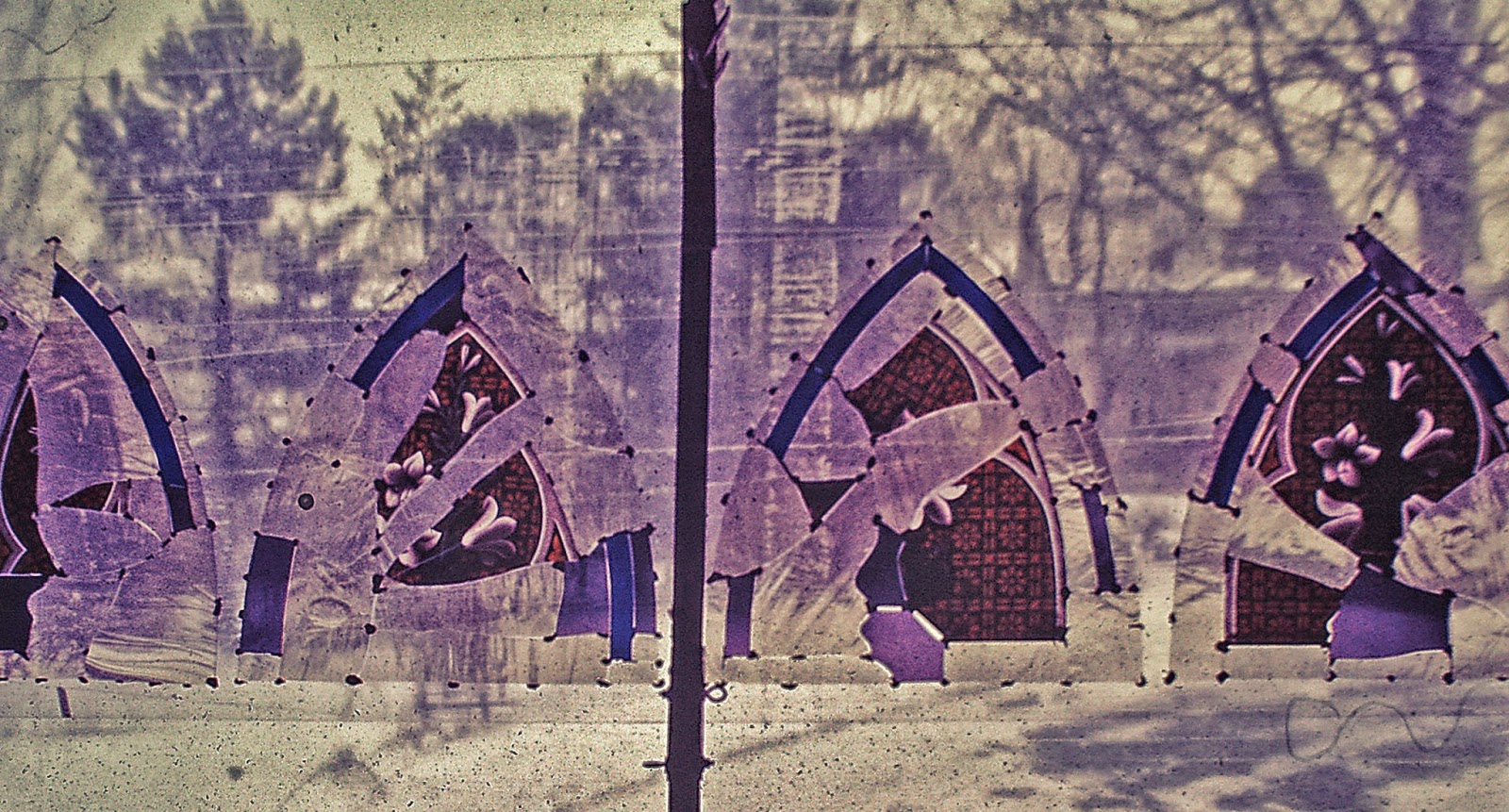 |
| Parts of four lancet-shaped, fire-damaged windows from the Shrine of the Immaculate Conception in Atlanta. The glass is held to a clear glass window with wax. Robert used the old glass with his own glass to produce his new designs for the windows. (Photo courtesy of Robert Pinart) |
Pinart designed windows for the Church of St. Anselm in Brooklyn, NY; St Edward the Confessor in Syosset, NY; the Shrine of St. Odilia in Onamia, MN; Queen of Angels Church in Austin, MN; and St. Anthony Shrine in Boston, among others, while at Rambusch.
 |
| The windows behind the altar at the St. Anthony Shrine. According to Robert Pinart the small, white petal-like devices in some windows enclose or restrict important scenes or stories for contemplation, while the exploding star-like devices in other windows depict things that cannot be contained in the space of a small window, such as the Alpha and Omega symbols. |
 |
| A section of the sanctuary windows on a viewing stand in the Rambusch building on 13th Street in Manhattan. At the top right is the story of Cain and Abel. Below it Abraham about to sacrifice Isaac. (Photo courtesy of Robert Pinart) |
The stained glass windows behind the second floor altar along with the clerestory windows at the St. Anthony Shrine brought Pinart to national attention when his work was featured on a cover of The Architectural Forum in November 1955. Shortly thereafter Pinart left Rambusch and became an independent stained glass artist/designer.
Robert obtained his first free-lance commission in 1956--designing windows for St. Luke's Episcopal Parish in Darien, Connecticut as a result of the Architectural Forum cover. Robert continued to design most of the new glass windows in this church over the next twenty years.
 |
| The St. Peter, the Annunciation and St. Polycarp windows at St. Luke's Episcopal Parish, Darien, Connecticut. |
 |
| Pinart’s last window for St. Lukes was a small abstract window for the Sacristy using faceted clear and white glass of varying thicknesses, shapes and textures along with colored glass. “Pinart chose a warm brown glass, as well as clear and white glass to contrast with the smoothness of the brown glass. An abstract pattern, possibly based on a floral motif, includes three large chunks of glass in a pattern, which seems to float. Meditating on the window, one thinks of angels, the Trinity, and the complexity of the natural world." (The Windows of Saint Luke’s Parish, Darien, Connecticut, 1855-2005, book privately published by the church, 2005, p. 40) |
His work became known to architects such as Edgar Tafel and Percival Goodman--initially because of the promotional efforts of Jean Nison, and they asked Robert to design the glass for some of their liturgical commissions.
 |
| A picture post card showing Edgar Tafel's Protestant Chapel at JFK Airport. |
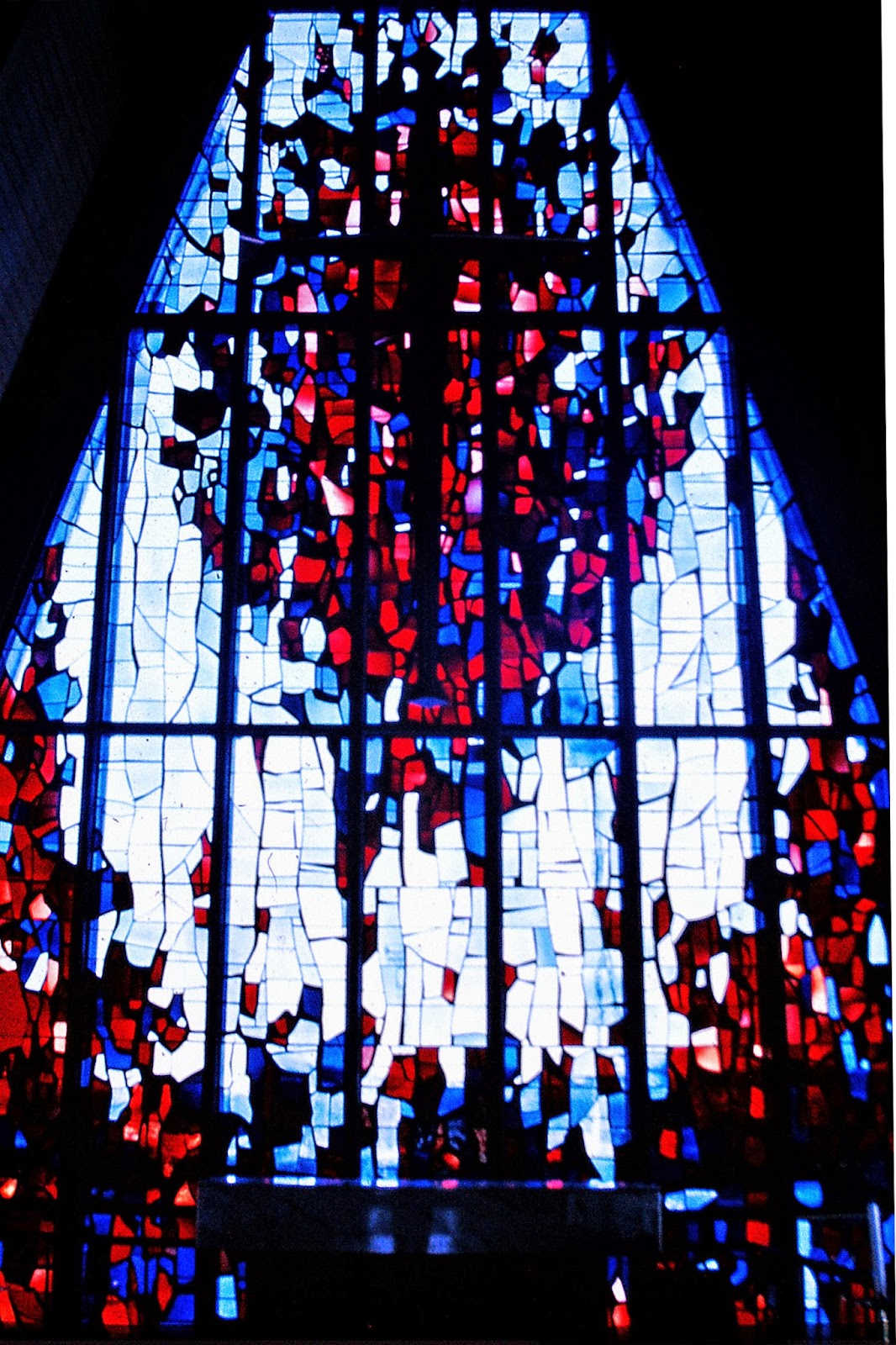 |
| The main window in the Protestant Chapel at JFK. The chapel was demolished in 1986, and Pinart's windows--he also designed two ceiling windows--may have been stored somewhere. In the 1990s Jean Nison tried to determine if these windows still existed, but she was unsuccessful. No one seems to know where they are. Recently, however, part of this window was pictured on the "Christ for the World" Chapel website: http://www.christfortheworldchapel.org/pages/news.htm. |
 |
| According to Robert Pinart, this gouache maquette was an early proposed design for the Protestant Chapel window. (Courtesy of Susan and Michael Padwee) |
Robert designed the stained glass for the Protestant Chapel at JFK Airport (since demolished) for Tafel,
 |
| A section of an exhibit of Pinart's work held at the Edward Hopper House in Nyack, New York in the 1960s. The small window at the left was made by Robert to show to Edgar Tafel as a color sample of his proposed window for the JFK Protestant chapel. (Photo courtesy of Robert Pinart) |
as well as the stained glass in a number of Goodman’s modern Jewish synagogues in the 1950s and 1960s.
 |
| Congregation Shaarey Zedek, Southfield, Michigan (1959-62) was one of Percival Goodman's designs. It rose from flat land and symbolized Mt. Sinai. The 45° dalle de verre windows were designed by Pinart. (Photo from the Shaarey Zedek website; http://www.shaareyzedek.org) |
 |
| Detail of the dalle de verre windows. (Photo courtesy of Robert Pinart) |
Another of Goodman's iconic synagogue designs was Temple Emanuel in Denver, Colorado. Robert designed the dalle de verre sanctuary windows and Ateliers Barillet in Paris fabricated the windows. In addition, Pinart designed a number of weavings, which were woven by Ed Fields, for the Men’s Chapel. According to one synagogue official, the whereabouts of these are unknown.
 |
| Behind the Ark. (Photo courtesy of Robert Pinart) |
 |
| One of four dalle de verre installations surrounding the ark. (Photo courtesy of Robert Pinart) |
 |
| A wooden maquette of one of the four dalle de verre windows illustrating the exterior, concrete matrix for the window. (Photo courtesy of Robert Pinart) |
Robert Pinart also worked with a number of glass studios such as Cummings, J. & R. Lamb, Jean-Jacques Duval and Wilmark (now Nancy Katz/Wilmark) Studios. These studios obtained liturgical commissions, and would ask Pinart to design the windows depending upon the needs of the church or synagogue. Robert also worked on significant repair and replication commissions, such as a damaged Chagall window in Union Church in Pocantico Hills, New York;
 |
| The domes in the Old Executive Office Building. (Photo courtesy of Robert Pinart) |
the stained glass domes in the Old Executive Office Building in Washington, DC; and the replication of the stained glass laylight in the Tweed Courthouse rotunda in New York City, which won a 2001 New York City Art Commission design award.
 |
| A dalle de verre window installed in the meditation room in the M. L. King, Jr. Student Center at the University of California at Berkeley c. 1962/63. "The window, designed by Robert Pinart..., depicts--in an abstract vocabulary--an angel in a great flash of light." ("California Student Center/Lower Sproul Plaza Historic Structure Report", July 15, 2009, p. 41) The concrete matrix heightens the play between the darker and lighter portions of the window. The Mayer of Munich stained glass company said their records indicate their company fabricated this window and had it shipped to Berkeley. (Photo courtesy of Robert Pinart) |
 |
| Pinart's installation of inserts of colored, abstracted, antique musical instruments within translucent panels of glass (c. 1958). (Photos courtesy of the Department of Music, University of California at Berkeley) |
Robert worked in the European crafts tradition that he learned as a young man in the Parisian glass ateliers.
 |
| An early maquette for the Lincoln Bay window commemorating the Civil War in the National Episcopal Cathedral, Washington, DC. (Photo courtesy of Robert Pinart) |
 |
| Sketch for one of two windows for the Saint Honore Boulangerie Patisserie in Nyack, New York (1986/87). (Courtesy Robert Pinart) |
He designed the glass windows after making drawings or maquettes that could be shown to, and discussed with, his clients.
 |
| The center window of three dalle de verre windows for St. Joseph Catholic Church, Wakefield, Massachusetts. The uncut glass sheets at the top are for leaded glass work, not the dalle de verre that Robert was working on. Some of the cut glass pieces for Robert's work--but not all--are laid out on the full-size cartoon. The three chapel windows, fabricated by the Cummings Stained Glass Studios in 1980, are below. (Above photo courtesy of Robert Pinart; photo below courtesy of Merry Nordeen and St. Joseph Church) |

He chose the glass he wished to use, and would even travel to Germany for the very best glass if the budget allowed for it. He would cut and shape the glass, after making a full-size cartoon of the window, or he would allow a glazier he trusted to cut the glass according to the cartoon.
 |
| Four of the lancet windows Robert made for the Shrine of the Immaculate Conception, Atlanta, Georgia. Professor of Art History Virginia Raguin of Holy Cross University supplied the Cummings Studios with the iconography needed for these, and the other Atlanta windows. (Letter from Virginia Raguin to Robert Pinart, 3 Jan 2000; photo courtesy of Robert Pinart) |
 |
| Part of a window for Temple Beth El, Charlotte, North Carolina. The glass pieces are held to plate glass with wax and then held up to the light. Robert wanted to see how the glass would look in different types of light before he permanenly bound the glass with epoxy. (Photo courtesy of Mark Liebowitz, Wilmark Stained Glass Studios) |
The cut glass would then be attached to clear plate glass with wax, and Robert would paint and stain the glass as needed for the design.
 |
| Robert Pinart painting a window held by wax on an easel at the Cummings Studio in North Adams, Massachusetts in 2000. The window was for Christ Church in Summit, New Jersey. (Photo courtesy of Robert Pinart) |
 |
| The installed Christ Church window. (Photo courtesy of Rev. Julie Yarborough and Christ Church) |
The glass would then be fired in a kiln; either lead cames would be used, or the dalle de verre pieces would be mounted in concrete or an epoxy matrix.
 |
| The Morristown (New Jersey) Jewish Center's "Jerusalem" window held to a glass viewing stand with wax at the Wilmark Stained Glass Studios in Pearl River, New York. (Photo courtesy of Robert Pinart) |
 |
| The Jerusalem window installed (1991). |
Although Robert Pinart was known for his liturgical stained glass commissions, he also designed stained glass for private residences. However, while his liturgical work has been fairly well documented, documenting a private commission is much more difficult. A few private commissions were mentioned in different lists of Pinart’s work written by various people over the years. Some of these just said “Langford residence” and gave a city or town name. Also, Robert has spoken to us about some of his private work from time to time, but our knowledge is incomplete.
 |
| A dalle de verre window in the Robert Ratcliff residence in Berkeley, California. (Photo c. 1960 at the left courtesy of Jean Nison and Juliana McIntyre; 2015 color photo courtesy of Robert Ratcliff's children, Lucy Pope and Kit Ratcliff) |
In the late 1950s Pinart and his wife, Jean Nison, designed dalle de verre windows and a tiled altar and baptismal font for the Shepherd of the Hills Lutheran Church in Berkeley, California. While working on that project, they were invited to dinner at the home of a Berkeley architect, Robert W. Ratcliff. There was a broken glass panel between the dining room and a stairway, and Pinart said he could design a new, abstract stained glass panel for the house. Pinart’s panel is still there and much admired by the current owners, the daughter and son-in-law of Robert Ratcliff. (Telephone conversation with Lucy Pope, 08 Dec. 2014.)
 |
| 35 Spring Street, Manhattan. (Image from a slide; courtesy of Jean Nison and Robert Pinart) |
After Robert’s ex-wife, Jean Nison, bought a townhouse at 35 Spring Street, Manhattan, Robert designed a three-part window to partially block a view of the street traffic. The two side portions of the window opened to the outside, and there was an outer clear glass window protecting the stained glass. Robert said he thought that Jean had the window removed and stored somewhere in the midwest when she sold the townhouse in the early 2000s. (Recorded interview with Robert Pinart, 11 December 2014) We later learned that the windows were slightly damaged, mainly in the lower right quadrant, during a small fire, and they were repaired by Mark Liebowitz (owner of Wilmark Studios) under Robert's direction.
 |
| Robert Pinart at 88 with one of a pair of mugs depicting some of his stained glass windows fabricated by Wilmark Studios. |
Our hope for the future is to write a monograph about Robert and the artistic influences that helped his creative process. Included will be a catalogue raisonné of his known work at the time and Robert's comments about many of his commissions and the architects and artists with whom he worked.
*****
Susan and I met Robert in the spring of 2014 when I was writing an article about his ex-wife, mid-century-modern ceramic artist Jean Nison. We went to Robert's home to interview him, and after talking with him, we began to visit schools, churches and synagogues where he designed windows; we researched his art work and recorded interviews with him in order to write a monograph about him. Many of the churches and synagogues throughout the country where Robert was commissioned to design windows, sent us photos of Robert's windows, as well as written material about the commissions. Thus far, we've taken two extended trips to photograph his work in New England and in the Southeast and mid-Atlantic states. Robert has also been very generous allowing us to digitize his slides and glass records and sketches for archiving and publication, and we were given a small archive of material to duplicate that was assembled by Jean Nison. We were also given access to the Rambusch archives by Catha and Viggo Rambusch, and to the Wilmark Stained Glass Studios archives by Mark Liebowitz and Nancy Katz. Other stained glass artists, such as Jean-Jacques Duval, C. Z. Lawrence, and Robert Rambusch, were of great help. More recently, we spent a week at the Rakow Research Library in the Corning Museum of Glass going through the Cummings Stained Glass Studio archives--about 604 boxes of uncataloged material. Cummings fabricated about forty of Robert's commissions.
*****
*****
Here's the link to a related New York Times article by Eve M. Kahn: http://www.nytimes.com/2015/09/04/arts/design/a-stained-glass-artist-enjoys-a-renaissance.html?ribbon-ad-idx=4&rref=arts/design&module=Ribbon&version=context®ion=Header&action=click&contentCollection=Art%20%26%20Design&pgtype=article.
And another link to a downloadable pdf file for educational/non-profit use only: http://tileresearcharticles.omeka.net/items/show/41.
And another link to a downloadable pdf file for educational/non-profit use only: http://tileresearcharticles.omeka.net/items/show/41.
Some of the places you can see Robert Pinart's windows in the New York-New Jersey-Connecticut area are:
St. Anselm's Roman Catholic Church, 356 82nd Street, Brooklyn,
NY (the side aisle windows in the Sanctuary)
Fifth Avenue Synagogue, 5 East 62nd Street, Manhattan (the oval
windows on the facade; a painted mural of the flora and fauna
of Israel has been painted over)
New City Jewish Center, 47 Old Schoolhouse Road, New City, NY
Young Israel of Scarsdale, 1313 Weaver Street, Scarsdale, NY
Morristown Jewish Center, 177 Speedwell Avenue, Morristown,
NJ (Chapel)
Christ Church, 561 Springfield Avenue, Summit, NJ
Hackensack UMV at Pascack Valley (chapel), 250 Old Hook
Road, Westwood, NJ
Temple Sholom (Blumberg Chapel), 594 North Bridge Street,
Bridgewater, NJ
Temple Beth El of Northern Valley, 221 Schraalenburgh Road,
Closter, NJ (Chapel and Sanctuary)
St. John the Baptist Church, 69 Valley Street, Hillsdale, NJ
(Sanctuary; there is also a metal sculpture on a tiled base in
the Sanctuary. The tiled base was made by Jean Nison
according to Robert)
Princeton Junior School, 90 Fackler Road, Lawrenceville, NJ
Congregation B'nai Israel, 2710 Park Avenue, Bridgeport, CT (the
old Ark tapestry now in the lobby)
St. Luke's Episcopal Parish, 1864 Post Rd, Darien, CT
Temple Sholom, 300 E. Putnam Avenue, Greenwich, CT (Chapel
and ten windows in the Sanctuary and adjacent area; Robert
Sowers designed the main sanctuary windows)
Congregation Mishkan-Israel, 785 Ridge Road, Hamden, CT
(Sanctuary; Robert's windows were fabricated by his friend,
Jean-Jacques Duval, who also designed the stained glass
windows in the Chapel)
St. Luke's Episcopal Church, 111 Whalley Avenue, New Haven,
CT (two side windows in the Apse, the window over the
entrance to the Nave, and a pair of windows in the left aisle)
*****
With this article I am broadening the scope of my "Tiles in New York" blog from just architectural tiles, ceramics and terra cotta to also include architectural glass and other architectural ornamentation. This blog, however, will retain its original name and url.
*****