A blog about architectural tiles, terra cotta and other ceramic surfaces, architectural glass and ornamentation in and around New York.

Showing posts with label Ehrich. Show all posts

Wednesday, November 1, 2017

Bits and Pieces: Updates for the Lever House, the Kesner Building and 2116 Ditmas Avenue, Brooklyn and an obituary

ROBERT PINART (1927-2017), Maître de verre vitrail


We are saddened to report that our friend, stained and dalle de verre glass artist Robert Pinart, died on October 1. 


Robert Pinart in Chartres, 1950s


Robert had been in deteriorating health for some time, and after ninety years his body was laid to rest in Gethsemane Cemetery in Congers, New York. His spirit and art will live on, however, in the stained and dalle de verre glass windows he designed for synagogues, churches, schools and residences throughout the United States and Canada. 


BITS AND PIECES

Every so often I receive a message about one of my blogs. Usually, someone has new information about a subject I’ve written about that significantly adds to that conversation. Below are two of these updates, and a third piece about a building that relates to a previous blog.

Jean Nison’s Fireplace Surround for Lever Brothers


(Photo taken and edited from: Jean Nison, "Fantasies in Tile", Craft Horizons, Vol. 13, No. 3, May-June 1953, p. 36+; edited by the author)

In my article about the mid-century modern ceramic tile artist, Jean Nison, I mentioned that she was commissioned to create a tile installation in the Lever Brother’s Boardroom in New York City’s landmarked Lever Building. According to Nison, she visited decorators, left tiles with them and hoped they would call her. This was how, she believed, Raymond Lowey Associates, the industrial design firm, asked her to make a wall decoration for Lever House, at that time the headquarters of Lever Brothers Corporation (now Unilever). I contacted the curator of the Lever House Art Collection, Mr. Richard Marshall, but he had no information about the fate of Nison's tile installation. Unilever Corporation moved out of the building in the 1980s, and may have taken the tiles with them. A request to Unilever for information, however, went unanswered.


Two of the tile designs from the Lever Brothers Boardroom fireplace surround illustrating the color scheme of the installation. (From the Mobile Museum of Art: Jean Nison, American, born in Egypt of French parents [sic]. Lever House, NYC, (Boardroom Tiles) (framed pair), c. 1952. Ceramic, Size 6 x 6 in. Gift of Eric M. and Joy Hart. G2005.21.13)

After reading my article, the Chief Curator of the Mobile (AL) Museum of Art, Paul Richelson, contacted me. Two tiles from the Boardroom Fireplace in Lever House had been donated to the Mobile Museum by Eric M. and Joy Hart in 2005. Either these were extra tiles that were not used in the installation, or the installation was removed when Unilever moved from Lever House to Connecticut and tiles were boxed and given to some of the executives. In either case, tiles from this installation may still exist.


To prove my point, a recent ebay auction listed a “replica” boxed tile of one of the donated Lever Brothers' fireplace tiles. Nison must have made extras to sell at Lever House as the box indicates.


The Restoration of the Hartford Faience Tiles on the Kesner Building (695-709 Sixth Avenue)


In 2010 I took photos of the Hartford Faience tiles on the Ehrich Brothers Emporium/J. L. Kesner Building, which is located between 22nd and 23rd Streets on the west side of Sixth Avenue in Manhattan.


The photos I used in my June 2015 blog were taken in 2000 and 2010, and many tiles were in poor condition--some even with holes drilled through them.


I again passed by the Kesner Building in 2014, and much of the street-level facade was obscured by ongoing construction. At that time I thought that whatever was happening would only further destroy the tilework on the facade. I was wrong!


The Sixth Avenue entrance to the Kesner Building with two pier columns of restored tiles.


"A restoration team from Jablonski Building Conservation, Inc. [...restored] the facade of 105 W 22nd Street/695-709 Sixth Avenue. Xsusha Flandro, Senior Conservator, was kind enough to explain the process:

'The tiles are glazed ceramic tiles manufactured by the Hartford Faience Company... . The current building was erected in phases between 1889 and 1911. The tiles are ca. 1913 when Chicago business man J.L. Kesner (hence the 'K' on the tile columns) leased the building and submitted plans for alteration to the first floor store fronts. Oddly enough Kesner was never in the building as he backed out of the lease, but since the construction plans were already submitted the Ehrich Brothers (owners of the building) went through with the building plans and completed the tile columns. The building is a contributing member to the Ladies Mile Historic District.

'A lot of prep work goes into the restoration of tiles. The first thing we did were cleaning tests. We completed small cleaning test samples and then based on results proceeded with the most gentle and effective of the cleaners tested to clean all the tiles. We also tested paint strippers (all pH neutral – not acidic and not alkaline – because harsh strippers can damage the glazes) in the same manner as the cleaners because some columns had graffiti and general over paint. After cleaning and paint removal we moved into removing abandoned anchors (where signage and such had been attached over the years). Then we moved into patching. We utilized a repair system manufactured by Edison Coatings out of Connecticut. Edison Coatings provided us with custom colored patch repair material for each color of glaze, after the patching was complete the patches are sanded and shaped to the correct profile, and then in-painted (only painted where the patch is) using a polyurethane paint system (also by Edison Coatings) custom colored to the glazes on the tiles. This is where the artistry comes in and we blend the colors onsite to match the adjacent historic tile glazes. No coating is placed over the work after we are finished, as everything we use is specifically manufactured for outdoor use.


Three views of the cleaning and in-painting of the tile work. (Photos courtesy of Jablonski Building Conservation, Inc., http://jbconservation.com/index.html)


'In this project we are conserving nine tile columns. All missing tiles or tiles which we could not successfully conserve are being replaced with custom tiles, manufactured by Shenfeld Studios, to match the existing. It took us approximately three weeks to complete all the conservation work on site. The replacement tiles are still a few months out.

'Ms. Flandro noted that the work requires extensive training.

'To be an architectural conservator you have to have a Master’s degree in Historic Preservation – and usually in the conservation sector of historic preservation, which is where you gain a lot of your materials knowledge. Similar to how art conservators go through school and then specialize in one material, we go through school and specialize in building materials. In our company in order to progress past junior conservator we are required to apply to be a Professional Associate with the American Institute of Conservation (of which I hold PA status and the owner of Jablonski Building Conservation, Mary Jablonski, is a Fellow.) AIC – Professional Associate requires at very least 3 years’ experience and your previous projects/works are peer reviewed and letters of recommendation are required.'”(1)


2116 Ditmas Avenue, Brooklyn


(Clockwise from UL) 2116 Ditmas Avenue facade; main entrance; painted tilework on both sides of entrance(2); from foyer looking into the lobby. (Photo credits: Michael Padwee)

Recently, while on an errand in the East Flatbush and Ditmas Park sections of Brooklyn, I passed by an apartment house that caught my eye because of some architectural elements on its facade, parts of which had been painted over. On closer inspection of the entranceway I saw what looked like 12” x 12” tiles, which had also been partially obscured by paint. The building had been constructed in 1935 according to New York City records, but there was no indication of an architect.
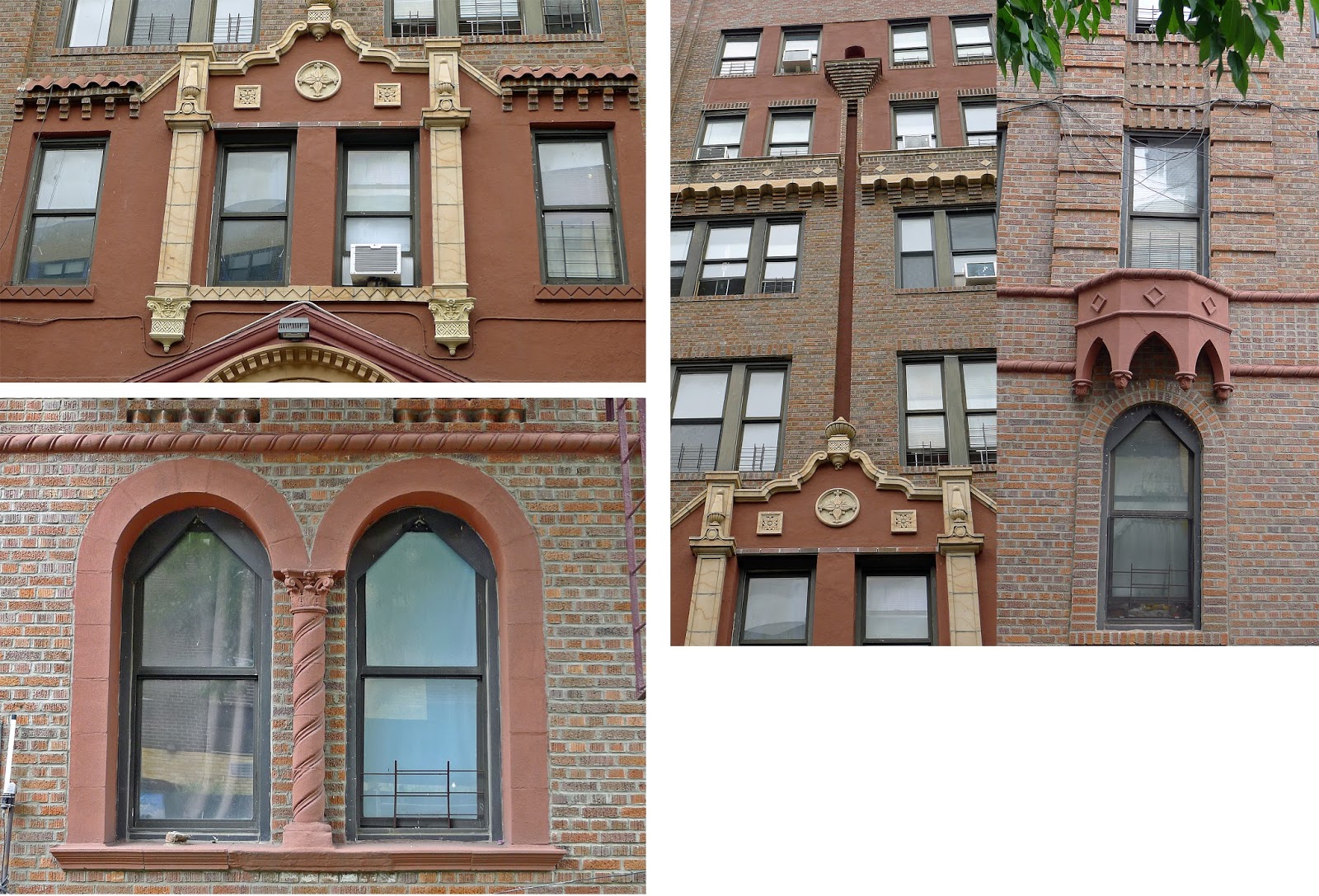


Terra cotta ornamentation on the exterior facade of 2116 Ditmas Avenue, Brooklyn. (Photo credits: Michael Padwee)


I entered the ground floor foyer and lobby, both of which had tile floors, as well as other wall decorations.


Five interior decorative wall elements in the building lobby. The column separating the two niches echoes the column and windows decoration on the facade. (Photos: Michael Padwee)

The foyer and lobby floors were composed mainly of hexagonal tiles with square and rectangular border tiles. There were at least seven hexagonal designs interspersed throughout the floors.


Some of the hexagonal insert tiles above were previously identified as Batchelder tiles in my October 1, 2013 blog post, “Ernest Batchelder in Manhattan”.

Ernest Batchelder's tile company in Pasadena, California, and later, Los Angeles, produced many craftsman-style tiles that were used in building construction throughout the country. I wrote of the use of Batchelder floor tiles in Manhattan apartment buildings, and published an article about the tiles in the RKO Keith's theater in Flushing, Queens in my October 2013 blog. I suspect there are many more such buildings throughout the city as Batchelder did have a showroom in Manhattan for architects and the construction industry, among others.


NOTES:

(1) http://www.newyorkitecture.com/restoration-in-progress/. Permission to reprint Ms. Flandro's remarks granted by Mary Jablonski, the president and founder of Jablonski Building Conservation, Inc. 
(2) This 12” square tile is Stock #97, page 18 in Batchelder Tiles: A Catalog of Hand Made Tiles, Batchelder-Wilson Company, Los Angeles, California, Fourth Edition, 1923. (Reprinted by the Tile Heritage Foundation in the 1990s.) 


Acknowledgements

My thanks to the following for their help with these articles: Paul Richelson, Chief Curator of the Mobile (AL) Museum of Art; Mary Jablonski, Executive Director of the Jablonski Building Conservation, Inc.; Robert Shenfeld of Shenfeld Studios.


*****
LINKS TO MY PAST BLOG ARTICLES


"The Commercial and Personal Art Tiles of Rafael Guastavino, Jr." (Part I)
read more...

"Art Deco Commercial Architecture: Montgomery Ward’s Mid-Size Department Stores"
read more...

"Tessellations: Islamic Tile Patterns and M.C. Escher"
read more...

"Grant's Tomb, the Community and the Gaudi-esque benches of Pedro Silva" AND A request for help
read more...

"A Factory As It Might Be" and the 2016 Ortner Preservation Awards
read more... 


The Atlantic Terra Cotta Company and the Beginnings of Polychrome Terra Cotta Use
read more...

Bits and Pieces: The Brooklyn-Battery Tunnel and following up on the James N. Gamble House and the Charles Volkmar Overmantle Mural

Art Deco Buildings and Their Lobbies: the Chrysler Building, the Film Center Building and the Kent Garage/Sofia Brothers Storage Warehouse

ARCHITECTURAL MURALS OF LUMEN MARTIN WINTER and a REPORT ON THE EMPIRE STATE DAIRY BUILDING

The Heart of the Park: Bethesda Terrace and its suspended Minton Tile ceiling

A Landmarks hearing was held on July 19, 2016...

Two Restorations: The City Hall Subway Station and the Tweed Courthouse

Egyptian, Moorish and Middle Eastern Ornamentation Used In Art Deco Terra Cotta in New York City, and Empire State Dairy Update
Wall Murals in Brooklyn: A Mini Survey

Inside Prospect Park: The park's Rustic, Classical and other Internal Architecture

Herman Carl Mueller in Titusville and Trenton, New Jersey; A Charles Volkmar Discovery in Clifton, New Jersey

A Book Review and New Discoveries and Updates-II: Jean Nisan, Ceramic Tile Artist

Polychrome Terra Cotta Buildings in Newark, New Jersey

New Discoveries-I: The Tiled House of Jere T. Smith

Introducing the Stained and Dalle de Verre Glass Art of Robert Pinart

Bits and Pieces: Polychrome Terra Cotta- and Tile-Clad Buildings

Socialist and Labor Architecture and Iconography in New York City

Bits and Pieces: Two Mosaics--Hamden, CT and Manchester, NH

The Renaissance Casino and Ballroom Complex in Harlem: Another Tunisian Tile Installation Headed for Demolition

Clement J. Barnhorn and the Rookwood Pottery

The Woolworth Building

The Mosaic Art of Hildreth Meière

Lost Tile Installations: The Tunisian Tiles of the Chemla Family

The Grueby Children's Murals on East 104th Street

The Experimental Lustre Tiles of Rafael Guastavino, Jr.

Bits and Pieces: Two "E"s--Eltinge and Elks; and more about Jean Nison

The Ceramic Tiles and Murals of Jean Nison

Pleasant Days in Short Hills: A Rookwood Wonderland

Architectural Ceramics in the Queen City

Isaac Broome: Innovation and Design in the Tile Industry after the Centennial Exhibition

"Immigration on the Lower East Side": A Public Arts Mural Created by Richard Haas

Movie Palaces-Part 2: The Loews 175th Street Theatre

Béton-Coignet in New York: The New York and Long Island Coignet Stone Company

Michelin House, London

Movie Palaces, Part 1: Loew's Valencia Theatre

An Architectural and Ceramic Tour of Istanbul - Part II

The Tiles of Fonthill Castle

An Architectural and Ceramic Tour of Istanbul - Part I

Tiled Facades in Madrid

Nineteenth Century Brooklyn Potteries

Ernest Batchelder in Manhattan

Leon Victor Solon: Color, Ceramics and Architecture

Architectural Art Tiles in Reading, Pennsylvania

Charles Lamb and Charles Volkmar

Kansas City Architecture - II

Kansas City Architecture - I

Westchester County--Atwood and Grueby

Modern Houses in New Caanan, Connecticut

PPG Place, Pittsburgh

Aluminum City Terrace, New Kensington, Pennsylvania

Newark's WPA Tile Murals: “Fine Art is an Important Part of Everyday Life”

Public Art Programs in New York City: The CETA Tile Murals at Clark Street

Concrete and Tiles-I: Moyer, Mercer, Murosa

The Café Savarin and the Rookwood Pottery; Chocolate Shoppe Rebounds

Architectural Ceramics of Henry Varnum Poor

Herman Carl Mueller and the Church of St. Thomas the Apostle

Meet Me at the Astor

The Mikvah Under 5 Allen Street; "Historic Hall" Apartments Revisited

London Post-3

Some Moravian Tile Sites in New York

London Post-2

London Post-1

Brooklyn's International Tile Company

Subway Tiles-Part III, the Squire Vickers Era

Subway Tiles-Part II, Heins and LaFarge

Subway Tiles--Part I, Guastavino tiles

Trent in New York-Part III, Historic Hall Apartment House

American Encaustic Tiling Company-Part II, Artists' Tiles

Trent in New York-Part II, a Dey Street Restaurant

American Encaustic Tiling Company-Part I, Tile Showrooms

Trent in New York-Part I, The Bronx Theatre

Fred Dana Marsh's Tiles

*****


About this blog:

This is a non-commercial, educational blog. Content is compiled/written by Michael Padwee and all opinions expressed herein are my own, or quoted, and are offered without intending to harm any person or company.

I fact-check as carefully as possible before posting and try diligently to cite sources of text and photos that are not my own.

I reserve the right to edit content—either add or delete material—as I see fit.

If you find a broken link on this blog, please contact me at mpadwee'at'gmail.com.

I do not accept anything of value to write about products or businesses. If I recommend a product or a company, it is strictly not for profit.

Permission is granted to link back to this site. In fact, link backs are appreciated.

Offensive comments or spam will be deleted. I reserve the right to decide what is considered offensive.

I am not responsible, nor will I be held liable, for blog comments. Writers of comments take full responsibility for their content.

I reserve the right to remove comments asking for appraisals or trying to sell items. (Click on "comments" in the section below to leave a comment.)


Monday, June 1, 2015

Bits and Pieces: Polychrome Terra Cotta- and Tile-Clad Buildings


While wandering around New York City taking photos of architectural ceramics and glass, I’ve come across many buildings with facades clad with polychrome terra cotta or tiles, or buildings with fragments of terra cotta that only hint at what they once were. Below are some of these buildings.


226 East 70th Street, Manhattan


Entrance to 226 East 70th Street, Manhattan. Manufacturer unknown. (Color photos courtesy of Michael Padwee unless otherwise noted.)

A search of the Office for Metropolitan History’s New Building Database for Manhattan shows that in 1927 the architect, Joseph Martine (of 1482 Broadway), designed this building for Leo Bernstein of the Bruitford (sic: should be Brentford) Realty Company. The building is a six-story brick tenement, 125’ wide by 100’ deep. (http://www.metrohistory.com/dbpages/NBresults.lasso?-MaxRecords=10&-SkipRecords=20922)  The owner obtained a Certificate of Occupancy, No. 14429, in 1928.

The front double-door entrance of this building is flanked by spiraling terra cotta columns topped by a semi-circular terra cotta panel.


Very little is known about the architect, but The Brooklyn Daily Eagle wrote about “Joseph Martine,...who has designed many of Brooklyn’s newest houses as well as hundreds on Long Island and in Westchester County.” (“Suggests Newlyweds Plan 6-Room House To Be Only Temporarily Two-Family”, The Brooklyn Daily Eagle, April 7, 1929, p. G3)


Ehrich Brothers Emporium/J. L. Kesner Building, Manhattan
(695-709 Sixth Avenue)


This building was designed in 1889 by the architect William Schickel as the Ehrich Brothers Emporium. The Ehrich Brothers store closed in 1911 and the building passed to Chicago merchants J.L. Kesner Company. Architects Taylor & Levi added new storefronts with Arts and Crafts style pilasters with terra cotta tile panels sporting the initial "K". The tiles were made by the Hartford Faience Company. Kesner moved from the building in 1913 (http://www.nyc-architecture.com/SOH/SOH054.htm), and the building is currently occupied by Staples and the Burlington Coat Factory. The building is within the Ladies Mile Historic District and has an elegant cast iron facade. The Kesner Building is built in the Renaissance Revival tradition. There is some damage to the tiles due to neglect.


A tiled storefront and pilaster in 2000.


Two closeup photos of the pilaster tiles (courtesy of Michael Padwee), and one of a damaged pilaster showing holes cut through the tiles. (Photo: http://billywoerner.wordpress.com/2010/05/06/walking-home-midtown-to-park-slope-may-5th-2010/)

The Hartford Faience Company was located in Hartford, Connecticut. This company was founded in 1894 as the Atwood Faience Company by Eugene Atwood, who had been a partner of William H. Grueby in Boston. (Susan J. Montgomery, The Ceramics of William H. Grueby, Arts and Crafts Quarterly Press, Lambertville, NJ, 1993, pp. 13-16) 


The Ambassador Apartments, Staten Island
(30 Daniel Low Terrace)


(Photo from Jan Somma-Hammel, “Cool Spaces: Staten Island's Ambassador Arms, an Art Deco classic with star-studded history”, Staten Island Advance, September 15 and 19, 2014; http://www.silive.com/homegarden/index.ssf/2014/09/cool_spaces_staten_islands_amb.html)

In the mid-1990s I worked on Staten Island. A few blocks from my office (and from the ferry terminal) was an apartment building at 30 Daniel Low Terrace in the St. George/Fort Hill neighborhood (http://forgotten-ny.com/2009/02/st-georgefort-hill-staten-island/) near Belmont Avenue, the Ambassador Apartments.


The street was named for a member of one of the early families that settled the area. The art-deco style gold, blue, white and pink terra cotta panels above the entrance and the first floor windows were possibly manufactured by the Atlantic Terra Cotta Company of Staten Island and Perth Amboy, New Jersey. The building was built in 1932 and designed by the architect Lucien Pisciotta. The lobby of the building still has the original tilework and fireplace ornamentation. (http://www.silive.com/homegarden/index.ssf/2014/09/cool_spaces_staten_islands_amb.html)


Terra cotta at roof line; terra cotta ornamentation on facade; lobby tiles and fireplace ornament. (Photos from Jan Somma-Hammel, “Cool Spaces: Staten Island's Ambassador Arms, an Art Deco classic with star-studded history”, Staten Island Advance, September 15 and 19, 2014; http://www.silive.com/homegarden/index.ssf/2014/09/cool_spaces_staten_islands_amb.html)


The Park Plaza Apartments, Bronx
(1005 Jerome Avenue)


The Park Plaza Apartments. (http://en.wikipedia.org/wiki/File:Park_Plaza_Apts_1001_Jerome_Av_jeh.jpg, photo taken by "Jim.henderson" in March 2011) 

In the Bronx, in the shadow of the original Yankee Stadium, stand the “Park Plaza Apartments [which] were one of the first and most prominent art deco apartment buildings erected in the Bronx in New York City. The eight-story, polychromatic terra cotta embellished structure at 1005 Jerome Avenue and West 164th Street was designed by Horace Ginsberg and Marvin Fine and completed in 1931. It is an eight story building divided into five blocks or sections, each six bays wide. There are about 200 apartments, ranging from one to five rooms." (http://en.wikipedia.org/wiki/Park_Plaza_Apartments_(New_York)


"[…The] most unusual architecture-related imagery can be found on the Park Plaza... . 


"A terra-cotta panel depicts a kneeling figure symbolically offering a skyscraper before an architectural alter on which the Parthenon is placed! 


"Additional polychrome plaques showing the city skyline and the rising sun also embellish this 1929-31 building." (Susan Tunick, Terra-Cotta Skyline: New York's Architectural Ornament, Princeton Architectural Press, New York, NY, 1997, p. 98)


The polychrome terra cotta was installed between 1929 and 1931, but it is not known which company manufactured the terra cotta. These buildings were listed as a New York City landmark in 1981 and in the National Register of Historic Places in June 1982 under reference number 82003346.


753-755 Flushing Avenue/738 Broadway, Brooklyn

There is a building at 755 Flushing Avenue in Brooklyn, just off Broadway and across Flushing Avenue from Woodhull Hospital, that has the remnants of polychrome terra cotta cladding. Much of the remaining terra cotta is obscured by signage, and I believe some of the terra cotta may have been removed in the past.


It is not known if the "TFC" tiling is original to the building or a result of one of the renovations.

Currently, this is a pharmacy. In the 1990s it was a fast food restaurant. The building, 753-755 Flushing Avenue, goes through the block at an angle to another entrance at 738 Broadway. A Certificate of Occupancy from 1929 shows renovations to this building completed by Stuckert & Leo, architects. And another CofO from 1951 shows more alterations to the Flushing Avenue exterior. The terra cotta manufacturer is unknown to me.


The polychromed terra cotta tiling rises from halfway up the inner doorposts (753 and 755 Flushing Avenue) and extends around the entryway arches.


There is at least one course of tiling that runs from the 755 entryway to the 753 entryway above the arches, but this is obscured by the signage on the building. Originally there may have been additional terra cotta on the upper floors of the building, but there is no proof of this at this time.


713-723 Nostrand Avenue/855-859 Sterling Place, Brooklyn


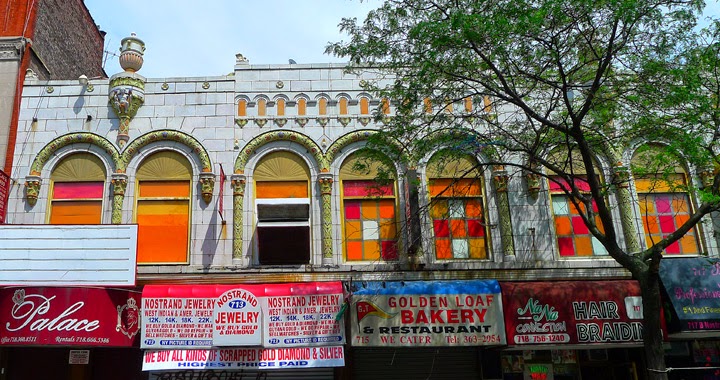
The building is “clad in  buff brick and terra cotta under a parapet with urns over bosses comprised of acroteria accentuated with puti; polychrome terra cotta cladding with baroque-inspired figural and foliated ornament; arched second-story windows with bundled polychromatic terra-cotta surrounds, some with decorative bosses.” (National Register of Historic Places Registration Form, Crown Heights North Historic District, August 14, 2013, Section 7, p. 127)

A corner building located at 713-723 Nostrand Avenue exhibits baroque polychrome terra cotta cladding. “The property is a two story retail building consisting of 7 units located on Nostrand Avenue between Sterling Place and Park Place. It is on a highly trafficked block in the Crown Heights section of Brooklyn.” (http://www.loopnet.com/Listing/17425948/713-723-Nostrand-Avenue-Brooklyn-NY/)  This building is further described in the Crown Heights Historic District II Designation Report: “Commercial buildings [in the district]...include the two-story building at 713 Nostrand Avenue..., which was designed by Isaac Kallich and completed c. 1929 [New Building # 2387-29]. Although its ground floor has been altered, this building’s second floor is a lively and fantastical display of Baroque Revival design, executed in polychrome terra cotta. Like the movie palaces of the time, which were often designed in freely adapted versions of exotic historical styles, this building was a place of amusement, constructed as a bowling alley and billiard hall.” (New York City Landmarks Commission, Crown Heights North Historic District II Designation Report, Edited by Mary Beth Betts, June 28, 2011, p. 30)


“Isaac Kallich [d. 1962] studied architecture in Odessa, Russia and completed his training at New York University. He practiced architecture in New York City for over fifty years and headed the firm of Kallich & Weinstein in Brooklyn.” (Crown Heights North Historic District II Designation Report, p. 522)  The New York Times has numerous articles that mention apartment buildings and single residences built in Manhattan, Queens and Brooklyn during the 1930s-50s, all designed by Isaac Kallich or his firm.


The Philadelphian Sabbath Cathedral/Kameo Theatre 
(530 Eastern Parkway, Brooklyn)


The Philadelphian Sabbath Cathedral, started out “...as the Cameo Theater in February of 1924. ...In 1925, the Loew’s chain took over the theater and renamed it the Kameo. It remained a movie theater until 1974, after which it was sold to the church. Although it needs to have the grime of the city removed, the terra-cotta ornament is well preserved and highly unusual. The structure of the roof theater remains as well. Inside, the church has preserved many of the original details. ...The architect, Eugene Wiseman, was a veteran theater architect." (http://www.brownstoner.com/blog/2010/08/building-of-the-112/#530-ep1-1)  


A suggested terra cotta facade for a theater in which advertising space becomes part of the artistic composition of the building. (National Terra Cotta Society, Architectural Terra Cotta Brochure Series, Volume Two, The Theatre,  1915, frontispiece and p. 20)

As in most of the above buildings, we do not know the manufacturer of the terra cotta, but the facade illustrates one of a number of suggestions made by the National Terra Cotta Society in 1915 for a terra cotta theater facade.


Thomson (or Thompson) Meter Company/Eskimo Pie Building, Brooklyn (100-110 Bridge Street)


“The Thompson Meter Company Building is located on the southwest corner of Bridge and York Streets in the DUMBO (Down Under the Manhattan Bridge Overpass) area of Community District 2, Brooklyn. ...The landmark building housed a manufacturer of disk water meters and later was acquired by the New York Eskimo Pie Corporation...in 1926. [The c]ompany founder, John Thompson, is credited with inventing the disk water meter that was only one of four types approved by the Commissioner of Water Supply in New York.” (City Planning Commission, March 24, 2004/Calendar No. 33, N 040295 HKK, “In the Matter of a communication dated February 19, 2004, from the Executive Director of the Landmarks Preservation Commission regarding...”, pp. 1-2)


The building displays a fairly early use in New York of polychromatic glazed terra cotta in order to add elaborate and colorful decorations to the plain concrete exterior. “Designed by Ecole des Beaux-Arts educated Louis Jallade*, the Thomson Meter Company Building incorporates the innovative reinforced concrete construction system developed by French engineer François Hennebique** in 1892. Relatively rare in New York City, the system permitted large, open and flexible interiors that must have been extremely handy in the manufacturing of the Thomson’s disk water meters. Jallade purposefully left the exterior structural concrete unclad so as to highlight this new, modern material – presaging the exploration and celebration of industrial materials later used extensively in the Modern Movement. However, on the building’s spandrels, Jallade incorporated extraordinary and colorful terra cotta ornament which gives the building a classical feel.


"The polychrome terra cotta reflects the design of many French buildings, both in its placement against the concrete background and in the use of motifs, such as chestnut leaves, which were prevalent in France. Of particular note are the terra cotta cartouches at the building’s corners, bearing the linked letters T and M for the building’s original owners. Today, the Thomson Meter Company Building is the best example of a terra cotta and concrete structure in New York City, if not the entire East Coast.” (“Statement of the Historic Districts Council, December 9, 2003, Regarding the Thomson Meter Company Building, 100-110 Bridge Street; http://www.hdc.org/testimonydec9.htm) 


*[Louis Jallade (1876-1957) “had come to the United States in 1877 and had been naturalized in 1897. He was a student in the New York Latin School from 1886 - 1892 and then studied in the Metropolitan Museum of Art Schools from 1892 to 1896. After three years in the ateliers of the Beaux-Arts Society in New York, Jallade went to Paris to study in the Ecole des Beaux-Arts (1901-1903) in the Atelier Laloux. Upon his return to the States, Jallade entered the office of Allan & Collins in Boston and was placed in charge of construction for the Union Theological Seminary in New York. By the end of 1906, however, he had set out on his own and constructed an illustrious career with a concentration on YMCA buildings (Norfolk, VA; Newport, RI; Roanoke, VA; Worcester, MA; Allentown, PA; McKeesport, PA; Hartford, CT; Passaic, NJ). In addition to a great number of YMCA structures, Jallade undertook a general practice that included churches, college buildings, hospitals, factories, hotels, garages, residences, schools, and libraries.” (http://www.philadelphiabuildings.org/pab/app/ar_display.cfm/51969)]


**[François Hennebique (1842-1921) “was a French engineer and self-educated builder who patented his pioneering reinforced-concrete construction system in 1892, integrating separate
elements of construction, such as the column and the beam, into a single monolithic element. The Hennebique system was one of the first appearances of the modern reinforced-concrete method of construction. Hennebique had first worked as a stonemason, later becoming a builder, with a particular interest in restoration of old churches. Hennebique's Béton Armé system started out by using concrete as a fireproof protection for wrought iron beams, on a house project in Belgium in 1879. He realised however, that the floor system would be more economic if the iron were used only where the slab was in tension, relying on the concrete in the compression areas. His solution was reinforced concrete – a concrete slab with steel bars in its bottom face. His business developed rapidly, expanding from five employees in Brussels in 1896, to twenty-five two years later when he moved to Paris.” (http://en.wikipedia.org/wiki/François_Hennebique)]  

It is my hope that those who read this will look up when walking around their city or town. See what types of ornamentation the architects and builders have used on their buildings to catch the eye of the beholder.


FURTHER READING:

In a previous blog post I discussed some of the color theories that were important to the architectural terra cotta industry. The books below also discuss the use of color in architecture, among other topics.

Susan Tunick, Terra-Cotta Skyline, Princeton Architectural Press, Princeton, NJ, 1996.
“Terra-Cotta Skyline presents the history, manufacture, and art of architectural terra cotta through documents, drawings, archival photographs, and brilliant new color images commissioned for this book. Lively accompanying text based on extensive research provides anecdotes and insights into the working methods of the architects, sculptors, and artisans who designed with terra cotta -- and the entrepreneurs and laborers involved in its production.” (http://www.preserve.org/fotc/skyline.htm) 

Regina Lee Blaszczyk, The Color Revolution, MIT Press, Cambridge, MA, 2012. 
"In this book, the award-winning historian Regina Lee Blaszczyk traces the relationship of color and commerce, from haute couture to automobile showrooms to interior design, describing the often unrecognized role of the color profession in consumer culture. Blaszczyk examines the evolution of the color profession from 1850 to 1970… ."

A newly published article that illustrates the use of ceramics in New York City architecture by Garth Clark, "The New Ceramic Art Gotham", can be accessed at: https://cfileonline.org/commentary-garth-clark-the-new-ceramic-art-gotham/?mc_cid=2a85101104&mc_eid=ce20ac39ad


ADDITIONAL RESOURCES:

Now that Christopher Gray has retired his weekly “Streetscapes” column in The New York Times, we have lost what was probably the best continuously-written source of information about the history of architecture in New York City.  All of Mr. Gray’s “Streetscapes” columns have been digitized, however, and a listing is available here

Daytonian in Manhattan is an historical/architectural blog that discusses historic buildings in Manhattan. it is written by Tom Miller, a transplant from Dayton, Ohio.


Forgotten New York is a blog by Kevin Walsh that calls attention to the artifacts of a disappearing or long-gone New York.

Hiatus

My "Tiles in New York" blog will be on vacation this summer. It will resume in September with an expanded focus. Besides architectural ceramics, the blog will post articles about architectural glass and other architectural ornamentation. Over the summer we will be continuing our research for a monograph/catalogue raisonné about the stained glass artist Robert Pinart. My September posting will be an introduction to the architectural glass art of Robert Pinart.