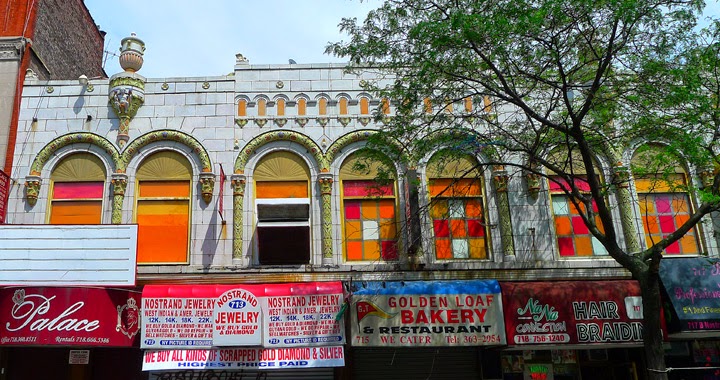
A blog about architectural tiles, terra cotta and other ceramic surfaces, architectural glass and ornamentation in and around New York.

Showing posts with label Grueby. Show all posts

Thursday, September 16, 2021

The Art-Deco Aztec Ballet Tiles of Agustín Lazo and the Brooklyn Bridge Grueby Eagles

The Art-Deco Aztec Ballet Tiles of Agustín Lazo

A number of years have passed since I first asked for help to find photos of the complete set of American Encaustic Tiling Company tiles designed by Agustín Lazo for one of Carlos Chávez’ Aztec Ballets in 1926/1927. Although I have received some responses with photos of individual tiles, four of the ten tiles are still missing. I am, therefore, writing this article consisting of the information I have in the hope that someone can complete it for me.


                Carlos Chávez

Carlos Antonio de Padua Chávez y Ramírez (1899-1978) was one of Mexico’s greatest composers after the Mexican Revolution. “The first public concert of [Carlos] Chávez’s music occurred in 1921, which included his Sextet for Strings and Piano. The performance was well received, and the new revolutionary government [of Mexico] shortly thereafter commissioned Chávez to compose a ballet based on ancient Aztec themes.(1) In El Fuego Nuevo, Chávez incorporated many indigenous Indian themes he recalled from his early years to create a distinctively sonorous orchestral work of seminal import to his future compositions. Unfortunately, the work was turned down by Julián Carillo, director of the Orquesta Sinfónica, and it remained unperformed until 1928 when it was premiered by the Orquesta Sinfónica de México under the baton of Chávez himself.”(2) Prior to this performance, however, Chávez lived in New York City where he attempted to have this Aztec Ballet produced at the Roxy Theater in late 1927.

“Sometime in 1927, Chávez became acquainted with Frances Flynn Paine, a dealer and agent specializing in Mexican art, and the proprietor of her own Mexican Arts Corporation at 74 Trinity Place in New York. She was willing to serve as Chavez's agent for El fuego nuevo, and on the strength of the composer's detailed scenario and Augustin Lazo's set and costume designs, she was able to get a written agreement in July 1927 from S. L. Rothafel (better known as ‘Roxy’) of the newly opened Roxy Theatre to produce the Aztec ballet before December 1 of the same year.”(3) Payne and Chávez also negotiated “...two commercial spin-offs [based on the agreement with Rothafel...]. Based on motifs in Augustin Lazo's costume design for the ballet, the Cheney Silk firm and the American Encoustic [sic] Tile Company had made products that were to be introduced simultaneously with the ballet production.”(4) The Aztec Ballet, however, was not performed in either late 1927 or 1928 in New York. 

Although the silks may or may not have ever been produced for sale by the Cheney Company, the tiles were produced by AET Co. and were introduced to the public by the Metropolitan Museum of Art in 1928: 

“Paine postponed introducing the silks for what she hoped would be a production of the ballet by the Metropolitan Opera. As for the tiles, the board of the Metropolitan Museum of Art displayed them in an International Exhibition of Ceramic Art in 1928, and Paine wrote to Chávez that Augustin Lazo's designs were receiving “high praise.”(5) 

The Metropolitan Opera did not produce the Ballet, however, and we do not know how many of the tile sets were produced by the American Encaustic Tiling Company. Nor do we know how many of those produced were ultimately sold, either singly or in sets. El fuego nuevo was not performed in New York until 1940, and by then Lazo’s costume designs were not being used.


               Agustín Lazo, 1927                     


Agustín Lazo  was a “Painter, stage designer and dramatist. Lazo had a vast cultural knowledge and was always up to date with new discoveries in European art and literature. He was born in Mexico City in 1896, and in his early life he was linked with the Open Air School of Painting of Santa Anita founded by Alfredo Ramos Martínez in 1913. Later, together with Rufino Tamayo, Julio Castellanos and Fernández Ledesma, he was a student of the National School of Fine Arts. He lived in Europe for a long time, where he was in contact with the avant-garde movements. Some authors consider him as the initiator of surrealism in Mexico, and as the greatest representative of the European aspect in Mexican painting between 1930 and 1949. Due to the unreal quality of his paintings and engravings these have been compared frequently with the work of Giorgio De Chirico. He designed sets for works directed by Celestino Gorostiza and wrote some dramas. He belonged to the 'group without a group' of the Contemporaries. He died in Mexico City in 1971.”(6)


The ten tiles designed by the avant-garde Mexican artist and costume designer Agustín Lazo    for Carlos Chávez’ Aztec Ballet, El fuego nuevo, in 1927 were executed by the American Encaustic Tiling Company, possibly under the direction of the AET art director, Leon Victor Solon. This set of ten tiles was exhibited in the first of three “one-line” or “one-material”, traveling exhibits organized by the American Federation of

Arts and the Metropolitan Museum of Art. These shows were conceived as a way “‘to bring to the American public and to American manufacturers, merchants and designers the best foreign achieve- ments in a particular field of applied art side by side with our own creations in the hope that thus we may be able more readily to estimate our own position and to take advantage of whatever suggestions the contemporary work of other peoples may hold for us.’ ...The first exhibit was devoted to ceramics.” (7)


“In the American section of the exhibition the predom- inance of tiles replaces the predominance in the foreign sections of orna-mental figures and groups--objects that seem to find but little place in the American ideal of ceramic decoration. ...Augustine Lazo of Mexico shows a vigorous series of designs with Maya [sic] motifs, a dancing medicine man, a sun warrior, a headless dancing figure, &c.” (8)


One of the 8” x 12” Aztec Ballet tiles. The action resembles a gymnast doing a hand-stand on a pommel horse. (Photo courtesy of Joanne Stuhr Curatorial Services, Tucson, AZ (9))


The six Lazo tiles pictured in this article are in the Art Deco style. "We usually recognize Art Deco designs and objects intuitively, once we see them, but when it comes to the definition of this visual arts style, things tend to be a little more complicated. First of all, there are different national variants of Art Deco and the Art Deco style itself is often described as a pastiche of styles and an eclectic combination of influences, materials, and shapes. [...]It first appeared in France in the 1920’s taking its name from [the] 1925 Exposition Internationale des Arts Décoratifs et Industriels Modernes. After its debut in Paris, Art Deco style was quickly accepted around the world, drawing from the different sources and affecting various disciplines, from visual and decorative arts to fashion, architecture, filmography and product design."(10)


The tiles, as examples of the new, modern ceramic art, were described by one critic of the exhibition: “Forms on the whole are simple, carefully studied for beauty of line and mass, and for suitability to purpose. To these conditions decoration is strictly subordinated. The pictorial motif is eschewed in favor of geometrical ornament or convention- alized natural forms. Often there is no other embel- lishment than that provided by the glaze, over which the modern ceramist has a skilled command.”(11) 


The designs of the Lazo tiles are brightly glazed and have a spare, geometric and almost surreal look to them. They seem very similar to the theatrical costume designs of the Russian Constructivists,(12) which "favoured simple geometric shapes and complementing, albeit bright, colours in their avant-garde designs. Their extensive work was geared towards a total re-organisation of life and a new form of artistic expression available to the masses... . (13)


"Although it drew its inspiration from [...]past art movements, one of the main features of Art Deco style was its orientation towards the future and celebration of modern ideas of progress. [...]Art Deco artists also searched for the exotic cultural elements they could incorporate into their artworks, and it is not surprising that there is a rich selection of cultural motifs, from ancient Egypt and Mesopotamia to Asia, Mesoamerica and Africa most of all."(14)


The one AET tile depicted in the Metropolitan Museum of Art’s International Exhibition of Ceramic Art, Catalogue, October 1-28, 1928, p. 360. (Courtesy of John Magon)


(Photo courtesy of Barbara Hoffman, whose grandfather, Carl Metzger, was the head of the production aspects at AET Co. in Perth Amboy, NJ.)


A “Headless Dancing Figure”? (Courtesy of Richard Mohr; other photos of this tile were sent by 

John Magon, a collector of Haeger pottery who found his tile in a second-hand bookstore, and Barbara Hoffman.)


AET used luster glazes on some of the tile sets in this series of Lazo’s costume designs. In this case, and those below, the luster glazes enhanced the tiles’ modern, art-deco look.(15)


A “Dancing Medicine Man” or “Sun Warrior”? (Photo credit: above, unkn,; another photo of this tile, 

luster-glazed, was sent by Barbara Hoffman)


(Photo credit: Barbara Hoffman)


(Photo credit: Barbara Hoffman)


The Metropolitan Museum of Art only depicted one of the Lazo tiles in the exhibition's catalogue in 1928, and the Met's research library could not locate any other materials about this set of tiles. The tiles, of course, could still be in Met storage somewhere in a "Warehouse 13" type situation.


In 2003 the Victoria and Albert Museum mounted an exhibit, “'Art Deco 1910-1939.' The show [was...] the first to explore Art Deco as a global phenomenon affecting cities as far apart as Paris, New York, Bombay and Shanghai.(16)


Tile historian Richard Mohr saw this exhibit at the Royal Ontario Museum, and the set of ten Lazo tiles were included. However, when I checked with both the ROM and the V&A a few years ago, neither museum could locate information about these tiles.


NOTES:

1. "It was Jose Vasconcelos who was responsible for the commission that led Chavez to compose his first ballet, El fuego nuevo (The New Fire), in 1921. This commission charged Chavez to write a ballet on an Aztec theme. The composer found a legend in Aztec mythology that he considered appropriate, which dealt with the ceremony signifying the renewal of life after the fifty two-year Aztec "century" by means of a new gift of fire from the gods. Through his recollections of Indian music from childhood excursions with his family to Tlaxcala in southern Mexico, Chavez was able to evoke a symphonic sonority of striking neoprimitive character without quoting a single Indian melody. (http://www.jstor.org/stable/1567581;  Robert L. Parker, “Carlos Chavez and the Ballet: A Study in Persistence,” in Dance Chronicle, Vol. 8, No. 3/4, 1985, p. 180.)


2. Carlos Chavez Biography:  http://craton.chez.com/ musique/chavez/bioeng.htm.


3. Robert L. Parker, “Carlos Chavez and the Ballet: A Study in Persistence,” in Dance Chronicle, Vol. 8, No. 3/4, 1985, p. 182.


4. Ibid., p. 184.


5. Ibid., p. 184-185.


6.  https://muralismoenmexico.wordpress.com/. From a google translation of the website; the above photo of Lazo is from the same article.


7. R. Craig Miller, Modern Design in the Metropolitan Museum of Art 1890-1990, The Metropolitan Museum of Art, New York, New York, 1990, p. 21.


8. Elisabeth Luther Cary, “INTERNATIONAL EXHIBITION OF CERAMIC ART OPENS”, The New York Times, October 7, 1928.


9. Ms. Stuhr (st.joan@comcast.net)

is the former Chief Curator of the Tucson Museum of Art and Chief Curator of the Kasser Mochary Foundation Art Foundation. Currently, Ms. Stuhr offers professional curatorial services and is a Board Officer and former President of Tucson's Museum of Contemporary Art.


10. https://www.widewalls.ch/magazine/what-is-art-deco-decorative-style 


11. Joseph Breck, “The International Exhibition of Ceramic Art”, The Metropolitan Museum of Art Bulletin, Vol. 23, No. 9, September 1928, p. 212.


12. http://www.veniceclayartists.com/the-art-of-isms/


13. Evgenia Dorofeeva, "Constructivism in Russia in the 1920s," The Russian Fashion Blog, June 2013.


14. https://www.widewalls.ch/magazine/what-is-art-deco-decorative-style


15. https://tilesinnewyork.blogspot.com/2014/09/the-experimental-lustre-tiles-of-rafael.html. The use of luster glazes by U.S. art pottery and tile companies had been developed since the 1890s with the help of the modern experiments of European potteries, as well as European ceramic artists who emigrated to the United States and brought with them their knowledge of historic luster processes. 


16. https://www.antiquesandthearts.com/victoria-albert-art-deco-exhibit-will-make-its-way-to-the-us/


*****

An article about the Grueby Brooklyn Bridge Eagles


Robert Klaraa senior editor at Adweek and freelance writer whose work has appeared in The Guardian, American Heritage and The History Channel, among others, has written an article in Brooklyn Magazine about the Grueby eagle station signs at the Brooklyn Bridge subway station. These signs, which still exist, have been hidden from public view for over 60 years.


Read the article:

"A FLEETING GLIMPSE AT THE LONG-FORGOTTEN BROOKLYN BRIDGE EAGLES"


https://www.bkmag.com/2021/09/07/a-fleeting-glimpse-at-the-long-forgotten-brooklyn-bridge-eagles/


Monday, June 1, 2015

Bits and Pieces: Polychrome Terra Cotta- and Tile-Clad Buildings


While wandering around New York City taking photos of architectural ceramics and glass, I’ve come across many buildings with facades clad with polychrome terra cotta or tiles, or buildings with fragments of terra cotta that only hint at what they once were. Below are some of these buildings.


226 East 70th Street, Manhattan


Entrance to 226 East 70th Street, Manhattan. Manufacturer unknown. (Color photos courtesy of Michael Padwee unless otherwise noted.)

A search of the Office for Metropolitan History’s New Building Database for Manhattan shows that in 1927 the architect, Joseph Martine (of 1482 Broadway), designed this building for Leo Bernstein of the Bruitford (sic: should be Brentford) Realty Company. The building is a six-story brick tenement, 125’ wide by 100’ deep. (http://www.metrohistory.com/dbpages/NBresults.lasso?-MaxRecords=10&-SkipRecords=20922)  The owner obtained a Certificate of Occupancy, No. 14429, in 1928.

The front double-door entrance of this building is flanked by spiraling terra cotta columns topped by a semi-circular terra cotta panel.


Very little is known about the architect, but The Brooklyn Daily Eagle wrote about “Joseph Martine,...who has designed many of Brooklyn’s newest houses as well as hundreds on Long Island and in Westchester County.” (“Suggests Newlyweds Plan 6-Room House To Be Only Temporarily Two-Family”, The Brooklyn Daily Eagle, April 7, 1929, p. G3)


Ehrich Brothers Emporium/J. L. Kesner Building, Manhattan
(695-709 Sixth Avenue)


This building was designed in 1889 by the architect William Schickel as the Ehrich Brothers Emporium. The Ehrich Brothers store closed in 1911 and the building passed to Chicago merchants J.L. Kesner Company. Architects Taylor & Levi added new storefronts with Arts and Crafts style pilasters with terra cotta tile panels sporting the initial "K". The tiles were made by the Hartford Faience Company. Kesner moved from the building in 1913 (http://www.nyc-architecture.com/SOH/SOH054.htm), and the building is currently occupied by Staples and the Burlington Coat Factory. The building is within the Ladies Mile Historic District and has an elegant cast iron facade. The Kesner Building is built in the Renaissance Revival tradition. There is some damage to the tiles due to neglect.


A tiled storefront and pilaster in 2000.


Two closeup photos of the pilaster tiles (courtesy of Michael Padwee), and one of a damaged pilaster showing holes cut through the tiles. (Photo: http://billywoerner.wordpress.com/2010/05/06/walking-home-midtown-to-park-slope-may-5th-2010/)

The Hartford Faience Company was located in Hartford, Connecticut. This company was founded in 1894 as the Atwood Faience Company by Eugene Atwood, who had been a partner of William H. Grueby in Boston. (Susan J. Montgomery, The Ceramics of William H. Grueby, Arts and Crafts Quarterly Press, Lambertville, NJ, 1993, pp. 13-16) 


The Ambassador Apartments, Staten Island
(30 Daniel Low Terrace)


(Photo from Jan Somma-Hammel, “Cool Spaces: Staten Island's Ambassador Arms, an Art Deco classic with star-studded history”, Staten Island Advance, September 15 and 19, 2014; http://www.silive.com/homegarden/index.ssf/2014/09/cool_spaces_staten_islands_amb.html)

In the mid-1990s I worked on Staten Island. A few blocks from my office (and from the ferry terminal) was an apartment building at 30 Daniel Low Terrace in the St. George/Fort Hill neighborhood (http://forgotten-ny.com/2009/02/st-georgefort-hill-staten-island/) near Belmont Avenue, the Ambassador Apartments.


The street was named for a member of one of the early families that settled the area. The art-deco style gold, blue, white and pink terra cotta panels above the entrance and the first floor windows were possibly manufactured by the Atlantic Terra Cotta Company of Staten Island and Perth Amboy, New Jersey. The building was built in 1932 and designed by the architect Lucien Pisciotta. The lobby of the building still has the original tilework and fireplace ornamentation. (http://www.silive.com/homegarden/index.ssf/2014/09/cool_spaces_staten_islands_amb.html)


Terra cotta at roof line; terra cotta ornamentation on facade; lobby tiles and fireplace ornament. (Photos from Jan Somma-Hammel, “Cool Spaces: Staten Island's Ambassador Arms, an Art Deco classic with star-studded history”, Staten Island Advance, September 15 and 19, 2014; http://www.silive.com/homegarden/index.ssf/2014/09/cool_spaces_staten_islands_amb.html)


The Park Plaza Apartments, Bronx
(1005 Jerome Avenue)


The Park Plaza Apartments. (http://en.wikipedia.org/wiki/File:Park_Plaza_Apts_1001_Jerome_Av_jeh.jpg, photo taken by "Jim.henderson" in March 2011) 

In the Bronx, in the shadow of the original Yankee Stadium, stand the “Park Plaza Apartments [which] were one of the first and most prominent art deco apartment buildings erected in the Bronx in New York City. The eight-story, polychromatic terra cotta embellished structure at 1005 Jerome Avenue and West 164th Street was designed by Horace Ginsberg and Marvin Fine and completed in 1931. It is an eight story building divided into five blocks or sections, each six bays wide. There are about 200 apartments, ranging from one to five rooms." (http://en.wikipedia.org/wiki/Park_Plaza_Apartments_(New_York)


"[…The] most unusual architecture-related imagery can be found on the Park Plaza... . 


"A terra-cotta panel depicts a kneeling figure symbolically offering a skyscraper before an architectural alter on which the Parthenon is placed! 


"Additional polychrome plaques showing the city skyline and the rising sun also embellish this 1929-31 building." (Susan Tunick, Terra-Cotta Skyline: New York's Architectural Ornament, Princeton Architectural Press, New York, NY, 1997, p. 98)


The polychrome terra cotta was installed between 1929 and 1931, but it is not known which company manufactured the terra cotta. These buildings were listed as a New York City landmark in 1981 and in the National Register of Historic Places in June 1982 under reference number 82003346.


753-755 Flushing Avenue/738 Broadway, Brooklyn

There is a building at 755 Flushing Avenue in Brooklyn, just off Broadway and across Flushing Avenue from Woodhull Hospital, that has the remnants of polychrome terra cotta cladding. Much of the remaining terra cotta is obscured by signage, and I believe some of the terra cotta may have been removed in the past.


It is not known if the "TFC" tiling is original to the building or a result of one of the renovations.

Currently, this is a pharmacy. In the 1990s it was a fast food restaurant. The building, 753-755 Flushing Avenue, goes through the block at an angle to another entrance at 738 Broadway. A Certificate of Occupancy from 1929 shows renovations to this building completed by Stuckert & Leo, architects. And another CofO from 1951 shows more alterations to the Flushing Avenue exterior. The terra cotta manufacturer is unknown to me.


The polychromed terra cotta tiling rises from halfway up the inner doorposts (753 and 755 Flushing Avenue) and extends around the entryway arches.


There is at least one course of tiling that runs from the 755 entryway to the 753 entryway above the arches, but this is obscured by the signage on the building. Originally there may have been additional terra cotta on the upper floors of the building, but there is no proof of this at this time.


713-723 Nostrand Avenue/855-859 Sterling Place, Brooklyn


The building is “clad in  buff brick and terra cotta under a parapet with urns over bosses comprised of acroteria accentuated with puti; polychrome terra cotta cladding with baroque-inspired figural and foliated ornament; arched second-story windows with bundled polychromatic terra-cotta surrounds, some with decorative bosses.” (National Register of Historic Places Registration Form, Crown Heights North Historic District, August 14, 2013, Section 7, p. 127)

A corner building located at 713-723 Nostrand Avenue exhibits baroque polychrome terra cotta cladding. “The property is a two story retail building consisting of 7 units located on Nostrand Avenue between Sterling Place and Park Place. It is on a highly trafficked block in the Crown Heights section of Brooklyn.” (http://www.loopnet.com/Listing/17425948/713-723-Nostrand-Avenue-Brooklyn-NY/)  This building is further described in the Crown Heights Historic District II Designation Report: “Commercial buildings [in the district]...include the two-story building at 713 Nostrand Avenue..., which was designed by Isaac Kallich and completed c. 1929 [New Building # 2387-29]. Although its ground floor has been altered, this building’s second floor is a lively and fantastical display of Baroque Revival design, executed in polychrome terra cotta. Like the movie palaces of the time, which were often designed in freely adapted versions of exotic historical styles, this building was a place of amusement, constructed as a bowling alley and billiard hall.” (New York City Landmarks Commission, Crown Heights North Historic District II Designation Report, Edited by Mary Beth Betts, June 28, 2011, p. 30)


“Isaac Kallich [d. 1962] studied architecture in Odessa, Russia and completed his training at New York University. He practiced architecture in New York City for over fifty years and headed the firm of Kallich & Weinstein in Brooklyn.” (Crown Heights North Historic District II Designation Report, p. 522)  The New York Times has numerous articles that mention apartment buildings and single residences built in Manhattan, Queens and Brooklyn during the 1930s-50s, all designed by Isaac Kallich or his firm.


The Philadelphian Sabbath Cathedral/Kameo Theatre 
(530 Eastern Parkway, Brooklyn)


The Philadelphian Sabbath Cathedral, started out “...as the Cameo Theater in February of 1924. ...In 1925, the Loew’s chain took over the theater and renamed it the Kameo. It remained a movie theater until 1974, after which it was sold to the church. Although it needs to have the grime of the city removed, the terra-cotta ornament is well preserved and highly unusual. The structure of the roof theater remains as well. Inside, the church has preserved many of the original details. ...The architect, Eugene Wiseman, was a veteran theater architect." (http://www.brownstoner.com/blog/2010/08/building-of-the-112/#530-ep1-1)  


A suggested terra cotta facade for a theater in which advertising space becomes part of the artistic composition of the building. (National Terra Cotta Society, Architectural Terra Cotta Brochure Series, Volume Two, The Theatre,  1915, frontispiece and p. 20)

As in most of the above buildings, we do not know the manufacturer of the terra cotta, but the facade illustrates one of a number of suggestions made by the National Terra Cotta Society in 1915 for a terra cotta theater facade.


Thomson (or Thompson) Meter Company/Eskimo Pie Building, Brooklyn (100-110 Bridge Street)


“The Thompson Meter Company Building is located on the southwest corner of Bridge and York Streets in the DUMBO (Down Under the Manhattan Bridge Overpass) area of Community District 2, Brooklyn. ...The landmark building housed a manufacturer of disk water meters and later was acquired by the New York Eskimo Pie Corporation...in 1926. [The c]ompany founder, John Thompson, is credited with inventing the disk water meter that was only one of four types approved by the Commissioner of Water Supply in New York.” (City Planning Commission, March 24, 2004/Calendar No. 33, N 040295 HKK, “In the Matter of a communication dated February 19, 2004, from the Executive Director of the Landmarks Preservation Commission regarding...”, pp. 1-2)


The building displays a fairly early use in New York of polychromatic glazed terra cotta in order to add elaborate and colorful decorations to the plain concrete exterior. “Designed by Ecole des Beaux-Arts educated Louis Jallade*, the Thomson Meter Company Building incorporates the innovative reinforced concrete construction system developed by French engineer François Hennebique** in 1892. Relatively rare in New York City, the system permitted large, open and flexible interiors that must have been extremely handy in the manufacturing of the Thomson’s disk water meters. Jallade purposefully left the exterior structural concrete unclad so as to highlight this new, modern material – presaging the exploration and celebration of industrial materials later used extensively in the Modern Movement. However, on the building’s spandrels, Jallade incorporated extraordinary and colorful terra cotta ornament which gives the building a classical feel.


"The polychrome terra cotta reflects the design of many French buildings, both in its placement against the concrete background and in the use of motifs, such as chestnut leaves, which were prevalent in France. Of particular note are the terra cotta cartouches at the building’s corners, bearing the linked letters T and M for the building’s original owners. Today, the Thomson Meter Company Building is the best example of a terra cotta and concrete structure in New York City, if not the entire East Coast.” (“Statement of the Historic Districts Council, December 9, 2003, Regarding the Thomson Meter Company Building, 100-110 Bridge Street; http://www.hdc.org/testimonydec9.htm) 


*[Louis Jallade (1876-1957) “had come to the United States in 1877 and had been naturalized in 1897. He was a student in the New York Latin School from 1886 - 1892 and then studied in the Metropolitan Museum of Art Schools from 1892 to 1896. After three years in the ateliers of the Beaux-Arts Society in New York, Jallade went to Paris to study in the Ecole des Beaux-Arts (1901-1903) in the Atelier Laloux. Upon his return to the States, Jallade entered the office of Allan & Collins in Boston and was placed in charge of construction for the Union Theological Seminary in New York. By the end of 1906, however, he had set out on his own and constructed an illustrious career with a concentration on YMCA buildings (Norfolk, VA; Newport, RI; Roanoke, VA; Worcester, MA; Allentown, PA; McKeesport, PA; Hartford, CT; Passaic, NJ). In addition to a great number of YMCA structures, Jallade undertook a general practice that included churches, college buildings, hospitals, factories, hotels, garages, residences, schools, and libraries.” (http://www.philadelphiabuildings.org/pab/app/ar_display.cfm/51969)]


**[François Hennebique (1842-1921) “was a French engineer and self-educated builder who patented his pioneering reinforced-concrete construction system in 1892, integrating separate
elements of construction, such as the column and the beam, into a single monolithic element. The Hennebique system was one of the first appearances of the modern reinforced-concrete method of construction. Hennebique had first worked as a stonemason, later becoming a builder, with a particular interest in restoration of old churches. Hennebique's Béton Armé system started out by using concrete as a fireproof protection for wrought iron beams, on a house project in Belgium in 1879. He realised however, that the floor system would be more economic if the iron were used only where the slab was in tension, relying on the concrete in the compression areas. His solution was reinforced concrete – a concrete slab with steel bars in its bottom face. His business developed rapidly, expanding from five employees in Brussels in 1896, to twenty-five two years later when he moved to Paris.” (http://en.wikipedia.org/wiki/François_Hennebique)]  

It is my hope that those who read this will look up when walking around their city or town. See what types of ornamentation the architects and builders have used on their buildings to catch the eye of the beholder.


FURTHER READING:

In a previous blog post I discussed some of the color theories that were important to the architectural terra cotta industry. The books below also discuss the use of color in architecture, among other topics.

Susan Tunick, Terra-Cotta Skyline, Princeton Architectural Press, Princeton, NJ, 1996.
“Terra-Cotta Skyline presents the history, manufacture, and art of architectural terra cotta through documents, drawings, archival photographs, and brilliant new color images commissioned for this book. Lively accompanying text based on extensive research provides anecdotes and insights into the working methods of the architects, sculptors, and artisans who designed with terra cotta -- and the entrepreneurs and laborers involved in its production.” (http://www.preserve.org/fotc/skyline.htm) 

Regina Lee Blaszczyk, The Color Revolution, MIT Press, Cambridge, MA, 2012. 
"In this book, the award-winning historian Regina Lee Blaszczyk traces the relationship of color and commerce, from haute couture to automobile showrooms to interior design, describing the often unrecognized role of the color profession in consumer culture. Blaszczyk examines the evolution of the color profession from 1850 to 1970… ."

A newly published article that illustrates the use of ceramics in New York City architecture by Garth Clark, "The New Ceramic Art Gotham", can be accessed at: https://cfileonline.org/commentary-garth-clark-the-new-ceramic-art-gotham/?mc_cid=2a85101104&mc_eid=ce20ac39ad


ADDITIONAL RESOURCES:

Now that Christopher Gray has retired his weekly “Streetscapes” column in The New York Times, we have lost what was probably the best continuously-written source of information about the history of architecture in New York City.  All of Mr. Gray’s “Streetscapes” columns have been digitized, however, and a listing is available here

Daytonian in Manhattan is an historical/architectural blog that discusses historic buildings in Manhattan. it is written by Tom Miller, a transplant from Dayton, Ohio.


Forgotten New York is a blog by Kevin Walsh that calls attention to the artifacts of a disappearing or long-gone New York.

Hiatus

My "Tiles in New York" blog will be on vacation this summer. It will resume in September with an expanded focus. Besides architectural ceramics, the blog will post articles about architectural glass and other architectural ornamentation. Over the summer we will be continuing our research for a monograph/catalogue raisonné about the stained glass artist Robert Pinart. My September posting will be an introduction to the architectural glass art of Robert Pinart.