A blog about architectural tiles, terra cotta and other ceramic surfaces, architectural glass and ornamentation in and around New York.

Showing posts with label polychrome terra cotta. Show all posts

Monday, October 1, 2018

Newark, New Jersey Loses Another Architectural Gem: Science High School and a new resource

Newark, New Jersey Loses Another Architectural Gem: Science High School 

As part of a larger article about Newark's polychrome terra cotta buildings, I wrote about the history of the building at 40 Rector Street in 2015--i.e., Ballantine Brewery's Malt House #3 (built in 1860), which was given an Art Deco facade in the 1930s and later became Newark's Science High School in the 1980s.(1)


40 Rector Street in about 2015. (Jessica Mazzola, "Abandoned school awaiting Shaq renovation damaged in blaze," November 19, 2015;   (https://www.nj.com/essex/index.ssf/2015/11/     abandoned_school_awaiting_shaq_renovation_damaged.html)

This building is described in the National Parks Service Registry of Historic Places as
"...a large, nineteenth century, former industrial building, with a considerable number of twentieth - century modifications. The 18-bay structure, varying from two to six stories, was built in a Medieval Revival style around 1860, as the Ballantine Brewery Malt House #3. Bay articulation is achieved through the use of brick pilaster strips. The eastern and central sections of the building retain their original medievalizing appearance. The western bays are harmonious in appearance, in spite of stylized Art Moderne ornamentation applied in the 1930s. Unification of design is achieved both with a continuous concrete and marble basement level, and with an ornamental brickwork facade and corbelled roofline that give the building its fortress-like appearance. Polychromatic terra cotta panels ornament the entrance on Rector Street. The building's basement contains substantial evidence of its former brewing usage, including kiln bases, drainage channels in the floor and vat settings. The three westernmost bays of the building, which are set back from the main body of the high school, were once a late nineteenth century, mansard roofed, blacksmith shop associated with the original brewery. The wing now serves as the cafeteria and kitchen of the high school.

"The building is both historically and architecturally significant. Designed by architect Charles H. Nicoll as the Malt
House Number 3, it is the oldest and largest surviving remnant of the Peter Ballantine & Sons Ale Brewery, which until c. 1912 dominated both sides of Front Street, a predecessor of McCarter Highway, at the foot of Rector Street. 

Ballantine Breweries and Malt Houses, c. 1890s. (https://knowingnewark.npl.org/chronology/1800-1899/)


Malt Houses 2, 3 and 4 in the 1890s. Photo taken from the roof of the brewery. (https://sites.google.com/site/pballantineandsons/breweries?tmpl=%2Fsystem%2Fapp%2Ftemplates%2Fprint%2F&showPrintDialog=1)        I could not find a photo of the front facade from the period before the Art-Deco ornamentation was added.

"The building is also ornamented with some of the best Art Deco mosaic and detailing in the city; probably applied when the brewery was converted into a school in the early 1930s. 


An ad for the New Jersey Law School at 40 Rector Street from the East Orange (NJ) High School Yearbook, The Syllabus 1930.

"In 1933, the building was taken over by Dana College, through a merger of the New Jersey Law School and the Seth Boyden School of Business. In October of 1935, Dana College and the University of Newark merged, and retained the latter name... . 


Rutgers University students in front of the 40 Rector Street entrance to Rutgers-Newark, c 1945. (Thomas J. Frusciano and Erika B. Gorder, "Rutgers through the Centuries: 250 Years of Treasures from the Archives," Exhibition Catalog, Special Collections and University Archives, Rutgers University Libraries, November 2015, p. 40.)
"Ten years later, the school was absorbed by Rutgers University and used as a chemistry laboratory. Essex County College leased the building from 1963-1976 when it was taken over by the Newark Board of Education for the present Newark Science High School... ."(2)  


Front door. (Science High School terra cotta photos courtesy of Michael Padwee)


Close-up of polychrome terra cotta ornamentation.


The side door, one of two secondary entrances.


Close-up of side door terra cotta.


Terra cotta ornament on the building's facade.


Kiyan Williams, a multidisciplinary artist and writer, was a student in the last class to set foot in Science High School: "My class, the class of 2009, was the last (and best) class to step foot in the old building on 40 Rector Street, the last class of Science High School, the end of an era." 

Kiyan Williams continues:

"After 2005 the old Science High was abandoned. For years it was rumored that Shaq purchased the building and would turn it into luxury condominiums to accommodate the city’s newest residents. During my yearly pilgrimage through my old stomping grounds I would visit the empty art deco building, kicking away debris from the front entrance as a devotee would at her temple.

"On my last visit, in January 2017, I encountered a wire fence surrounding 40 Rector Street, a sign that the world around me was slowly morphing into something strange and new. Once I got closer to the ominous gate I saw a stunning view of the blue-green Passaic waters where there once stood tall brick walls enclosing rooms where my [S]panish and physics classes were held. The old locker room was an exposed pile of red and buff ashes. I felt exposed."(3)  


Newark's Science High School under the Wrecking Ball, February 17, 2017. (https://www.nj.com/essex/index.ssf/2017/02/old_science_high_school_in_newark_demolished_leavi.html

Will "Shaq Tower" and other new development projects in downtown Newark bring about a revival for all, as NBA Hall of Famer Shaquille O'Neal wanted, or just bring about more of the same wealthy gentrification that we've seen elsewhere?


Notes:
(1) The Fall 2018 Friends of Terra Cotta Newsletter also has an article about the loss of this building.

(2) United States Department of the Interior
National Park Service, National Register of Historic Places
Registration Form, Military Park Commons Historic District, Newark, New Jersey, Section 7, Page 25; https://npgallery.nps.gov/NRHP/GetAsset/2c63edce-def4-43f3-bfe2-fec8d7a568f2?....

(3) Kiyan Williams, "A Eulogy For Science High School";  https://mystudentvoices.com/a-eulogy-for-science-high-school-fee5f2890d2b. Also, see  http://www.kiyanwilliams.com/bio/.

 
A New Resource: Architectural Terra Cotta of Milwaukee County by Ben J. Tyjeski

Ben Tyjeski, a ceramics sculptor and architectural historian of terra cotta in the midwest, has written a well-documented book about the terra cotta buildings in Milwaukee County, Wisconsin. Architectural Terra Cotta of Milwaukee County is a 226 page, softbound, historical reference of the use of terra cotta. There are three sections about the use of clay in architecture, the terra cotta manufacturers and the architects of the Milwaukee County buildings, followed by five chapters of building descriptions from the earliest historically to the most modern. A "Building Inventory" lists the buildings by year built and includes the architects, the terra cotta company/supplier, if known, and notes if the building has been demolished. An index ends this well-illustrated book.

"Architectural Terra Cotta of Milwaukee County is not your ordinary building survey.  Inside are detailed descriptions on the terra cotta of nearly 200 buildings.  They discuss the motifs, surfaces, and designs, as well as give context to how and why the structures were built.  There are 350 colored photographs."

There were only 19 copies of this book left unsold in September (only 100 were printed). If you'd like to purchase a copy (US $59.95--free shipping), contact Ben Tyjeski via email (tyjeskib@gmail.com), or via his website, Tyjeski Terra Cotta Works.


LINKS TO MY PAST BLOG ARTICLES


"A Possible Early Sketch for one of Frederick Dana Marsh's Marine Grill Murals" and a new exhibit.
read more...

"The Commercial and Personal Art Tiles of Rafael Guastavino, Jr.: Part II"
read more...

"The Lower East Side and Bialystoker Landsmanshaftn"

"The Identification of United States Art Tiles" and three new resources

"Tile Advertisements in the Paris Métro" and "SAVED!!! The Empire State Dairy Tile Murals in Brooklyn, New York"

"The Sevillian tile style: Catalogo de Azulejos de Estilo Sevillano"

"Bits and Pieces: Updates for the Lever House, the Kesner Building and 2116 Ditmas Avenue, Brooklyn" and an obituary for Robert Pinart

"The Commercial and Personal Art Tiles of Rafael Guastavino, Jr." (Part I)

"Art Deco Commercial Architecture: Montgomery Ward’s Mid-Size Department Stores"

"Tessellations: Islamic Tile Patterns and M.C. Escher"

"Grant's Tomb, the Community and the Gaudi-esque benches of Pedro Silva" AND A request for help

"A Factory As It Might Be" and the 2016 Ortner Preservation Awards
The Atlantic Terra Cotta Company and the Beginnings of Polychrome Terra Cotta Use

Bits and Pieces: The Brooklyn-Battery Tunnel and following up on the James N. Gamble House and the Charles Volkmar Overmantle Mural

Art Deco Buildings and Their Lobbies: the Chrysler Building, the Film Center Building and the Kent Garage/Sofia Brothers Storage Warehouse

ARCHITECTURAL MURALS OF LUMEN MARTIN WINTER and a REPORT ON THE EMPIRE STATE DAIRY BUILDING

The Heart of the Park: Bethesda Terrace and its suspended Minton Tile ceiling

A Landmarks hearing was held on July 19, 2016...

Two Restorations: The City Hall Subway Station and the Tweed Courthouse

Egyptian, Moorish and Middle Eastern Ornamentation Used In Art Deco Terra Cotta in New York City, and Empire State Dairy Update
Wall Murals in Brooklyn: A Mini Survey

Inside Prospect Park: The park's Rustic, Classical and other Internal Architecture

Herman Carl Mueller in Titusville and Trenton, New Jersey; A Charles Volkmar Discovery in Clifton, New Jersey

A Book Review and New Discoveries and Updates-II: Jean Nisan, Ceramic Tile Artist

Polychrome Terra Cotta Buildings in Newark, New Jersey

New Discoveries-I: The Tiled House of Jere T. Smith

Introducing the Stained and Dalle de Verre Glass Art of Robert Pinart

Bits and Pieces: Polychrome Terra Cotta- and Tile-Clad Buildings

Socialist and Labor Architecture and Iconography in New York City

Bits and Pieces: Two Mosaics--Hamden, CT and Manchester, NH

The Renaissance Casino and Ballroom Complex in Harlem: Another Tunisian Tile Installation Headed for Demolition

Clement J. Barnhorn and the Rookwood Pottery

The Woolworth Building

The Mosaic Art of Hildreth Meière

Lost Tile Installations: The Tunisian Tiles of the Chemla Family

The Grueby Children's Murals on East 104th Street

The Experimental Lustre Tiles of Rafael Guastavino, Jr.

Bits and Pieces: Two "E"s--Eltinge and Elks; and more about Jean Nison

The Ceramic Tiles and Murals of Jean Nison

Pleasant Days in Short Hills: A Rookwood Wonderland

Architectural Ceramics in the Queen City

Isaac Broome: Innovation and Design in the Tile Industry after the Centennial Exhibition

"Immigration on the Lower East Side": A Public Arts Mural Created by Richard Haas

Movie Palaces-Part 2: The Loews 175th Street Theatre

Béton-Coignet in New York: The New York and Long Island Coignet Stone Company

Michelin House, London

Movie Palaces, Part 1: Loew's Valencia Theatre

An Architectural and Ceramic Tour of Istanbul - Part II

The Tiles of Fonthill Castle

An Architectural and Ceramic Tour of Istanbul - Part I

Tiled Facades in Madrid

Nineteenth Century Brooklyn Potteries

Ernest Batchelder in Manhattan

Leon Victor Solon: Color, Ceramics and Architecture

Architectural Art Tiles in Reading, Pennsylvania

Charles Lamb and Charles Volkmar

Kansas City Architecture - II

Kansas City Architecture - I

Westchester County--Atwood and Grueby

Modern Houses in New Caanan, Connecticut

PPG Place, Pittsburgh

Aluminum City Terrace, New Kensington, Pennsylvania

Newark's WPA Tile Murals: “Fine Art is an Important Part of Everyday Life”

Public Art Programs in New York City: The CETA Tile Murals at Clark Street

Concrete and Tiles-I: Moyer, Mercer, Murosa

The Café Savarin and the Rookwood Pottery; Chocolate Shoppe Rebounds

Architectural Ceramics of Henry Varnum Poor

Herman Carl Mueller and the Church of St. Thomas the Apostle

Meet Me at the Astor

The Mikvah Under 5 Allen Street; "Historic Hall" Apartments Revisited

London Post-3

Some Moravian Tile Sites in New York

London Post-2

London Post-1

Brooklyn's International Tile Company

Subway Tiles-Part III, the Squire Vickers Era

Subway Tiles-Part II, Heins and LaFarge

Subway Tiles--Part I, Guastavino tiles

Trent in New York-Part III, Historic Hall Apartment House

American Encaustic Tiling Company-Part II, Artists' Tiles

Trent in New York-Part II, a Dey Street Restaurant

American Encaustic Tiling Company-Part I, Tile Showrooms

Trent in New York-Part I, The Bronx Theatre

Fred Dana Marsh's Tiles

*****


About this blog:

This is a non-commercial, educational blog. Content is compiled/written by Michael Padwee and all opinions expressed herein are my own, or quoted, and are offered without intending to harm any person or company.

I fact-check as carefully as possible before posting and try diligently to cite sources of text and photos that are not my own.

I reserve the right to edit content—either add or delete material—as I see fit.

If you find a broken link on this blog, please contact me at mpadwee'at'gmail.com.

I do not accept anything of value to write about products or businesses. If I recommend a product or a company, it is strictly not for profit.

Permission is granted to link back to this site. In fact, link backs are appreciated.

Offensive comments or spam will be deleted. I reserve the right to decide what is considered offensive.

I am not responsible, nor will I be held liable, for blog comments. Writers of comments take full responsibility for their content.

I reserve the right to remove comments asking for appraisals or trying to sell items. (Click on "comments" in the section below to leave a comment.)


FOR SOME REASON I HAVE BEEN LOCKED OUT FROM REPLYING TO COMMENTS MADE ON MY BLOG ARTICLES. IF YOU WANT AN ANSWER TO A COMMENT, PLEASE LEAVE ME A WAY TO CONTACT YOU OTHER THAN THROUGH A REPLY. THANKS.

Friday, April 1, 2016

Egyptian, Moorish and Middle Eastern Ornamentation Used In Art Deco Terra Cotta in New York City, and Empire State Dairy Update

Egyptian, Moorish and Middle Eastern Ornamentation Used In Art Deco Terra Cotta in New York City

Egyptian, Moorish, and Middle Eastern motifs were considered exotic to North American eyes in the 1920s. Tutankhamun’s tomb had recently been discovered, causing a decorative interest in everything Egyptian, and the popularity and growth of Fraternal organizations that used Moorish, Egyptian and Middle Eastern motifs helped to increase this interest in the general population. From the 1920s to the early 1930s a number of Art Deco buildings in New York City were built using Egyptian, Moorish, and other Middle Eastern motifs; I will look at three buildings that were built using these: two of the buildings are in Manhattan--Mecca Temple/City Center (1923) and The Pythian Temple (1927), now the Pythian Condominiums--and one in Brooklyn--The Cranlyn Apartments (1931). All of these buildings used polychrome terra cotta in their construction and ornamentation.


Mecca Temple/City Center
130 West 55th Street, Manhattan


Mecca Temple (1923), now City Center and a picture post card of the Mecca Temple showing its tiled dome. (All color photos courtesy of Michael Padwee unless otherwise noted; PPC courtesy of Cardcow)


Mecca Temple was built in 1923/24 “to house the functions of the Ancient Order of Nobles of the Mystic Shrine (the Shriners), [...and] has a significant place in the architectural and cultural history of New York City. Designed by Harry P. Knowles, himself a Shriner, in a Moorish-inspired style which is both symbolic and functionally expressive, the building is a major example of fraternal architecture. ...A brief history of...the Shriners...not only explains the appearance of Mecca Temple/City Center, it also puts the building into the context of the architecture of fraternal orders... . The Shriners are a 19th-centeury off-shoot of the Order of Freemasons[..., and associations] with the architecture of past civilizations are manifest in Masonic buildings... .” (Charles C. Savage, “City Center 55th Street Theater/formerly Mecca Temple, 131 West 55th Street, Borough of Manhattan”, Landmarks Preservation Commission, April 12, 1983, Designation List 164 LP-1234, p. 1. 


“The Ancient Arabic Order of the Nobles of the Mystic Shrine, more familiarly known as the Shriners, was established in 1871 by William Jermyn Florence, an actor from England, and Dr. Walter Millard Fleming, a surgeon. From the beginning, the group had an interest in theatrical antics and good works in medical care. As an offshoot of the many Masonic lodges then flourishing in New York City, the Shriners' first home was at the Old Cottage, located at 464 [sic, 456] Sixth Avenue.


A 1909 engraving of Knickerbocker Cottage by Samuel Hollyer.

By 1921 the Shriners had accumulated enough funds to purchase the studio of Adolph Zukor’s Famous Players Film Company, which sat empty and unused on West 55th Street, a block lined with garages and stables. Within a year, in its place would rise a fantastic Moorish structure worthy of any silent movie epic. (“A Moorish Fantasy - The New York City Center, 131 West 55th Street”, Daytonian in Manhattan blog, January 13, 2012; http://daytoninmanhattan.blogspot.com/2012/01/moorish-fantasy-new-york-city-center.html)


“[...In] 1922, the New York Shriners purchased a 100 by 200 foot plot on West 55th Street between Sixth and Seventh Avenues that extended through to 56th Street. The plan was to erect a large temple facility that could be rented out for additional income. Harry P. Knowles, a Mason and a Shriner, designed the Moorish-style buildings, but he died early in 1923 before his plans were completed; consequently, the architectural firm of Clinton & Russell was hired to realize Knowles' designs.


Digging the foundation for the Mecca Temple. (from the collection of the New York Public Library, http://digitalcollections.nypl.org/items/510d47d9-b662-a3d9-e040-e00a18064a99)

“The auditorium façade on 55th Street was faced with sandstone broken by a shallow recess that framed the main entrance. Above the doors was a two-story tile screen with horseshoe arches and brightly colored terra cotta and glazed tile.” (http://www.nycago.org/Organs/NYC/html/MeccaTemple.html)


The 55th Street facade of City Center is “a monumental expanse of ashlar sandstone enclosing the back of the auditorium,...sparsely pierced by slit-like lancets.” The major tile work is within the alfiz entrance enframement, and is scaled to the passing pedestrian. (“City Center 55th Street Theater/formerly Mecca Temple, 131 West 55th Street, Borough of Manhattan”, Landmarks Preservation Commission, April 12, 1983, Designation List 164 LP-1234, p. 5). The alfiz is framed by the “great arch”.

“No specific [historic architectural] prototype was used for this domes [sic, domed] temple. Knowles drew upon a more general academic historicism, including the Alhambra, Egyptian mosques and Templar church facades. ...The arcade of horseshoe arches, the schematized naturalistic forms in the attached columns and capitals, the colorful glazed tiles (from the New York Architectural Terra Cotta Company in Long Island City), the pilasters and friezes of the alfiz itself, the lancet windows, and the contrast of all this with the tawny sandstone ashlar facing evoke Islamic sources.” (“City Center 55th Street Theater/formerly Mecca Temple, 131 West 55th Street, Borough of Manhattan”, Landmarks Preservation Commission, April 12, 1983, Designation List 164 LP-1234, p. 6)


The alfiz over five arches supported by engaged pairs of polished granite columns with polychrome terra cotta capitals.


“The main floor lobby is entered through the center five of...nine arches. Above each of these, five coupled-arch windows, lighting a mezzanine level, rest on a molding the length of the arcade. These two stories are framed together by an alfiz. The mezzanine molding extends over the remaining horseshoe arches at either side of the alfiz. Entrances through these arches open into staircases leading to the mezzanine and first balcony levels. The two larger horseshoe arched entrances flanking the giant facade arch are the two stairtowers leading down to the banqueting hall and up to the second balcony. This accent is described by the gentle curve of the arch. Thus, the alfiz and this great arch serve not only to unify the facade but to indicate interior arrangement of the exterior.” (“City Center 55th Street Theater/formerly Mecca Temple, 131 West 55th Street, Borough of Manhattan”, Landmarks Preservation Commission, April 12, 1983, Designation List 164 LP-1234, p. 6)


Detail of the muqarnas cornice over the alfiz.

Charles C. Savage goes on to describe the polychrome terra cotta for the Landmarks Commission report: “The use of polychrome, glazed terra cotta is remarkable. The alfiz, a characteristic Islamic aedicular motif, often rendered in ‘faience mosaique,’ is here composed of ochre-glazed terra-cotta pilasters on a sky-blue field supporting a muqarnas cornice, also of polychrome glazed terra cotta. The wall surface framed within is covered with glazed polychrome tiles: an abstracted foliate form in dark blue, green, and ochre on a white ground. This tiled surface extends beyond both sides of the alfiz and below the mezzanine molding to the edge of the giant arch. The horseshoe arches, with vousseirs of the same glazed-ochre tile, are supported by slender, coupled and engaged polished pink and grey veined granite columns with polychrome (glazed) terra-cotta capitals derived from Owen Jones and Jules Goury’s Alhambra.


(L) Capital of a column from the Hall of Ambassadors in the Alhambra (M. Jules Goury and Owen Jones, PLANS, ELEVATIONS, SECTIONS, AND DETAILS OF THE ALHAMBRA, Vol. I, Pub. by Owen Jones, London, 1842, Plate XXXV), and (R) a capital from the Mecca Temple.


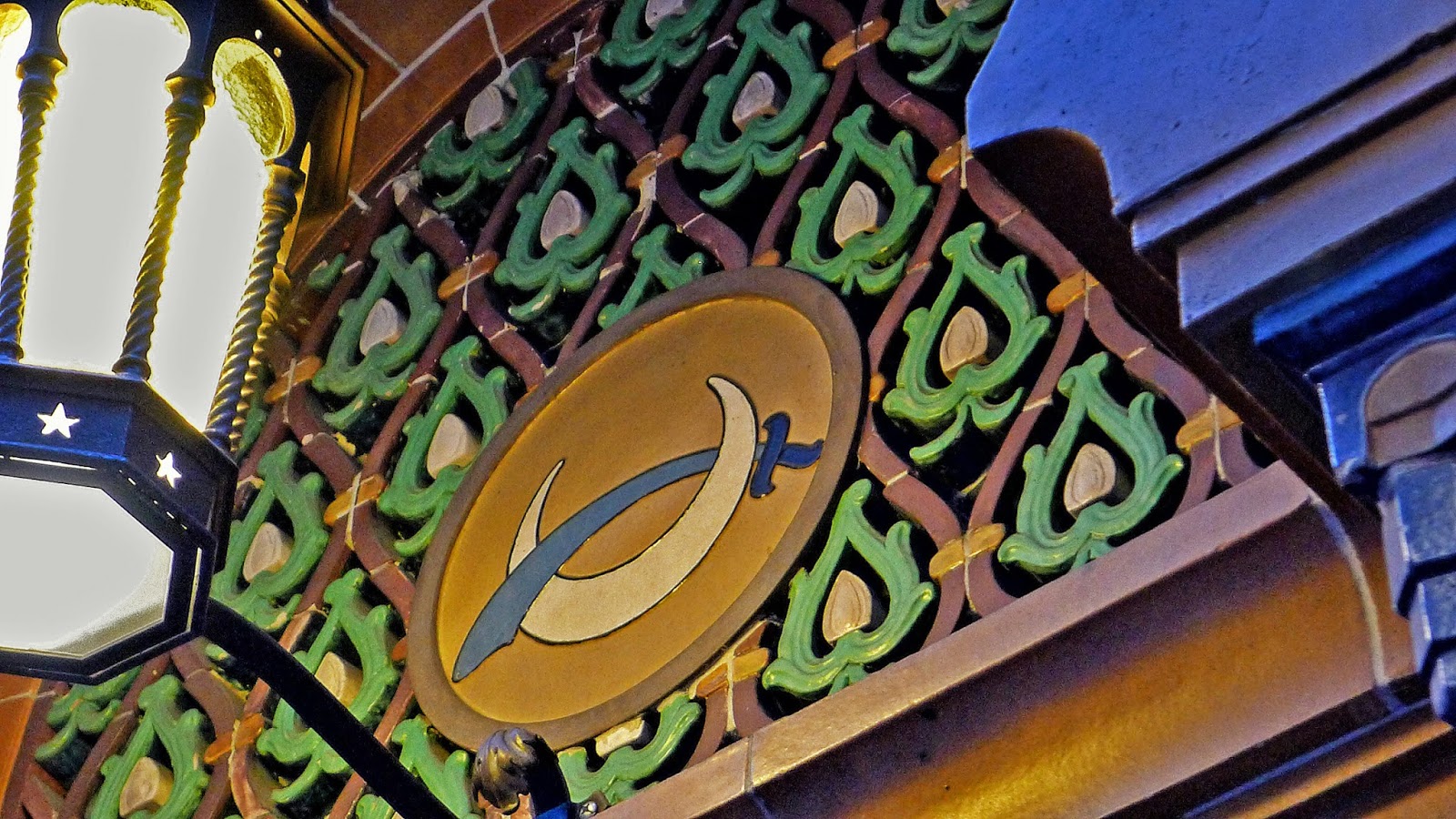
“The tympana within the arches contain terra-cotta grilles, scimitar and crescent--one of the ‘jewels’ of the Order--set against a smaller version of the foliate design, of green, ochre and white on a deep, blue ground. The engaged colonettes between the coupled mezzanine windows are themselves polychrome, glazed, terra cotta.” (“City Center 55th Street Theater/formerly Mecca Temple, 131 West 55th Street, Borough of Manhattan”, Landmarks Preservation Commission, April 12, 1983, Designation List 164 LP-1234, p. 6)


Terra cotta grille with the crescent and scimitar.


Details of the tiled alfiz and a grille above one door. “The facade’s success rests in the tightly balanced play, or mesh, of [Knowles’] two sub-schemes, massive bulk and human-scaled entrances.” (“City Center 55th Street Theater/formerly Mecca Temple, 131 West 55th Street, Borough of Manhattan”, Landmarks Preservation Commission, April 12, 1983, Designation List 164 LP-1234, p. 6)


The lobby of the Mecca Temple--as with the lobbies of the Pythian Temple and The Cranlyn--brought the Art Deco and Eastern motifs from the exterior into the interior. (We were not allowed to enter the building proper to take additional photos when we visited, but you can find some photos of the auditorium here.)


Two views of the ticket lobby.


Details of the interior architectural terra cotta.


Views of the coffered lobby ceiling and the lighting fixture.


“Knowles, the engineer, managed to create vast interior spaces with no visible vertical obstructions. To do so required some ingenuity including the largest single piece of steel ever used in a New York building.


The Mecca Temple dome being built in 1924 with Ludowici roof tiles. (http://www.ludowici.com/wp-content/uploads/2014/06/not_all_created.pdfThe dome housed an exhaust fan that was eight feet in diameter. 

The dome was constructed in 1924 with roof tiles manufactured by the Ludowici Tile Company. The dome lasted over 75 years without restoration, but by 2005 it was in serious need of repair.  "For some years it had been apparent that the dome was leaking, since the 1920's waterproofing membrane, made of thick felt, began to fail. Water was seeping from the dome into the glorious domed ceiling above the 2,753-seat auditorium, staining and flaking its pristine ornamental plaster." (Glenn Collins, "Fixing a Leaky Roof, and What a Roof!", The New York Times, March 25, 2005; http://www.nytimes.com/2005/03/25/nyregion/fixing-a-leaky-roof-and-what-a-roof.html)


A contemporary view of the dome. (http://www.ludowici.com/project-gallery/gallery/new-york-city-center-in-new-york-city-new-york/)

"The dome, which is 104 feet in diameter, is rare in that it was devised as a perfect geometric sphere, although it looks more like an oblate spheroid. That's because the dome emerges from the roof above the sphere's widest theoretical diameter. Beyond that, it is 'the only graduated clay-tile dome in the Northeast, so it's unique,' said Bob Anderson, the reconstruction foreman from the general contractor, Nicholson & Galloway. He was referring to the dome's 28,475 Spanish tiles, which are graduated, meaning that they change in shape, getting narrower closer to the top. ...Normally, he said, Spanish tile is used to cover only ordinary traditional pitched roofs or mansard roofs. As for domes, most of them are sheathed in copper or limestone, like the one at Low Library at Columbia University. Above all, the new dome must not look new... . And so, red, light red and ochre terra-cotta tiles are being installed in a random pattern to give the dome that heirloom quality... ." (Glenn Collins, "Fixing a Leaky Roof, and What a Roof!", The New York Times, March 25, 2005; http://www.nytimes.com/2005/03/25/nyregion/fixing-a-leaky-roof-and-what-a-roof.html)

“...The Great Depression dealt a hard blow to the Shriners and by the late 1930s the group was in financial trouble. Most Shriner lodges were exempt from taxation because of the organization’s charitable works. But because the Mecca Temple rented the auditorium to outsiders for additional income, it gave up its exempt status. ...In 1942 the City of New York foreclosed on the property to satisfy back taxes of $622,543. It was the end of the line for the Mecca Temple[, and it] was almost the end of the line for the structure, as well. The City placed the winning bid on the building in its own auction. The suggestion was offered to demolish the auditorium for a parking garage. But Mayor Fiorello LaGuardia had other plans. ...LaGuardia, along with Newbold Morris, Morton Baum and Joseph McGoldrick, envisioned the transformation of Mecca Hall into [...what it remains today,] a city-owned, non-profit center for the arts.” (“A Moorish Fantasy - The New York City Center, 131 West 55th Street”, Daytonian in Manhattan blog, January 13, 2012; http://daytoninmanhattan.blogspot.com/2012/01/moorish-fantasy-new-york-city-center.html)


The Pythian Temple (now the Pythian Condominiums)
135 West 70th Street, Manhattan

According to Christopher Gray, “Fraternal orders flourished after the Civil War, and by the 1910s and ’20s, the Elks, the Knights of Columbus, the Masons and other organizations felt the need for huge lodges, sometimes with hotel rooms. ...The Pythians completed their high-rise house [...in 1927]. About 150 feet tall, it was built mostly in buff brick and terra cotta. Sprinkled over the surface is some of the most brilliant polychrome terra cotta in New York... .” (Christopher Gray, “Streetscapes: An Improbable Cradle of Rock Music”, The New York Times, June 18, 2009; http://www.nytimes.com/2009/06/21/realestate/21scapes.html?_r=0)


A set from D. W. Griffith's Intolerance (1916). (From the Cohen Film Collection, http://cohenfilmcollection.net/Details.aspx?id=fabe4e9a-0a40-e311-bba7-d4ae527c3b65)

“...The Pythians had an eye for drama, and hired [Thomas] Lamb, a Scottish-born specialist in magnificent movie palaces. The architect created a blockbuster synthesis of Egyptian, Babylonian and Assyrian motifs evoking the grandeur of D. W. Griffith’s Babylonian movie set for his 1916 ‘Intolerance.’ 


An historic 1928 photo of The Pythian Temple. (From the collection of the Museum of the City of New York.)

“The building was intended to be the regional meeting facility for the lodges of the Knights of Pythias and as such, it housed several stacks of windowless lodge halls, each one complete with ancillary rooms and an organ loft. This pile of meeting rooms was suspended above the columnless auditorium which occupied the entire third floor by two enormous steel plate trusses, two stories tall, that spanned between the western and eastern party walls deep within the building. Covering the ziggurat-like stepped mass, more than 170 feet high, was exuberant terra-cotta decoration, including four ten-foot-tall pharaohs in full color, of various Assyrian, Egyptian and Babylonian revival styles that represented the symbols of the Knights of Pythias rite.” (http://www.dgarch.com/pythiancondos.html)


The facade of the remodeled Pythian Condominiums. (http://www.dgarch.com/pythiancondos.html)

“In the early 1980s, the architect David Gura oversaw a radical conversion of the Pythian Temple into apartments, a devilishly complicated alteration because of large beams, the windowless facade, and double-height lodge and other rooms. He inserted banks of windows into the facade as gently as possible, and added greenhouse-type structures on the upper terraces.


“...In its transformation to the PYTHIAN CONDOMINIUMS, most of the ornamentation was retained. Eighty-four condominium apartments plus four professional office suites on the ground floor were inserted into the former lodge floors. The existing structural frame, different on every floor, has for all intents and purposes been retained unchanged. New duplex apartments were threaded throughout the old trusses and inserted between the existing floor slabs. New floor slabs trisect the old auditorium space. New windows were added in a manner that reveals both the original construction and new renovation. Gold reflective curtain wall with deep red-colored framing members are split at the fifth floor, providing terraces for bedrooms on that level and showing both how the mass above is suspended on trusses and how the original five-bay architectural facade was overlaid on a six-bay structural frame. ...Decorative elements on the southern facade were either retained in place and restored or salvaged for use elsewhere within the building.” (Christopher Gray, “Streetscapes: An Improbable Cradle of Rock Music”, The New York Times, June 18, 2009; http://www.nytimes.com/2009/06/21/realestate/21scapes.html?_r=0)


Three views of the facade terra cotta.

“...The Pythian Temple’s ground-floor colonnade, with Assyrian-type heads, is centered on a brilliantly glazed blue terra-cotta entry pavilion.


One of the Pharonic figures.


“The windowless middle section steps back at about 100 feet up, with four seated Pharaonic figures similar to those of Ramses II at Abu Simbel. Two more setbacks rise to a highly colored Egyptian-style colonnade, and to giant urns carried by teams of yellow, red and green oxen. In a rendering, the urns are lighted with fires.


(From: Christopher Gray, “Streetscapes: An Improbable Cradle of Rock Music”, The New York Times, June 18, 2009; http://www.nytimes.com/2009/06/21/realestate/21scapes.html

“Published photographs of the lobby show a double-height space in what appears to be polished black marble, with Egyptian decor, like a winged orb, or perhaps Isis, over the doorway.” (Christopher Gray, “Streetscapes: An Improbable Cradle of Rock Music”, The New York Times, June 18, 2009; http://www.nytimes.com/2009/06/21/realestate/21scapes.html?_r=0.


“A 1928 photo of the lobby shows a double-height space in what appears to be polished black marble, with Egyptian decor, like a winged orb, or perhaps, Isis, over the doorway.” (http://www.nytimes.com/slideshow/2009/06/18/realestate/0621-scapes-slideshow_9.html; Photo credit, Office for Metropolitan History)


Another view of the lobby interior (1928)


The Cranlyn (1931)
80 Cranberry Street, Brooklyn


The Henry Street facade of the Art Deco Cranlyn (built 1931).

The Cranlyn apartment house rises above its brownstone and brick neighbors in the Brooklyn Heights Historic District, of which it is also a part. “This is a classic Art Deco apartment building. It’s got the massing of shapes with the ziggurat cuts in the upper floors, with their penthouse terraces, and decorative bands of alternating brick colors, and some really nice terra-cotta trim.” (http://www.brownstoner.com/blog/2010/08/building-of-the-123/)


The upper facades on Henry Street and on Cranberry Street showing the alternating colors of the bands of brick.

“Hyman Isaac Feldman [1896-1981, the architect], born in Lemberg (Russia), immigrated to New York in 1900. He studied at Cornell, Yale, and Columbia, and began an architectural practice in New York in 1921. Over the course of a long career he designed well over 4,000 residential and commercial buildings, including many hotels and apartment houses; he also wrote articles on economics, real estate, and architecture. In 1932, the Brooklyn Chamber of Commerce presented him with its first award for best apartment house design (for the Cranlyn Apartments, 80 Cranberry Street, 1931, found within the boundaries of the Brooklyn Heights Historic District). Many of Feldman's most interesting designs were Art Deco style apartment buildings, examples of which can be found in the Bronx, the Riverside-West End Historic District, the expanded Carnegie Hill Historic District, and the Upper West Side/Central Park West Historic District. His work after World War II is represented in the Upper East Side Historic District.” (Donald G. Presa, “NOHO Historic District Designation Report”, NYC Landmarks Preservation Commission, June 29, 1999, p. 191)


The Art-Deco entrance to the Cranlyn and the plaque over the entrance. The plaque has a representation of Brooklyn’s Borough Hall over “THE CRANLYN” and a towering skyscraper behind Brooklyn's Borough Hall, and a sun with rays behind the skyscraper.

Although the Cranlyn is a fairly new building--85 years old--it occupies “...the most historic...site in Brooklyn Heights... . It was formerly the location of the Brooklyn Armory, which was the headquarters of the New York State Militia's Fourteenth Regiment, which fought in most of the big battles of the Civil War. Before that, it was the location of the Apprentices' Library, established as an educational center and ‘to keep young men out of grogshops... .” (http://www.brooklyneagle.com/articles/2015/11/25/brooklyn-heights-buildings-stories-tell)


One of the polychrome panels on the Cranberry Street facade. Peacock representations are found in ceramics throughout the Near and Middle East.


Detail of the peacock panel.


The Art Deco motifs of the building are continued in the interior. Although we do not know if the lobby interior has been changed from the original over the past eighty-five years, some Art Deco decoration remains.


A metal grille, the marble floor, the lighting and the bronze elevator doors in the lobby of the Cranlyn.

These are only three examples of Egyptian, Moorish and Middle Eastern motifs being used as part of Art Deco construction during the first third of the twentieth century. The Mecca Temple and the Cranlyn were built so their major polychrome terra cotta features could be easily seen from street level. The Pythian Temple was built so that half the decorations could be seen from the street, but other major polychrome decorations were too high to be clearly seen by the general public. New construction materials and methods were allowing buildings to be built taller and taller, making it more difficult to see colorful decorative elements on them unless they were close to street level.

In the 1920s the terra cotta industry asked architects to consider using polychrome terra cotta as a major building and ornamental material in their projects. Some architects and architectural designers formed their own theories of architectural coloring--Raymond Hood, Ely Jacques Kahn, Leon Solon, among others--that were used in some of their varied projects, and they proselytized to the architectural community. “Unfortunately, the potential of terra cotta to provide lasting color in architecture was never fully exploited. Instead, this unique quality was obscured by the continued demand for a product which mimicked other building materials.” (Susan Tunick, Terra-Cotta Skyline, Princeton Architectural Press, New York, New York, 1997, p. 125)

Susan Tunick, the author of Terra-Cotta Skyline, discusses the reasons why the large-scale use of polychrome terra cotta diminished. “As skyscrapers reached new heights, color became increasingly difficult to see and consequently its impact diminished. A new wave of extremely tall buildings brought with it the abolition of the cornice and much decorative detail. ...With ornament nearly eliminated, the tonal massing of the building form became the predominant design concern. Terra cotta...serve[d] a valuable function in the taller towers that continued to be constructed until the early 1930s, but in such buildings the role of polychrome disappeared. [...These buildings] used terra cotta in...distinctive way[s], but the emphasis was on tonality or linear pattern, and not on color.” (Susan Tunick, Terra-Cotta Skyline, Princeton Architectural Press, New York, New York, 1997, pp. 85-86)

The Depression and Moderne architecture almost dealt a death-blow to the architectural terra cotta industry, but terra cotta is again being used in many restorations and other architectural projects in this country and around the world.


*****

Some of these motifs are also found in the Tunisian and Persian-style tiles that were once used extensively in the United States. I have previously written articles about the Tunisian tiles of the Chemla family that were used mainly in California and Florida, but also in New York during the nineteen-teens and twenties: http://tilesinnewyork.blogspot.com/2014/11/lost-tile-installations-tunisian-tiles.html and http://tilesinnewyork.blogspot.com/2015/03/the-renaissance-casino-and-ballroom.html.


*****

Update: the Empire State Dairy Murals

As a result of my article about wall murals last month, and specifically the piece about the Empire State Dairy tile murals, and because of the recent rezoning of the East New York section of Brooklyn for development by the Mayor and City Council, I was interviewed about the murals. After seventeen years of silence, perhaps someone is listening.

Uptown Radio, a Columbia University station ran a four minute story: https://soundcloud.com/uptownradio/160304-bernard-landmarks-e2.

News12, a local Brooklyn cable news channel ran a story taped at the building site: http://brooklyn.news12.com/news/historian-works-to-save-empire-state-dairy-factory-in-east-new-york-1.11547563.

The Brownstoner, a local real estate blog that publishes architectural and preservation articles, printed this story: http://www.brownstoner.com/blog/2016/03/east-new-york-brooklyn-empire-state-dairy-tiles/?ic_source=icma.

Finally, The Brooklyn Eagle reported on the building being calendared for a landmarks hearing in July:  http://www.brooklyneagle.com/articles/2016/3/8/landmarks-preservation-commission-calendars-two-east-new-york-borden-dairy.