A blog about architectural tiles, terra cotta and other ceramic surfaces, architectural glass and ornamentation in and around New York.

Showing posts with label LaGuardia. Show all posts

Sunday, January 1, 2017

Bits and Pieces: The Brooklyn-Battery Tunnel and following up on the James N. Gamble House and the Charles Volkmar Overmantle Mural

The Brooklyn-Battery Tunnel


Drive through any tunnel built in the first half of the twentieth-century, and the interior wall covering will most likely be “subway tiles.” Subway tiles have been a boon to modern decorative arts for awhile, now, but they’ve been an architectural staple for a much longer time.

This was the view of the Manhattan to Brooklyn tube wall in December 2015. (Courtesy of Michael Padwee)

If you’ve driven through the Brooklyn Battery Tunnel (renamed the Governor Hugh L. Carey Tunnel) between Battery Park in lower Manhattan and Red Hook in South Brooklyn over the past two years, you might have noticed that tiles were being removed from the tunnel walls. The repairs and restoration are the result of the storm surge from Hurricane Sandy, which flooded the tunnel in 2012. (Noah Hurowitz, “Battery recharge: Tunnel to half-close overnight for three years”, Brooklyn Paper, March 4, 2015; http://www.brooklynpaper.com/ stories/38/10/dtg-brooklyn-battery-tunnel-repairs-2015-03-06-bk_38_10.html)

Saltwater pours into the Manhattan entrance of the Brooklyn-Battery Tunnel during Hurricane Sandy. (Photo credit: Associated Press / John Minchillo)

Proposals for a crossing between the Battery Park in lower Manhattan and the Red Hook section of Brooklyn had been around since 1929. "...Originally envisioned as a three-tube, six-lane tunnel, the crossing was to connect two pieces of Robert Moses' rapidly expanding arterial network: the West Side Highway in Manhattan, and the 'Circumferential bypass' (later known as the Gowanus Expressway and the Belt Parkway) in Brooklyn. The proposed tunnel, which also had the support of Mayor Fiorello LaGuardia, was approved by the New York City Board of Estimate in November 1930. However, its construction was delayed by the deepening economic depression. By 1936 the story of the Brooklyn-Battery Tunnel became acrimonious with a political and economic dispute between two alternatives on how to connect these major arteries in Manhattan and Brooklyn: a Brooklyn-Battery Bridge or a Brooklyn-Battery Tunnel." (http://www.nycroads.com/crossings/brooklyn-battery/)


(taken with permission from Samuel Amadon's poem, “The Brooklyn–Battery Bridge in the Brooklyn–Battery Tunnel”; https://www.poetry foundation.org/poetrymagazine/poems/detail/90969)

There were many political and personal twists and turns before the tunnel actually was built. "...Mayor La Guardia [established] the New York City Tunnel Authority...in 1935 to build the Queens Midtown Tunnel. In 1936 the City advanced $75,000 to this Authority for preliminary studies of a Battery Tunnel. On January 25, 1939, however, the Mayor and Board of Estimate decided on a bridge instead of a tunnel, and to use the Triborough Bridge Authority as the agency to finance it. This started a bitter controversy provoked by opponents of the bridge who claimed it would spoil the view from Brooklyn.” (Triborough Bridge and Tunnel Authority, Brooklyn Battery Tunnel, May 1950, p. 3) It was also suggested that much taxable land in Lower Manhattan would be lost to access roads and construction, and development in Lower Manhattan would be greatly curtailed.

When the funding changed from the NYC Tunnel Authority to the Triborough Bridge Authority, LaGuardia ceded control of the NYC Tunnel Authority to Robert Moses. Moses “changed the original plan from a six-lane tunnel crossing to a six-lane bridge crossing. This change reflected the values of the bankers that would finance such a project: that a bridge would be built for less money, cost slightly less to operate, and carry more traffic. Moreover, this change reflected his own personal philosophy: his eagerness to build impressive monuments for all to see. According to an aide, Moses regarded a tunnel as ‘but a hole in the ground.’” (http://www.nycroads.com/crossings/brooklyn-battery/)

A 1939 model of the proposed Brooklyn-Battery Bridge. (From the collection of the Museum of the City of New York) "Moses hired his favorite designer - Othmar Ammann - for the proposed Brooklyn-Battery Bridge. The design of Moses' proposed crossing -a twin suspension bridge linked together by a central anchorage near Governor's Island - was similar to that of the twin suspension span of the San Francisco-Oakland Bay Bridge." (http://www.nycroads.com/crossings/brooklyn-battery/)

Before the tunnel was actually built, this controversy involved Mayor LaGuardia, Robert Moses, the Army Corps of Engineers, property owners on both sides of the proposed bridge, ordinary citizens and President Franklin D. Roosevelt. 

Eleanor Roosevelt delivered the president’s message on this subject: “I have a plea from a man who is deeply interested in Manhattan Island, particularly in the beauty of the approach from the ocean at Battery Park. He tells me that a New York official, who is without doubt always efficient, is proposing a bridge one hundred feet high at the rive, which will go across to the Whitehall Building over Battery Park. This, he says, will mean a screen of elevated roadways, pillars, etc., at that particular point. I haven't a question that this will be done in the name of progress, and something undoubtedly needs to be done. But isn't there room for some consideration of the preservation of the few beautiful spots that still remain to us on an overcrowded island?” (http://www.nycroads.com/crossings/brooklyn-battery/)

On July 17, 1939 the Secretary of War, Harry Woodring, ruled that the proposed bridge could not be located seaward of the Brooklyn Navy Yard; it would be vulnerable to attack in the event of war, and it could block access to the Navy Yard. “[It] could be argued that this was a ludicrous objection, since the Brooklyn and Manhattan bridges were downstream of the Navy Yard. In the end, perhaps the Battery crossing decision stemmed from the long-[simmering] grudge between Moses and Roosevelt.” (Ibid.)

The Brooklyn-Battery Tunnel under construction. (From The New York Times archives, 1944)

A noted tunnel engineer, Ole Singstad, began directing the construction of the tunnel in 1940, but World War II interrupted construction until 1945. The tunnel was completed in 1950 and was opened to auto traffic on May 25, 1950.

I did mention the tiles in the beginning of my article. According to a 1948 newspaper article, the “...Brooklyn-Battery tunnel is getting the longest tile lining ever installed in the  United States. Seventeen teams of tile setters are already working on the...two tubes. ...When completed, the tunnel’s lining will extend 9117 feet... . The tile, a total of 780,000 square feet, or enough for 6500 average size bathrooms, is being installed to simplify cleaning and to diffuse light for motorists... .” (“New Brooklyn-Battery Tunnel Gets Tile Job”, November 17, 1948. An unattributed newspaper article.)

I only discovered the name of the original wall tile manufacturer when I saw an ad on ebay for a 6 5/8” diameter commemorative tile made for the dedication of the Brooklyn-Battery Tunnel in 1950.

The reverse of this tile reads: “ROMANY TILES  UNITED STATES QUARRY TILE CO.” (Courtesy of Michael Padwee)

The United States Quarry Tile Company began in East Sparta, Ohio as “...the U. S. Roofing Tile Co. in 1913, with plants in Parkersburg, West Virginia, and East Sparta, Ohio, and became the United States Quarry Tile Co. in 1926. ...East Sparta’s ‘other’ two tile plants, the Federal Clay Products Co., later ([in]1936) acquired by United States Quarry Tile, and the East Sparta Clay and Limestone Co., which morphed into the Sparta Ceramic Co. in 1922. The Sparta Ceramic Co. in turn became a fully owned subsidiary of US. Ceramic Tile in 1954, due in part to the fact that its Spartan tile complemented U. S. Quarry Tile’s Romany Tile and due in part to the fact that most of the stockholders of the two companies were the same.” (James L. Murphy, “KOW: The Ceramic Art of Kenneth O. Weaver”, Contributions to Ohio Ceramic History No. 2, Grovetucky Press, Grove City, Ohio, 2010, pp. 2, 3)

Many people know of the U.S. Quarry Tile Company (now the United States Ceramic Tile Company) because of their 10” diameter, art pottery line, Romany Spartan plates:

The Romany-Spartan American Institute of Architects’ Centennial ceramic plate, 1957.

According to the website of Ceramic Solutions, a supplier of imported tiles, the new "subway" wall tiles are being manufactured by Agrob Buchtal of Germany. 


A rendering of the Hugh L. Carey Tunnel (Brooklyn-Battery Tunnel) proposed repairs. (http://www.mta.info/news-bridges-and-tunnels-hugh-l-carey-tunnel/2014/11/17/queens-firm-be-awarded-2825-million-contract)

"As part of the redevelopment the tunnel wall tiles will be complet[ly] replaced with new Agrob Buchtal, Chroma wall tiles, offering easier cleaning, as well as diffusing light for motorists.


The Chroma Plural Colour Chart
"ChromaPlural was specially developed for complex design requirements.Ten ranges of colors form a color circle comprising 50 co-ordinated shades. Six color spheres illustrate various color nuances and areas of application." (http://www.agrobbuchtal.de/en/cd/produkte/produkte_seiten_2_13092.html)


"These tiles will also act as a fire-retardant, providing a protective coating for the tunnel in the event of a fire. Agrob Buchtal supplies tiles for roadway tunnels and underground railways all over the world... ." (http://www.ceramicsolutions.com.au/ redevelopment-hugh-l-carey-tunnel-tile-finish) 


The colors and tiles of Agrob Buchtal. This ceramics company was organized "...in 1992 after a merger by the traditional Deutsche Steinzeug Cremer & Breuer AG and AGROB Wessel Servais AG companies[. The] AGROB BUCHTAL tile range picks up on a history which dates far back into the 18th century." (http://www.agrob-buchtal.de/en/unternehmen/index.html?pe_id=763)


FOLLOWING UP ON:

The James N. Gamble House in Cincinnati, Ohio

At the end of my May 2013 blog I reported on the loss of the James N. Gamble house and its tile installations in Cincinnati, Ohio. Below is a further report on what's happened to the site since. James N. Gamble was one of the founders of the Proctor and Gamble Company.


April 1, 2013. In about three hours, the 170-year-old house was rubble. (Photo credit: The Cincinnati Enquirer)

"3 years ago today the City of Cincinnati lost what was arguably her most historic single-family residence. Thirty-six months later, the lot still sits empty and idle. Imagine how far along the restoration would be today if the owners -- and Procter & Gamble -- had truly understood its importance and valued their own origins. Imagine if both the owners and the company recognized that in all likelihood they would not themselves exist today if it weren't for the contributions of the man who called this place home for more than 6 decades. So much was lost that day, three years ago, when the historic James N. Gamble house was demolished. Rendering courtesy of Graeme R Daley, who fought bravely & tirelessly to help preserve this important piece of American history for future generations. Let's hope that at some point in the near future the owners will follow through on their promises of transforming what remains into an educational center that will benefit the local community." (https://www.facebook.com/groups/savethegamblehouse/)


The Charles Volkmar Overmantle in Clifton, New Jersey

In my January 2016 blog I wrote about a house in Clifton, New Jersey that had a fireplace with a tiled panel overmantle. This panel is 72" long x 24" high and depicts a boar hunt with dogs,


The fireplace with the Volkmar tile overmantle.

a boar, and hunters in the background. The panel is signed in the lower left scenic tile, which had been broken and repaired.


The owner of the house decided not to try to remove the tile panel, and has placed the property on the market. It will be up to the new owner to determine the future of the panel.


*****


LINKS TO MY PREVIOUS ARTICLES:


Art Deco Buildings and Their Lobbies: the Chrysler Building, the Film Center Building and the Kent Garage/Sofia Brothers Storage Warehouse
read more...

ARCHITECTURAL MURALS OF LUMEN MARTIN WINTER and a REPORT ON THE EMPIRE STATE DAIRY BUILDING
read more...

The Heart of the Park: Bethesda Terrace and its suspended Minton Tile ceiling
read more... 

A Landmarks hearing was held on July 19, 2016...
read more...

Two Restorations: The City Hall Subway Station and the Tweed Courthouse
read more...

Egyptian, Moorish and Middle Eastern Ornamentation Used In Art Deco Terra Cotta in New York City, and Empire State Dairy Update
Wall Murals in Brooklyn: A Mini Survey
read more...

Inside Prospect Park: The park's Rustic, Classical and other Internal Architecture
read more...

Herman Carl Mueller in Titusville and Trenton, New Jersey; A Charles Volkmar Discovery in Clifton, New Jersey
read more...

A Book Review and New Discoveries and Updates-II: Jean Nisan, Ceramic Tile Artist
read more...

Polychrome Terra Cotta Buildings in Newark, New Jersey
read more...

New Discoveries-I: The Tiled House of Jere T. Smith
read more...

Introducing the Stained and Dalle de Verre Glass Art of Robert Pinart
read more...

Bits and Pieces: Polychrome Terra Cotta- and Tile-Clad Buildings
read more...

Socialist and Labor Architecture and Iconography in New York City
read more...

Bits and Pieces: Two Mosaics--Hamden, CT and Manchester, NH
read more...

The Renaissance Casino and Ballroom Complex in Harlem: Another Tunisian Tile Installation Headed for Demolition
read more...

Clement J. Barnhorn and the Rookwood Pottery
read more...

The Woolworth Building
read more...

The Mosaic Art of Hildreth Meière
read more...

Lost Tile Installations: The Tunisian Tiles of the Chemla Family
read more...

The Grueby Children's Murals on East 104th Street
read more...

The Experimental Lustre Tiles of Rafael Guastavino, Jr.
read more...

Bits and Pieces: Two "E"s--Eltinge and Elks; and more about Jean Nison
read more...

The Ceramic Tiles and Murals of Jean Nison
read more...

Pleasant Days in Short Hills: A Rookwood Wonderland
read more...

Architectural Ceramics in the Queen City
read more...

Isaac Broome: Innovation and Design in the Tile Industry after the Centennial Exhibition
read more...

"Immigration on the Lower East Side": A Public Arts Mural Created by Richard Haas
read more...

Movie Palaces-Part 2: The Loews 175th Street Theatre
read more...

Béton-Coignet in New York: The New York and Long Island Coignet Stone Company
read more...

Michelin House, London
read more...

Movie Palaces, Part 1: Loew's Valencia Theatre
read more...

An Architectural and Ceramic Tour of Istanbul - Part II
read more...

The Tiles of Fonthill Castle
read more...

An Architectural and Ceramic Tour of Istanbul - Part I
read more...

Tiled Facades in Madrid
read more...

Nineteenth Century Brooklyn Potteries
read more...

Ernest Batchelder in Manhattan
read more...

Leon Victor Solon: Color, Ceramics and Architecture
read more...

Architectural Art Tiles in Reading, Pennsylvania
read more...

Charles Lamb and Charles Volkmar
read more...

Kansas City Architecture - II
read more...

Kansas City Architecture - I
read more...

Westchester County--Atwood and Grueby
read more...

Modern Houses in New Caanan, Connecticut
read more...

PPG Place, Pittsburgh
read more...

Aluminum City Terrace, New Kensington, Pennsylvania
read more...

Newark's WPA Tile Murals: “Fine Art is an Important Part of Everyday Life”
read more...

Public Art Programs in New York City: The CETA Tile Murals at Clark Street
read more...

Concrete and Tiles-I: Moyer, Mercer, Murosa
read more...

The Café Savarin and the Rookwood Pottery; Chocolate Shoppe Rebounds
read more...

Architectural Ceramics of Henry Varnum Poor
read more...

Herman Carl Mueller and the Church of St. Thomas the Apostle
read more...

Meet Me at the Astor
read more...

The Mikvah Under 5 Allen Street; "Historic Hall" Apartments Revisited
read more...

London Post-3
read more... 

Some Moravian Tile Sites in New York
read more...

London Post-2
read more...

London Post-1
read more...

Brooklyn's International Tile Company
read more...

Subway Tiles-Part III, the Squire Vickers Era
read more...

Subway Tiles-Part II, Heins and LaFarge
read more...

Subway Tiles--Part I, Guastavino tiles
read more...

Trent in New York-Part III, Historic Hall Apartment House
read more...

American Encaustic Tiling Company-Part II, Artists' Tiles
read more...

Trent in New York-Part II, a Dey Street Restaurant
read more...

American Encaustic Tiling Company-Part I, Tile Showrooms
read more...

Trent in New York-Part I, The Bronx Theatre
read more...

Fred Dana Marsh's Tiles
read more...


*****


About this blog:

This is a non-commercial, educational blog. Content is compiled/written by Michael Padwee and all opinions expressed herein are my own, or quoted, and are offered without intending to harm any person or company.


I fact-check as carefully as possible before posting and try diligently to cite sources of text and photos that are not my own.


I reserve the right to edit content—either add or delete material—as I see fit.


If you find a broken link on this blog, please contact me at mpadwee'at'gmail.com.


I do not accept anything of value to write about products or businesses. If I recommend a product or a company, it is strictly not for profit.


Permission is granted to link back to this site. In fact, link backs are appreciated.


Offensive comments or spam will be deleted. I reserve the right to decide what is considered offensive.


I am not responsible, nor will I be held liable, for blog comments. Writers of comments take full responsibility for their content.


I reserve the right to remove comments asking for appraisals or trying to sell items. (Click on "comments" in the section below to leave a comment.)


Tuesday, July 1, 2014

The Ceramic Tiles and Murals of Jean Nison


"Jean Nison, 1953" (Courtesy of UC Berkeley, Bancroft Library,  Johan Hagemeyer (1884-1962), Photographer; http://content.cdlib.org/ark:/13030/ft5c600792/?docId=ft5c600792&layout=printable-details

A few months ago California tile preservationist Brian Kaiser contacted me and asked if I knew of Jean Nison and her tile commissions. Brian had recently saved one of Nison's murals from certain destruction--a double dragon mural in the bathroom of the Tichenor House in Long Beach, California--and was in the process of restoring it. 


Part of Jean Nison’s double dragon tile mural, c. 1953, rescued by Brian Kaiser. Note her use of “bubbling” in the glazes of the tiles. This effect was obtained by the mixing of gold and other metals with the glaze and dripping or painting it onto the tile before a low-temperature firing. (Photo courtesy of Brian Kaiser)

The Tichenor House is listed on the National Register of Historic Places. It was built in 1904-1905 by the architects Charles Sumner Greene and Henry Mather Greene for Adelaide Tichenor, a civic leader and philanthropist who founded the Ebell Club in her home and established an orthopedic clinic that bears her name.

“[The] Tichenor House was one of only three homes constructed in Long Beach by the renowned architectural team of Charles and Henry Greene.... . The Greene brothers refined the familiar low-profile, wide-porch Craftsman bungalow with their skilled use of wood craftsmanship, and the influence of their early study of Japanese art and architecture. From its crooked clinker brick and timbered wood exterior to the hand-painted silk wallpaper and huge slate fireplace in the second-story sitting room, the Tichenor House provides an excellent example of the Greene brothers' ability to blend Oriental themes in an occidental house.


The full double dragon mural in the master bathroom. (Photo courtesy of the American Craft Council Library)

“The house was extensively remodeled [...by architect Adrian Wilson and his associate, Alden Becker, in 1953] with many modern changes to the interior,” (http://articles.latimes.com/1991-05-05/news/hl-2211_1_tichenor-houseincluding the addition of Nison’s tile mural. “Wilson took part of the upstairs balcony, and converted it into a Master Bath for the Master Bedroom. [...The owners, Dr. and Mrs. William Casselberry] hired [Nison], to create a very rare, one-of a kind ceramic tile [mural] for that room, ...a fantastic mural forming the wall behind the bathtub. It was composed of some organic-style tile covered with Gold Blisters, and had two very large dragons [...pictured on the tiles]. The mural was about 7 feet by 7 feet in size. Jean's signature is in the lower right hand corner of the mural.” (http://www.justanswer.com/antiques/7ehtb-ra-jpm.html)

In December of 2011 a fire started in the rear of the house and was extinguished in about twenty minutes.   (http://www.presstelegram.com/technology/20111212/fire-strikes-historic-tichenor-house)  

“The fire in the [bath]room must have been very intense, because the tile was covered with soot that was burned onto the surface of the tile face. The tile also had a crackle glaze, which has many very tiny cracks over the entire surface. This was intentional, and reflects the style of the tile. Unfortunately, the soot permeated the crackle glaze... .” (http://www.justanswer.com/antiques/7ehtb-ra-jpm.html)

Brian Kaiser became involved after the insurance adjuster said the bathroom was totaled and should be demolished. The owner of the house contacted the Tile Heritage Foundation, and through them, Kaiser, who successfully saved the mural in the two weeks allowed to him before the bathroom was demolished.

When Nison obtained the commission for this mural, she had been involved with ceramics for only about five years. In an article published in American Artist magazine in 1954 Nison states that she was mostly self-taught as a ceramic artist: “I began experimenting by myself; I am too undisciplined to work in a class, too impatient to carry out the step-by-step routine [class] assignments... . I preferred to go it alone, believing that this way offered a greater chance of striking out on a more original road. I knew I would have to learn what not to do the hard way, but that is the way I took! ...Gradually I came to know what effects and what ends I was after, what kind of subject matter and what technical effects I preferred. I devoted myself to the study of decoration and its appropriate application to ceramics... . I tried to purge my drawing of every nonessential. I wanted to capture on tile the richness of enamel with drawings as simple and dramatic as possible. Animals and mythological subjects interested me especially.” (Jean Nison, “Ceramic Tiles”, American Artist, Vol. 18, No. 6, Summer 1954, p. 60)

(Photo from Jean Nison, “Ceramic Tiles”,  American Artist, Vol. 18, No. 6, Summer 1954, p. 61)

Nison experimented with glazes, bubbling effects, and paints. “My first experiments were with glazes—usually mixtures—in an attempt to get a variety of color with underglaze and yet not be limited to the monotony of a glazed white background. After some time I was able to work out the problem. The underglaze colors were modified, but not muddied, by a colored, transparent glaze over the drawing, and a new textural effect which is still peculiar to my tiles. This gives a three-dimensional quality to the drawing, enriches the color and causes irregular bubbles on the surface.” (Jean Nison, “Fantasies in Tile”, Craft Horizons, Vol. 13, No. 3, May-June, 1953, p.37)  

According to Robert Pinart*, Jean Nison's first husband, she fired her tiles twice. She purchased biscuit tile blanks from different sources, painted her background and main designs on the blanks, and fired the tiles in a kiln in Fred Farr's** studio in Greenwich Village. She would then mix her gold and other metallic glazes until they were a very viscous liquid, and thickly apply the liquid onto the tiles with a brush. Nison would then fire the tiles a second time at a very low temperature. Mr Pinart said if a mistake was made and the firing temperature was too high, the gold would burn off. 

*[In the course of doing research for this article, I was able to locate and, on May 8 and May 24, 2014, interview Jean Nison's first husband, Robert Pinart, an internationally renowned stained glass artist. His remembrances of Ms. Nison are included in this article.]

**[Fred Farr (1914-1973) was a sculptor, ceramic artist and modernist jewelry-maker. In the 1950s he was a ceramics instructor at the Brooklyn Museum Art School. Fred Farr exhibited in the Museum of Modern Art, the Whitney Museum of American Art, the Metropolitan Museum of Art, the American Museum of Natural History, and in many other museums and galleries in the United States, Haiti and South America. He was represented by the Bertha Schaefer Gallery in New York. (“The Brooklyn Museum Art School, Courses in Ceramics” pamphlet, Fall Term, September 1951)  Robert Pinart said that Fred Farr and Jean Nison were friends, and he allowed Nison to use his kiln for her tile work. Farr also used animal motifs on his ceramics, bronze sculptures and drawings.]

According to Kaiser, Nison used very thin, very brittle, talc-body tile for her murals. “One of the most striking features of the tile, is the fact that Ms. Nison had a very unique element to her style. Her basic field tiles have a very ‘Organic’ appearance, with splotches of color dropped on the tile in a completely random manner. In addition, she used large quantities of Gold, which were so thick, that it created bulges or ‘blisters’ on the surface of the tile. This gave the tile a very pronounced texture, and they were not really flat at all. Dr. Jamison[, the current owner of the Tichenor House,] believes that the Gold was 24kt Gold. The Gold would have to be tested to confirm that. I also do not know how much the Gold would be diluted in the glaze, so it could be easily applied.” (http://www.justanswer.com/antiques/7ehtb-ra-jpm.html)   Gold is very toxic to use, as well as expensive. Nison’s glazes in this mural also contained lead, which cannot be used today because of its toxicity. In a telephone conversation, Robert Pinart mentioned that Ms. Nison obtained her bubbling effect partially by firing the glazed tiles at different low temperatures, like his own stained glass creations. (Telephone conversation with the author, 4-30-2014)  Mr. Pinart said the expense of the gold did not matter to Nison. It was always the effect that mattered to her.


(Photo from Jean Nison, “Ceramic Tiles”, American Artist, Vol. 18, No. 6, Summer 1954, p. 61)

According to Robert Pinart, Nison's first exhibition was in 1952 at America House. "America House was a retail sales outlet founded by Mrs. Vanderbilt Webb in New York in 1940. It was open for thirty years, beginning on East Fifty-fourth Street moving to Madison Avenue at Fifty-second Street three years later; and finally in 1960 to 44 West Fifty-third Street where it closed January 31, 1971." (http://digital.craftcouncil.org/cdm/ref/collection/p15785coll5/id/3654)

In late 1952, during the depths of the Cold War, “to refute the impression fairly widely held abroad that our culture is a purely mechanistic one,” the State Department “arranged a series of exhibits for ‘export’ overseas to demonstrate facets of our cultural life. One of these, a collection of handicrafts by contemporary American craftsmen, ...will be sent to Turkey, Greece and India.” (Betty Pepis, “Handcrafts of the United States”, The New York Times, October 12, 1952)   Jean Nison’s ceramic tiles were among the crafts to be sent abroad, and this is the first mention of her ceramics in the press that I was able to find. 

Jean Nison also met Robert Pinart in 1952. She was a salesperson in a French bookstore in Rockefeller Center, and he was purchasing a book about architecture. Mr. Pinart said he was fairly new to the United States at the time and was working for Rambusch Studios. He was very impressed by Nison's command of the French language, and her wide range of knowledge in many subjects that also interested him.


(Jean Nison, "Fantasies in Tile", Craft Horizons, Vol. 13, No. 3, May-June 1953, p. 37)

Nison’s subject matter at first focused on animals, but she began working with abstract shapes when she obtained a commission for Lever House in Manhattan. According to Nison, she visited decorators, left tiles with them and hoped they would call her. This was how, she believed, Raymond Lowey Associates, the industrial design firm, asked her to make a wall decoration for Lever House, at that time the headquarters of Lever Brothers Corporation (now Unilever). I contacted the curator of the Lever House Art Collection, Mr. Richard Marshall, but he had no information about the fate of Nison's tile installation. Unilever Corporation moved out of the building in the 1980s, and may have taken the tiles with them. A request to Unilever for information, however, went unanswered.


(Jean Nison, "Fantasies in Tile", Craft Horizons, Vol. 13, No. 3, May-June 1953, p. 36+)

A 1953 Craft Horizons article has a poor image of Nison’s tiled fireplace surround in the Lever Brothers boardroom. Nison described the tiles as having four different abstract designs, which were chosen by Raymond Lowey Associates and/or Lever Brothers out of about a thousand she submitted. According to Nison, the four designs or icons selected were “vital and modern” and showed a “beauty of tonal relationship and shape.” It is our loss that the original fireplace surround probably no longer exists, and color photos also do not seem to exist.


Another photo of the Lever Brothers tile installation in Lever House. (Image in the artist’s file in, and courtesy of, the American Crafts Council Library)

Nison explained the process by which she created multiple tile murals: “For a composition involving several tiles I first make a pencil drawing on paper and transfer it onto an assembled group of tiles. Although I visualize the color scheme I want, I do not try to color the sketch. This really would be rather purposeless since what happens in...glazing can not be anticipated. 


Jean Nison working with her glazes in an undated photo. (Photo courtesy of the American Craft Council Library)


“The colors are worked into the design in underglaze or in mixtures of several glazes and underglaze in an effort to achieve certain desired effects of color and texture. Actual glazes are much richer in color than mere underglaze colors... . Because of the difficulty of approximating ceramic colors and textures on paper, in sketches submitted for a client’s approval I always work out a section or a miniature version of the design in actual ceramics.” (Jean Nison, “Ceramic Tiles”, American Artist, Vol. 18, No. 6, Summer 1954, pp. 61, 84-85.)


A tile panel with a "medieval feeling". (Jean Nison, "Fantasies in Tile", Craft Horizons, Vol. 13, No. 3, May-June 1953, p. 36+)

Although Jean Nison painted some tiles with scenes “as far removed from the Twentieth Century as possible,” she was also part of the Mid-century Modern movement. In 1953 an article in The New York Times discussed modern ceramic tile designers such as Alexandra Kasuba, Harris Strong, Werner Prins and Jean Nison: “The development of a variety of decorating styles has accompanied the revival of tile design, with the result that collections of such objects resemble an art gallery.” The Times reported that Nison used a tile mural of classic figures standing in a grove of trees as the center of a table made by Zarch Sourian. The tile glazes were pale blues touched with bronze color. The thick, textured clear glaze used on top imparts a misty look. (“For the Home: Tiles Enhance Variety of Objects”, The New York Times, February 25, 1953)


One of Nison’s multi-tile panels with abstract animal designs from this period is shown above. It was described as a “plaque consisting of twenty five [sic] ceramic tiles encased in a bronze band. Tiles are in hues of cobalt, brown, and light blue with designs in gold drippings.” (http://www.1stdibs.com/furniture/wall-decorations/decorative-art/fabulous-tile-plaque-encased-bronze-signed-nison/id-f_197133/)   Below is a close-up view:


The bubbling of the gold-infused glaze is evident.

Pinart said that Nison worked on commissions obtained through a man named "Lippincott", later identified as J. Gordon Lippincott of the Lippincott and Margulies design firm. The archivist of the current Lippincott firm, Erika Rosenberg, suggested I contact Jonathan Lippincott, J. Gordon Lippincott's grandson, who had some of his grandfather's papers. Mr. Lippincott discovered that his grandfather hired Jean Nison to create tile work that was permanently installed in the Lippincott house in Scarsdale (built in 1951-52), but there were no records of other Nison commissions for Lippincott & Margulies in the family papers. 


The Lippincott House in Scarsdale. (Photo from "They Designed Their House to Enrich Their Family Life", House Beautiful, Vol. 95, September 1953, pp. 138-145)

House Beautiful featured this house in the September 1953 issue, and a recent report by the Village of Scarsdale states that "Although Scarsdale does not have the concentration of Modern houses by famous architects found in places such as New Canaan, Connecticut, there are a number of excellent examples of Mid-century Modernism in the village. […A] few Modern houses were...built [in the Fox Meadow section of Scarsdale], most importantly the home of Mr. and Mrs. J. Gordon Lippincott…designed in 1950 by Ray S. Johnson and J. Stein… . Lippincott, a partner in the firm of Lippincott & Margulies, was one of the leading industrial designers of the mid-twentieth century… ." (Li-Saltzman Architects and Andrew Dolkart, "Reconnaissance Level Cul;tural Resource Survey Report", Village of Scarsdale, New York, July 12, 2012, pp. 3-18, 7-17)


(Photo: "They Designed Their House to Enrich Their Family Life", House Beautiful, Vol. 95, September 1953, pp. 138-145)

Nison’s contribution was three tile installations--a rooster above the kitchen stove, a built-in tile table and a tile mural of bulls at the house entrance according to Dalia and Merrill Berman, who were, and still are, the second owners of this Modernist house. The rooster panel can be seen in one of the photos from the House Beautiful article (above) and in the contemporary photo below. 


The roosters tiles are set in the kitchen’s exhaust hood over the cooking range and form a  30” X 12” mural. (Phototographer: Itai Taubenfeld; photo courtesy of Merrill and Dalia Berman)
The bulls are embedded in the entrance hall’s floor and are 18” X 24”.


(Phototographer: Itai Taubenfeld; photo courtesy of Merrill and Dalia Berman)

The tiles below are part of the built-in kitchen table: 31” X 40”.  The Bermans assume the table is also the work of Jean Nison.  Legend has it that the tiles for the table did not emerge from the firing as expected but were loved by the Lippincotts as they were. (Email from Dalia Berman to Michael Padwee, June 18, 2014)


Part of the built-in tile table. (Phototographer: Itai Taubenfeld; photo courtesy of Merrill and Dalia Berman)

Many tiles manufactured by the Mosaic Tile Company of Zanesville, Ohio were used on floors and walls throughout the house in order to promote a “care-free” quality of life for the family.


An ad from a 1955 House Beautiful magazine showing the Mosaic Tile Company's tile work throughout the house. Nison’s tile kitchen table can be seen in the top right photo.

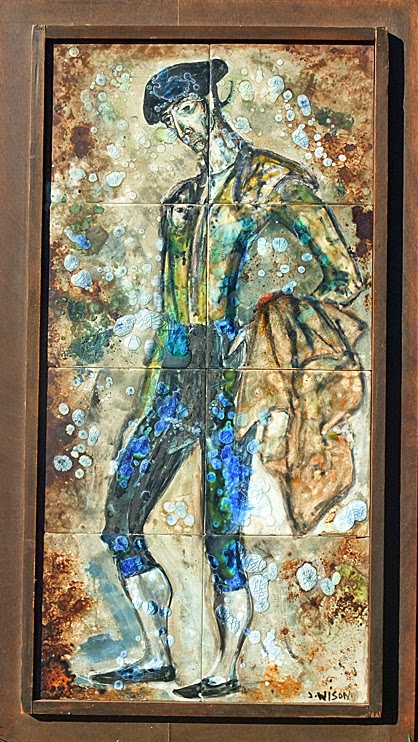
Jonathan Lippincott said that Nison's tile panels went with his grandparents' artistic aesthetic: they enjoyed traveling in Mexico, Central and South America and collected masks and other local crafts; also, when the house was sold some non-permanent tile panels, such as "The Toreador" made by Nison, were retained by the family.


A 12" x 24", 8-tile “Toreador” panel in the possession of the Lippincott family. Nison’s signature is in the lower right corner. (Photo courtesy of Jonathan Lippincott and the Lippincott family)


The "Arts of Daily Living" Exhibition


Wall mural (left) created by Jean Nison for the Plant-Lover's Bathroom in the “Arts of Daily Living Exhibition” in Pomona, California in 1954. (Scanned from "The Bathroom–Our Refuge from Stress", House Beautiful, Vol. 97, No. 3, March 1955, p. 115. The October 1954 House Beautiful magazine contains an article about the other rooms in this exhibition.)
In 1954 one of her murals was featured in the “Arts of Daily Living Exhibition” in Pomona, California. The objects in the rooms, and the rooms themselves in this exhibition were considered the epitome in personal comfort that the post-war middle class should be aspiring to.


A close-up of Nison's mural. 

“In the Fine Arts Building of the 1954 L.A. County Fair, Millard Sheets, director of exhibitions—an accomplished painter, influential chair of Scripps College’s art department, designer of dozens of bank mosaics, and all around art impresario—collaborated closely with the staff of House Beautiful magazine to produce an extraordinary installation of 22 architect-designed model rooms.” (Thea M. Page, “EXHIBITIONS | When the L.A. County Fair Was Totally Mod”; http://huntingtonblogs.org/2011/11/jeremy-adamson-lecture/)   


Nison’s contribution was the tile wall mural in the “Plant Lover’s Bathroom” designed by the architect John deKoven Hill.* Again, there is no further record of this mural except the photo and a brief article in House Beautiful magazine (March 1955) which states that a “Glamorous diffusion of light and the curious, subaqueous quality of Jean Nison’s ceramic tile mural create the illusion of other-world-ness, hence seclusion.”

House Beautiful says of this exhibit that the rooms "are filled with things of grace and meaning, possessed with the function of beauty as well as the beauty of function. They show the best in today's living, as the best is actually being enjoyed in many homes across the country… . [The] 22 rooms of the exhibition are distinctly of our world and time; they are the product of our people; they have whatever quality we have." ("Here is the New American Beauty", House Beautiful, Vol. 96, No. 10, October 1954, p. 191) "The 22 rooms…were created to show the best in today's living. They are intended to express the philosophy that true culture begins at home, and that as your interests grow and widen your home acquires beauty by reflecting your own expanding life.  ("Rooms for a Lively Life", House Beautiful, Vol. 96, No. 10, October 1954, p. 168) 

*[John deKoven Hill was the architectural editor for House Beautiful at the time and designed most of the room exhibits in the show. (http://www.oac.cdlib.org/view?style=oac4;view=dsc;docId=kt6k4034m6;query=John%20deKoven%20Hill;dsc.position=
10001;#hitNum3)

Jean Nison also exhibited her ceramics at the Architectural League of New York from November 20-December 4, 1954. The Architectural League of New York rented its Pine Room exhibit space to local artists, and Nison exhibited twenty panels of her tile work there. (“Architectural League of New York records, 1880s-1974, bulk 1927-1968", Archives of American Art, Smithsonian Institution, Box 67, Folder 14.)


In April 1955 Nison’s tiles were featured in the second of a series of monthly exhibits of contemporary craftsmen in the Brooklyn Museum Gallery Shop. The exhibit notice stated that Ms. Nison exhibited at the Architectural League of New York, America House Gallery in New York, Gumps in San Francisco, and the Corning Museum of Glass in Corning, New York. (Notice and image in the artist’s file of the American Craft Council Library, 1224 Marshall Street NE, Suite 200, Minneapolis, MN 55413) 

In 1957 Nison was chosen to participate in a 1957-58 exhibit, “The Patron Church”, at the Museum of Contemporary Crafts (now the Museum of Art and Design) in Manhattan. This was “an exhibition of over 200 ceremonial objects in nearly all media of the arts and crafts.” (Robert Bradbury, “The Patron Church”, Craft Horizons, December 1957)   In this exhibit “emphasis will be placed on the position of the church as an important patron of architects, artists and craftsmen who are prominent in the field of modern design. Featured in the display will be outstanding examples of contemporary Catholic, Protestant and Jewish religious architecture, which will be shown in scale models, photo murals and color transparencies. ...Accompanying the architecture many examples of original work...by leading artists and craftsmen will be displayed.” (“Church Art and Architecture at Crafts Museum”, press release from the Museum of Contemporary Crafts dated September 12, 1957)


A photo of part of a multi-tile mural by Jean Nison from the ACC Member Files, Digital File No. D014-038. Image based on the exhibition "The Patron Church" held at the Museum of Contemporary Crafts in New York City from October 11, 1957 through January 5, 1958. (Note the bubbling effect from gold and silver, mixed with glaze and painted onto the tiles.)

Nison was represented by two ceramic tile pieces.
(The Patron Church: Catalog of an exhibition held October 11, 1957 through January 5, 1958 at the Museum of Contemporary Crafts in New York City, Tibbs, Thomas S. and Laurer, Robert A., contributors, 1957, p. 20)  The first was a tile mural titled “Station of the Cross”. The photo above, located in the artists’ digital records of the American Crafts Council, may be a symbolic representation of a Station, or the Stations, of the Cross, with a Greek Alpha appended to it, and may be one of tile murals Nison exhibited. 


Alpha and Omega”, Jean Nison, Egyptian, 1957, Glazed ceramic, wood. 19 3/4 x 19 3/4 x 1 1/4 in. (50.2 x 50.2 x 3.2 cm), Gift of the artist, through the American Craft Council, 1958.
PHOTO: ED WATKINS, NYC 2008. (Photo courtesy of the Museum of Arts and Design, New York, NY)
The other ceramic tile panel of Nison’s in this exhibit was a nine-tile mural, titled "Four Christian Symbols" or “Alpha and Omega”, which referred to Revelations 22:13 in the New Testament where Jesus states, “I am the Alpha and Omega, the first and the last, the beginning and the end.” (http://biblehub.com/revelation/22-13.htm) “The letters Alpha and Omega in juxtaposition are often used as a Christian visual symbol. The letters were shown hanging from the arms of the cross in Early Christian art... . This phrase is interpreted by many Christians to mean that Jesus has existed for all eternity. The phrase 'alpha and omega' may signify that God is eternal.” http://en.wikipedia.org/wiki/Alpha_and_Omega) The chi and rho letters above the alpha and omega represent Jesus Christ and come from the Greek word "ΧΡΙΣΤΟΣ"  which means Christ. (http://en.wikipedia.org/wiki/Chrismon)  This mural is part of the permanent collection of the Museum of Arts and Design. (http://collections.madmuseum.org/code/emuseum.asp?emu_action=searchrequest&newsearch=1&moduleid=1&profile=objects&currentrecord=1&style=single&rawsearch=id/,/is/,/7/,/false/,/tru)

When this exhibition ended, Nison exhibited some of her ceramic tiles--probably those above--at an art symposium, "Art and Christian Life", at St. Joseph’s College for Women in Brooklyn, New York in February, 1958. (“St. Joseph’s Alumnae Sponsor Art Symposium”, Alumnagram, St. Joseph’s College for Women, Vol. 9, No. 2, Winter 1958, p.4) 


Undated poster (c.1960 or later) from the artist’s file in the American Craft Council Library, 1224 Marshall Street NE, Suite 200, Minneapolis, MN 55413.

Although Craft Horizons stated that Jean Nison participated in another exhibition of religious arts in 1958 at the Dallas Museum of Fine Art, there was no mention of her as an exhibitor in the exhibition catalog.
(“Religious Art of the Western World”, Dallas Museum of Fine Arts, March 23-May 25, 1958; http://texashistory.unt.edu/ark:/67531/metapth183401/m1/3/)   Of the exhibition Craft Horizons wrote: "...two years in the making, ‘Religious Art of the Western World’, presented some of the most interesting and valuable ecclesiastical objects from medieval times to the 20th century...at the Dallas Museum of Fine Arts... . Among the contemporary craftsmen included were: Robert Sowers, Mariska Karasz, Anni Albers, Jan Yoors, Allan Porter, Talbot Studios, Robert Pinart, Jean Nison, Jean de Marco, Janet de Coux, Ludwig Wolpert, Karl Drerup, Henry Lee Willet, Jack Larsen.” (Craft Horizons, Vol. 18, No. 4, July-August 1958, p. 47)  Although the Dallas Museum of Art’s digital records of exhibiting artists (http://www.dm-art.org/research/archives), also did not list Nison as an exhibitor, Dallas Museum of Art Digital Archivist, Hillary Bober, did locate a listing for Jean Nison and her contribution to this exhibition. (“Religious Art of the Western World, Catalogue list of all objects in exhibition...”: “JEAN NISON, American. 476. Pair of tile plaques, ceramic. Designs of Christian symbols.”) Unfortunately, the Dallas Museum did not have a pictorial record of Nison’s work.

Written material for this exhibition--possibly a press release from the Dallas Museum of Art--states that the "exhibit will not be an outline or history of religions, but will attempt to use art objects as symbols of the religious spirit. The main intention of the exhibition is to indicate the relationship between art and religion of the past and the present, and to explore the possibilities of a closer, more fruitful union for the immediate future." (http://files.dma.org/multimedia/document/145355466815371_original.pdf, p. 2)


Nison/Pinart mural competition entry. The New York City Housing Authority Photo # 02.003.27988, (http://www.laguardiawagnerarchive.lagcc.cuny.edu/ImageDetail.aspx), from the La Guardia and Wagner Archives, La Guardia Community College/The City University of New York.

In October 1958, a competition, sponsored by the Henry Street Settlement, was held to select a mural to be installed in the community center at La Guardia Houses on the Lower East Side of Manhattan. A $300 second prize went to Robert Pinart and Jean Nison...for their entry.
(http://www.laguardiawagnerarchive.lagcc.cuny.edu/ImageDetail.aspx Pinart, who would become an internationally renowned stained glass artist, and Nison were married at this time and worked together on at least two projects. (“Mural Selected for East Side Houses”, The New York Times, October 23, 1958. Also, Pinart’s personal portfolio has his address as 119 E. 28th Street, New York City, the same as Ms. Nison’s address; http://antiquessupplycenter.com/pinart-stained-glass)
  
Robert Pinart explained that the competition was to fill a flat wall space that had no back-lighting with a mural. Thus, the mural would have been all ceramic or ceramic mosaic, rather than glass, had they won the competition. Pinart said he thought the design on the left side of the mural was more his than Nison's, and the design on the right side of the mural was more Jean's. The colors of the mural would have been beige and ochre with a deep, dark background. (Telephone conversation with the author, 4-30-2014 and interview on 5-8-2014) The size of the winning mural by Elemer Polony was 28’ long x 5.5’ high, and it is assumed that the Nison-Pinart mural would also have been in that size range. [It should be noted that Jean Nison and Robert Pinart were both represented in the same museum exhibitions--"The Patron Church" and "Religious Art of the Western World"--but this may have been the first time they collaborated on a specific work.]


Shepherd of the Hills Lutheran Church, 401 Grizzly Peak Blvd., Berkeley, CA. (Photo courtesy of Google Maps)

Sometime in 1959/60 Jean Nison and Robert Pinart obtained commissions to design the tiles for the altar and baptismal font, and for four stained glass windows, in the Shepherd of the Hills Lutheran Church in Berkeley, California. 


Jean Nison’s tiled altar in the Shepherd of the Hills Lutheran Church. (http://www.sothb.org/) Printed material from the Church states that "The free standing altar was designed to use the frontal ceramic tiles planned and executed by Jean Nison. The curious bubbly glazes of Miss Nison's tiles is unique and characteristic and is a result of her study and experimentation to create an effect of other-worldliness and a new effect in the diffusion of light."

The church’s website states, “...the current sanctuary was designed by Carleton A. Steiner, [an architect who also designed the First United Methodist Church in Sunnyvale, CA in 1954,]...and dedicated on May 24, 1960. ...Robert Pinart created the stained glass windows representing the biblical themes and Jean Nison designed the ceramic tiles on the altar and baptismal font.” (http://www.sothb.org/who_we_are/history.php)


One of Robert Pinart's stained/slab glass windows. Printed material from the Church states "The four slab-glass windows were especially designed (including the color) and executed by Robert Pinart… . These windows tell the story of the redemption in the Old Testament. [This window] portrays the two tablets of the Ten Commandments of God which Moses delivered to the people of Israel."

The tiles in the church installation seem very similar to those Nison designed for the religious exhibitions at the Museum of American Crafts and the Dallas Museum of Art, and Nison may have obtained the commission as a consequence of this. 


The church, however, could not locate any information about how Nison and Pinart obtained their commissions. Nison's sister lived in Berkeley, and she may have had something to do with this commission. (Jean Nison had a close relationship with her sister, Alice Simon, and designed tile murals for her sister's house in Berkeley, according to Pinart.) Another connection to Robert Pinart was that the Rambusch Studios in New York designed the altar appointments. Pinart worked for Rambusch Studios in the early 1950s where his work received critical acclaim.


The Baptismal Font at the Shepherd of the Hills Church. According to printed material supplied by the Shepherd of the Hills Church, "The baptismal font matches the altar with artistic use of concrete and Miss Nison's tiles. Thus the font and altar outwardly signify the inner spiritual relationship between the two sacraments."

Previously, Nison discussed the working relationship between ceramic artists and architects. Nison wrote that tiles “...are especially suited to modern design and the artist is fortunate who can discover the architect who shares his belief in the appropriateness of his colorful product in contemporary building. Given an opportunity to function in such an important way the ceramic artist will...have the satisfaction of placing a really integrated design with the architect... .” (Jean Nison, “Ceramic Tiles”, American Artist, Vol. 18, No. 6, Summer 1954, p. 85) 

Robert Pinart said that Nison spent a good deal of time "on the road" trying to sell their work to architects. She would literally knock on architects' doors to talk to them about her ceramic, and his stained glass, work. (Telephone conversation, 4-30-2014) This was essentially the same method she used with interior designers. Pinart also said Jean was a good critic of his work, and helped him with his art. In addition, she unselfishly promoted his work to architects to the detriment of her own work. Pinart gave her credit for bringing him together with the architect Percival Goodman. Pinart and Goodman worked on a number of commissions together.


In September 1960 the American Craft Council reported that Jean Nison would participate in an architectural and crafts exhibit at the American Institute of Architects convention at Sun Valley, Idaho in October. West coast artist and Director of the ACC Craft Research Service, Sam Richardson, was in charge of the exhibit… . (“Craft Research Service”, ACC Outlook, Vol. 1, No. 7, September 1960, p. 3)  There was nothing in Jean Nison’s file in the American Craft Council Library, however, about this exhibit.


Part of the mural Jean Nison designed for Roosevelt Hospital, New York, NY. (Photo courtesy of the American Craft Council Library)
Also, at about this time, Nison received a commission to design a tile mural for Roosevelt Hospital in New York City through the offices of Elizabeth Draper, Inc., a high-end interior designer. This mural most certainly no longer exists as the current building at 1000 Tenth Avenue, Manhattan, a “13-story Skidmore, Owings & Merrill designed facility was built in 1990. The original hospital was on the same block but faced Ninth Avenue. Much of the original hospital, including the emergency room, was torn down to make way for two 49-story apartment buildings [on the block]." (http://en.wikipedia.org/wiki/St._Luke%27s-Roosevelt_Hospital_Center#Mount_Sinai_Roosevelt)  

We know very little about the life of Jean Nison. She seems to have left almost no record of her early life and upbringing, except what she tells us in her 1953 Craft Horizons article, and from a search of public records. Nison wrote that she was born in Egypt and received her early education in France. Her mother was a sculptor, and her maternal grandfather was Ernest Lawson, a landscape painter in the late 19th and first third of the 20th century. Ernest Lawson (1873-1939) painted many landscapes of the Inwood section of Manhattan (http://myinwood.net/artist-ernest-lawson/),  and he was known as one of “The Eight”, painters whose works were rejected by the National Academy of Design and went on to exhibit on their own at the renowned Macbeth Gallery, as well as in the iconic Armory Show of 1913. 

In 1961 Jean Nison was a member of the group “Artist-Craftsmen of New York” and either lived in 119 East 28th Street, Manhattan, or had her studio there, or both. Later, she moved to Spring Street in Greenwich Village.


Searching through public records, we find that Jean Nison and her mother Margaret arrived on the S.S. Roma from Cannes, France on December 23rd, 1933.


The passenger list also states that Margaret Nison was born in Asheville, North Carolina on September 5, 1895, and Jean was born on March 30, 1922. Margaret’s home address was listed as 119 East 19th Street, New York, New York. (New York, New York Passenger Lists, 1909, 1925-1957 > vol 11692-11963, Dec 22, 1934 > Image 378 of 847)  An article in a recent Our Afghans about Margaret Nison states: “A sculptor, Margaret's own story is fascinating and interesting. She was born in Paris, the daughter of one of America's foremost landscape artists, Ernest A. Lawson. He was born in Halifax, Nova Scotia, Canada [in about 1873,] moving to the United States in 1887. He became a member of 'The Eight' a controversial group of eight artists...who, although mounting only one exhibition together (1908), started an entire 'stream' of development in American art. Lawson had earlier married his art teacher Ella Holman. Margaret was born while he was studying in Paris at the Acadamie Julian... . In 1940, Margaret Nison (by this time a divorcee) was living in Santa Fe, renting a property with her 72 year old mother Ella Lawson. It is almost certain that Nison was living there to enable [her] involvement with 'El Delirio', the retreat for American artists and sculptors set up by the sisters, Amelia and Elizabeth White. [Margaret] continued with her sculpting for the rest of her life. She married again and died as Mrs Margaret Lawson Bensco in April 1989 in Berkeley, California where she had lived for many years... . ...Margaret Nison was resident in New York in 1935, having recently moved there from the country (meaning Connecticut). [...She] started her New Mexico Afghan Hound kennels in the early 1930's[...but] even before we get to New Mexico, we can see that Ms. Nison was significantly active in Connecticut as a breeder, exhibitor.” (http://www.afghanhoundtimes.com/nison.htm) 

Margaret tells some of her own history in a 1976 interview for the Archives of American Art. Margaret’s first husband and Jean's father, Charles Nison, worked for the International Red Cross, which may explain the reported birth of Jean in Egypt in 1922. Margaret separated from her husband in about 1926-27 and moved to Paris where Jean, and presumably her older sister, Alice, received their early education. In the taped interview Margaret refers to herself as “not making the grade” as a sculptor, but she had high praise for the artistic talents of her daughter, Jean.  (“Tape Recorded Interview with Margaret Blasco, Daughter of Painter Ernest Lawson, Berkeley, California, by Paul Karlstrom”. Transcript read in the Archives of American Art Library, 300 Park Avenue South, Room 300, New York, NY. (http://www.aaa.si.edu))


Robert Pinart said that Margaret was an excellent sculptor of animals, an animalier; she was able to catch animal movement very realistically.


Jean Nison and Robert Pinart, c. 1956. (Photo courtesy of Robert Pinart and his Facebook page,  https://www.facebook.com/pages/Robert-Pinart/187323068030153)


Jean Nison was first married to architectural stained glass artist Robert Pinart (b. 1927) in 1956, and then to Gordon Cuyler (1908-1983). Cuyler was a Lt. Commander in the U.S. Navy in World War II, and, after the war, became the assistant to the head administrative officer of the New York Zoological Society. He retired in 1972. (“Obituaries”, Town Topics (Princeton, NJ), Vol. 37, No. 50, February 16, 1983, p. 27)


(Craft Horizons, Vol. XXIV, No. 3, May-June 1964, p. 49)

It is apparent that Jean Nison ended her ceramic career in the mid-1960s. Her last mention in Craft Horizons was a photo of one of her tiles in the 1964 May-June issue as part of a compendium of American crafts and craftspersons at that time. (Rose Slivka, “The American Craftsman/1964”, Craft Horizons, Vol. 24, No. 3, May-June 1964, pp. 10+)


A single tile on a Wheeling Tile Company (Wheeling, WV) blank showing an animal shape with gold bubbles. (Author’s collection)

However, Mr. Pinart told the author that Ms. Nison became involved in other projects--a house she purchased in Portugal, and her house in Greenwich Village being two of them--that took up a great deal of her time. (Telephone conversation, 4-30-2014 and interview, 5-8-2014) 

Fame can be ephemeral--even to innovative ceramic tile makers who were thought to have important contributions to make in the world of design--especially if your largest known creations are attached to buildings that catch fire, or are demolished to make way for a more modern structure. Jean Nison wasn’t a prolific architectural ceramist. Some of her murals were on thin, delicate tiles that might not withstand a salvaging process, and others, such as the "Arts of Daily Living” mural, were not meant to be permanent installations; others may still exist, but were just lost to time. Nison's work, however, did fall into a broad definition of "mid-century modern" design with its organic look, almost abstract animal-like and other designs, and her "blistering" glaze effects. 


*****
An update to this article may be accessed at: http://tilesinnewyork.blogspot.com/2015/12/a-book-review-and-new-discoveries-and.html

*****

I would like to thank the following individuals and institutions that helped with the reseach for this article: Brian Kaiser for his preservation efforts, and for bringing Jean Nison to my attention; the Tile Heritage Foundation for reporting on the preservation efforts; Ellen Holdorf, Registrar, Samantha De Tillio, Curatorial Assistant and Collections Committee Manager, and Ronald Labaco, Marcia Docter Curator, Museum of Arts and Design, New York, NY; Richard D. Marshall, Art and Exhibition Curator, Lever House Art Collection; Dr. Richard Sturm, administrative director of the New York program of New Brunswick Theological Seminary at St. John's University, Queens (ret.); Simon Glynn; Hillary Bober, Digital Archivist, Dallas Museum of Art, and the Dallas Museum of Art; Jessica Shaykett, Librarian, American Craft Council Library; Pastor Kim Swenson of the Shepherd of the Hills Lutheran Church, Berkeley, CA; Joy Goodwin, Archives Specialist, Archives of American Art, New York, NY; Elizabeth Botten, Reference Services, Archives of American Art, Washington, DC; Erika Rosenberg, Archivist at Lippincott; Jonathan Lippincott, grandson of J. Gordon Lippincott; Dalia and Merrill Berman and Itai Taubenfeld for the photos of the Lippincott House; Mark Liebowitz of Wilmark Stained Glass Studios, where Robert Pinart created many of his religious stained glass commissions over the years; and especially to Robert Pinart for his input and for his generous sharing of Nison's history. (As a result of meeting Robert Pinart and with his permission, we are planning to write an article about his architectural stained glass in the metropolitan New York area.)


(Photo from Jean Nison, “Ceramic Tiles”, American Artist, Vol. 18, No. 6, Summer 1954, p. 60)